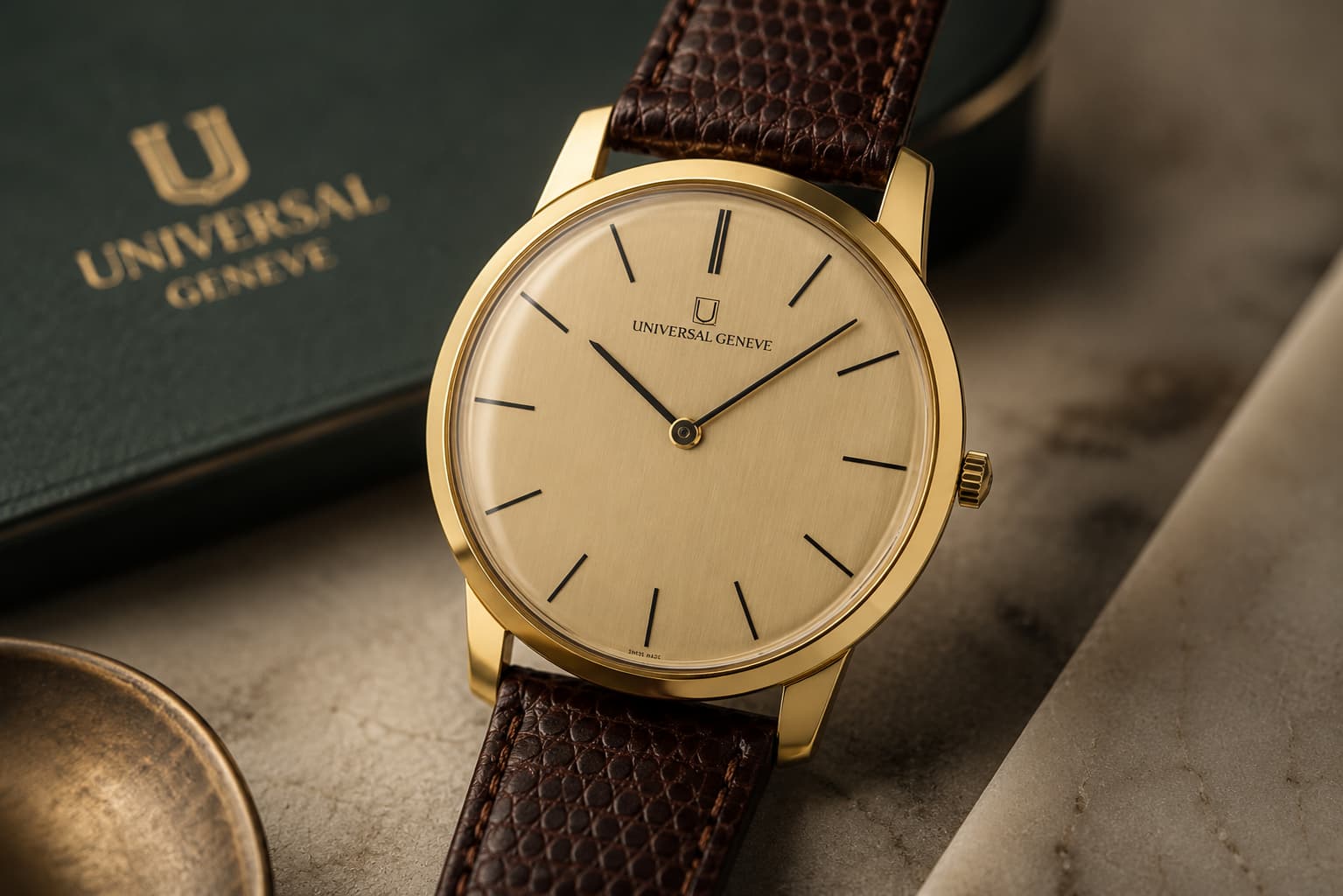
Long before it became a favorite name whispered among vintage watch collectors, Universal Genève was one of the most inventive watchmakers in Switzerland, trading blows with names like Omega and Patek Philippe. Its watches introduced some of the earliest wrist-worn chronographs, helped pioneer the micro-rotor automatic movement, and gave a 23-year-old designer named Gérald Genta his very first commission before he went on to shape the Royal Oak and the Nautilus. Then, almost as quickly as it rose, the brand faded into near obscurity for more than thirty years. Its recent purchase by Breitling has put Universal Genève back in the spotlight, making now a good moment to understand where the brand came from, what made it special, and where it’s headed next.
The History of Universal Genève
Universal Genève was founded on January 18, 1894, in Le Locle, Switzerland, by two young horology students named Numa-Émile Descombes and Ulysse-Georges Perret, who first registered the company as Universal Watch.
The pair started small, working in what the Swiss watch trade calls an établissage — essentially a workshop that bought movement parts (called ébauches) from outside suppliers, then assembled, finished, and cased them into complete watches. Descombes died suddenly in 1897, and Perret went on to partner with a watchmaker named Louis-Edouard Berthoud, briefly running the company as Perret & Berthoud. The duo kept building the brand’s reputation for precise, well-made timepieces, including some of its earliest wrist chronographs at a time when most men still carried pocket watches. During the First World War, the company produced both pocket watches and trench watches, and by 1925 it had patented and produced its first automatic watch, the Auto Rem.
In 1919, the company moved its headquarters to Geneva, and by the mid-1930s it had adopted the name most collectors know today: Universal Genève. That “Genève” name mattered — under Swiss watchmaking convention, only companies producing their watches in the canton of Geneva to a high standard could use the city’s name, so the move gave the brand instant prestige. Through the 1930s, Universal Genève also became the North American sister brand to Patek Philippe, both distributed at the time through the Henri Stern Watch Agency, which is part of why collectors sometimes describe vintage Universal Genève pieces as an accessible entry point into that same design world.
Universal Genève’s Most Famous Watches
Universal Genève’s reputation rests on two model families above all others: the Polerouter, its most famous everyday watch, and the Compax and Tri-Compax, its flagship chronographs.
The Polerouter
The Polerouter is Universal Genève’s most famous watch, released in 1954 as a tribute to Scandinavian Airlines System’s first-ever polar flights connecting Europe to North America over the North Pole.
Universal Genève commissioned the design from a then-unknown 23-year-old artist named Gérald Genta, who would later go on to design the Audemars Piguet Royal Oak and the Patek Philippe Nautilus, two of the most celebrated watches in modern horology. His design for what was originally called the “Polarouter” featured a compact case with distinctive curved lugs, built to resist the magnetic interference that early jet cockpits could cause in a mechanical movement. SAS pilots and crew were given the watch to wear on those pioneering polar routes, and the model was renamed Polerouter about a year later.
What made the Polerouter mechanically significant came in 1955, when Universal Genève introduced the caliber 215 inside it — one of the very first “micro-rotor” automatic movements ever produced. Instead of using a large winding rotor that spans the whole movement, a micro-rotor is a smaller weight set into the same plane as the rest of the mechanism, letting the entire watch sit noticeably thinner on the wrist. Universal wasn’t quite first to market with the idea; a rival Swiss company, Büren, filed a similar patent earlier, and the two brands ended up in a legal dispute over the technology that lasted until 1958. Despite that, the caliber 215 remains one of the landmark automatic movements in watchmaking history, and the Polerouter family grew over the following decade into several distinct variants:
- Polerouter Date — the first version with a calendar complication, added in 1958
- Polerouter Day-Date — added separate day and date apertures, powered by the caliber 72
- Polerouter Sub and Polerouter Super — sportier two-crown models built around the later caliber 69
- Polerouter de Luxe — introduced alongside the original model in 1954, built exclusively in solid gold cases with the classic twisted lugs
- Polerouter Jet — a later-1950s steel model with straight lugs and gold dial accents, giving it a more modern, aviation-inspired look than the original
- Polerouter III — a later-1960s redesign with a larger, more tonneau-shaped case
The Compax and Tri-Compax
The Compax and Tri-Compax were Universal Genève’s flagship chronograph families, and the Tri-Compax in particular combined a chronograph with a full calendar and moon-phase display — a genuinely complicated watch for its era.
Universal Genève had been building chronographs since the 1930s, with early models like the Compur (1933) and the Aero-Compax (1936) establishing the brand as a serious player in the category. The Tri-Compax, launched in 1944, took things further by stacking three complications on top of the timing function: a day, date, and month calendar plus a moon-phase indicator, all fit into a single elegant case. Because of that combination, collectors often describe vintage Tri-Compax models as an accessible cousin to the Patek Philippe reference 1518, a legendary and far more expensive perpetual calendar chronograph that shares a similar layout.
In the 1960s and 70s, the Compax line found unexpected pop-culture fame. A version worn by racing driver Jochen Rindt’s wife, Nina, became known among collectors as the “Nina Rindt” chronograph, while a Tri-Compax associated with musician Eric Clapton picked up his name too. Those nicknames still stick to the reference numbers today and tend to drive up interest — and prices — whenever examples come up at auction.
Golden Shadow and Other Notable Pieces
Beyond the Polerouter and Compax families, Universal Genève also built a reputation for pushing the limits of thinness. In 1966, the brand released the caliber 66, which powered the Golden Shadow, White Shadow, and Gilt Shadow watches — measuring just 2.5mm in case height and, at the time, one of the thinnest automatic watches in the world.
The Breitling Acquisition and 2026 Relaunch
Like most traditional Swiss mechanical watchmakers, Universal Genève was hit hard by the quartz crisis of the 1970s and 80s, when cheap, accurate quartz watches from Japan flooded the market and pushed many Swiss brands toward collapse. The brand kept producing watches through this period but lost much of the technical ambition that had defined its golden era, and in 1989 the struggling company was purchased by Stelux Holdings, a Hong Kong-based watch retail and distribution group. Under Stelux, Universal Genève’s name and trademarks stayed alive, and the company occasionally released new watches, but most output leaned toward simpler, mass-market fashion watches aimed mainly at Asian retail markets. For roughly three decades, Universal Genève existed more as a name on old auction catalogs than as an active competitor in fine watchmaking.
That changed in December 2023, when Breitling announced it had acquired Universal Genève from Stelux Holdings for a reported price of around 60 million Swiss francs, with plans to rebuild it as a standalone, high-end watchmaker. Breitling CEO Georges Kern said the brand would run as its own dedicated company rather than simply becoming a Breitling sub-line, with its own team and headquarters in Geneva, and that the relaunched watches would sit above Breitling in price using newly developed, in-house movements rather than off-the-shelf components.
The revival arrived in 2026, when Universal Genève formally returned at Watches & Wonders Geneva with 36 new watches spread across five collections, built around three new in-house calibers, alongside limited vintage-inspired reissues of icons like the Polerouter and Compax. The brand revived a historic tagline from its 1950s and 60s advertising, “Le Couturier de la Montre” (“The Couturier of the Watch”), leaning into its reputation for elegant, tailored design. Reception has been mixed so far: some in the watch community have welcomed the return, while others have pushed back on entry prices reportedly starting around CHF 14,000 to 15,000, arguing that figure sits well above what made the original brand’s watches appealing. Whether the relaunched Universal Genève can recapture the mechanical reputation of its 1950s and 60s heyday remains to be seen, but the return itself has already reignited interest in vintage examples on the secondary market.
Vintage vs. New Universal Genève Watches
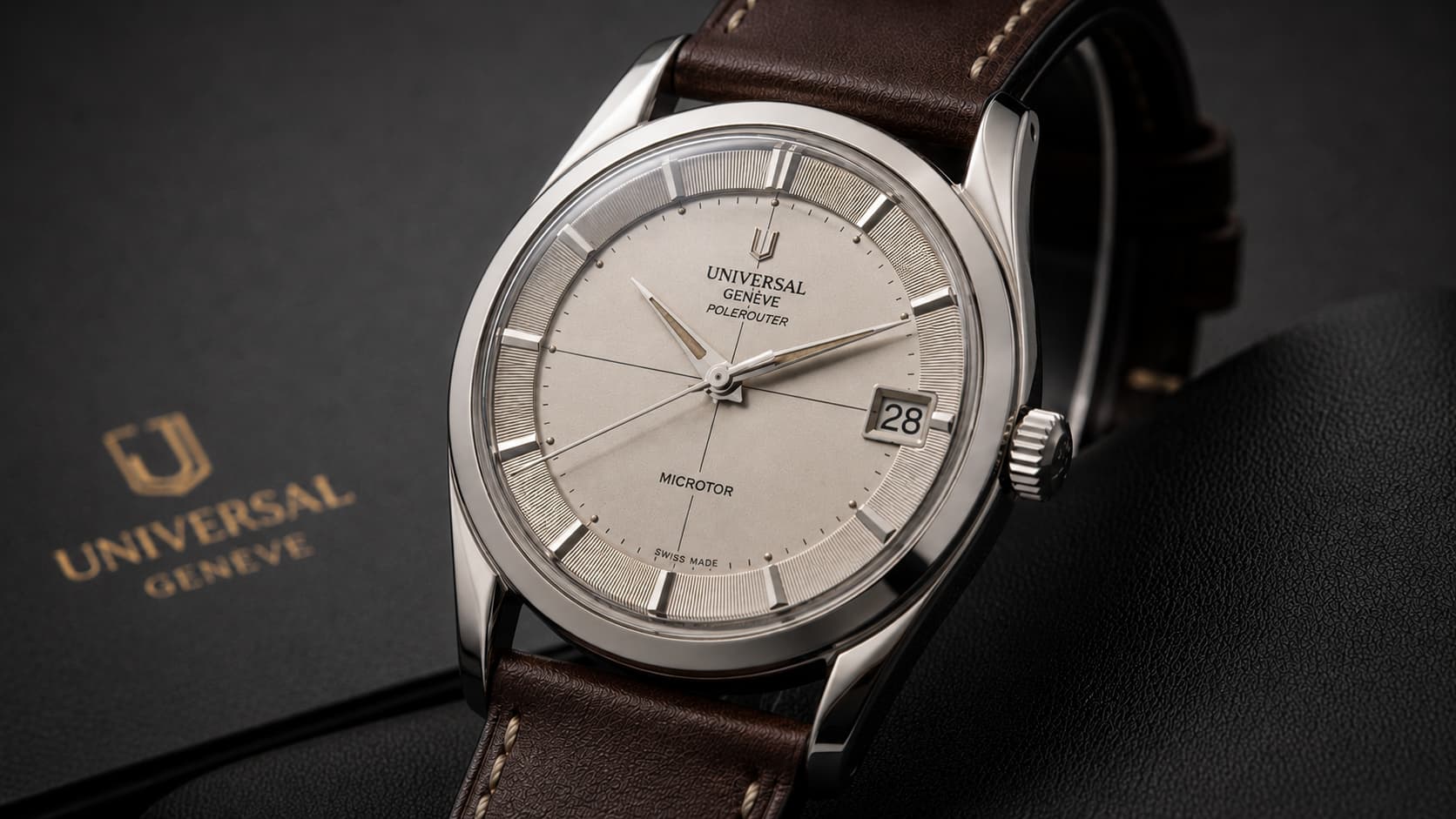
Right now, anyone interested in owning a Universal Genève has two very different paths: a decades-old vintage piece from the brand’s original run, or one of the new 2026 relaunch watches from Breitling.
A well-preserved vintage Universal Genève, especially a Polerouter or Compax-family chronograph, offers real mechanical history and hand-finished detail, and typically costs far less than comparable vintage Omega, Rolex, or Patek Philippe pieces. That value gap exists mostly because the brand spent decades out of the spotlight, so its vintage watches never built up the same brand-driven demand as its more famous rivals, even though the engineering and design pedigree are comparable. Buyers should still be careful, the same way they would with any 60-to-80-year-old mechanical watch: look for original dials without heavy water damage or amateur redials, confirm the movement matches the reference number, and buy from a dealer or auction house that can document the watch’s history where possible.
New 2026 relaunch watches, by contrast, come with modern in-house movements, full manufacturer warranties, and Breitling’s backing for future servicing, but at a significantly higher price point than the vintage originals that built the brand’s reputation. The two paths ultimately serve different priorities: vintage buyers are paying for authentic history and mechanical rarity, while new buyers are paying for a fresh, warrantied watch built to modern standards under a brand trying to re-earn its old reputation.
| Vintage Universal Genève | 2026 Relaunch | |
|---|---|---|
| Typical price | Roughly a few hundred to a few thousand dollars, depending on condition and model | Reportedly starting around CHF 14,000–15,000 |
| Movement | Original mid-century calibers (e.g., caliber 215 micro-rotor) | New in-house calibers developed under Breitling |
| Warranty | None, unless recently serviced by a dealer offering one | Full manufacturer warranty |
| Servicing | Requires a watchmaker experienced with vintage micro-rotor movements | Backed by Breitling’s modern service network |
| Primary appeal | Authentic mechanical history and design pedigree | A new watch built to current standards under a revived name |
What Universal Genève Watches Are Worth
Universal Genève sits in an unusual spot for a watch investment conversation, because its most significant price catalyst in decades — Breitling’s acquisition and 2026 relaunch — is still playing out in real time rather than being old news already priced into the market.
Industry watchers and vintage dealers have generally expected renewed brand awareness to push demand, and prices, for well-known vintage references like the Polerouter and the “Nina Rindt” Compax higher over the following couple of years, similar to what happened with other brands after a high-profile revival. Vintage Universal Genève watches have historically traded across a wide range, from a few hundred dollars for simpler steel time-only pieces in fair condition up to several thousand dollars for gold cases, rare complications, or celebrity-nicknamed references in excellent condition, with the rarest examples reaching well beyond that at auction. As with any collectible watch, condition, originality, and documented history matter far more to resale value than the brand name alone, and a beautiful original dial will almost always outsell a mechanically sound watch with a replaced or repainted one.
Caring for a Vintage Universal Genève
Most Universal Genève watches in circulation today are 50 to 80 years old, so caring for one is closer to caring for a small antique machine than a modern watch.
Vintage dials and hands from this era were often finished with radium- or tritium-based luminous material, which can degrade or discolor over time; it’s best left undisturbed rather than cleaned or “refreshed,” since that lume is part of what makes an original dial valuable and, in the case of radium, should only ever be handled by someone familiar with the material. Case gaskets and crystal seals also break down with age regardless of how a watch was stored, so even a Polerouter that once had genuine water resistance should not be assumed to be water-resistant today unless it has been recently serviced and pressure-tested by a professional. On the movement side, calibers like the 215 micro-rotor are mechanically significant but relatively uncommon, so it’s worth finding a watchmaker who has specific experience with vintage Universal Genève or similar micro-rotor movements rather than a general quartz-watch repair shop.
A handful of habits tend to protect a vintage piece between services:
- Vintage water resistance ratings, even on a Polerouter Sub, shouldn’t be treated as current unless seals have been recently checked
- Strong magnets, from speakers to phone cases to laptop edges, can affect timekeeping in older movements
- Harsh cleaning products and ultrasonic cleaners can damage original dials and lume
- Direct sunlight and humidity swings are best avoided; a case or pouch offers more protection than a drawer
- Servicing is best handled by a watchmaker familiar with vintage calibers rather than a general battery-and-strap shop
Frequently Asked Questions
Who owns Universal Genève now?
Universal Genève is currently owned by Breitling SA, which acquired the brand from Hong Kong-based Stelux Holdings in December 2023 and relaunched it as a standalone luxury watchmaker in 2026.
What is the most famous Universal Genève watch?
The Polerouter, designed in 1954 by a 23-year-old Gérald Genta for Scandinavian Airlines System pilots, is Universal Genève’s most famous and most collected model.
Is Universal Genève the same company as Universal Watch?
Yes, Universal Genève started life in 1894 under the name Universal Watch before relocating to Geneva and adopting the Universal Genève name by the mid-1930s.
Did Gérald Genta design other watches besides the Polerouter?
Yes, and the Polerouter came nearly two decades before his more famous work, which includes the Audemars Piguet Royal Oak and the Patek Philippe Nautilus.
Why did Universal Genève disappear for so long?
The brand struggled through the 1970s and 80s quartz crisis like many Swiss mechanical watchmakers, and after being sold to Stelux Holdings in 1989 it mostly produced simpler fashion watches rather than the mechanically ambitious pieces that built its reputation.
Conclusion
Universal Genève’s story is really two stories in one: a genuinely important mid-century Swiss watchmaker that helped push chronograph and automatic-movement design forward, and now a brand attempting a rare, well-funded second act under Breitling. The Polerouter and Compax families remain the clearest proof of what made the original company special, and they’re still the most sensible entry point for anyone curious about the brand’s vintage output, while the 2026 relaunch offers a very different, much pricier way into the name today. Whichever path a buyer chooses, the brand’s renewed visibility means both its vintage catalog and its future releases are worth paying attention to.