Zodiac is one of the oldest names in Swiss watchmaking, but it rarely gets the spotlight that brands like Rolex or Omega enjoy. That is a little unfair, because Zodiac helped invent the modern dive watch and has spent more than 140 years building tools that people actually wear into the ocean, the desert, and outer space testing labs. What makes the brand worth understanding is a mix of genuine engineering history, a handful of standout current models, and a parent company that has just come through a rocky financial stretch.
What Is the Zodiac Watch Brand?
Zodiac is a Swiss watch brand founded in 1882 in Le Locle, a small watchmaking town in the Jura Mountains. It is best known today for tough, colorful dive watches, especially the Sea Wolf family.
A watchmaker named Ariste Calame started the company as a small workshop making precision pocket watches. His son, Louis Ariste Calame, took over in 1895 and officially registered the name “Zodiac” in 1908. Since then, the brand has moved through pocket watches, waterproof wristwatches, dive watches, and quartz models, always staying true to one idea: build a reliable, good-looking tool watch that will not break the bank.
Interestingly, Zodiac has an odd, unconfirmed link to true crime as well. In the late 1960s, an unidentified serial killer active in Northern California signed a series of taunting letters with a symbol resembling Zodiac’s watch logo, and some researchers believe that resemblance is where the killer’s chosen nickname originated, though the connection has never been proven. Decades later, David Fincher’s 2007 film about the case, titled simply Zodiac, showed a suspect wearing an actual Zodiac Sea Wolf on screen.
The Zodiac Watch Timeline
Zodiac’s story splits into four main chapters: the early workshop years, the 1953 dive watch breakthrough, a rough patch during the Quartz Crisis, and a modern rebirth under new ownership.
The Early Years of Zodiac
In its first decades, Zodiac focused on making pocket watches as accurate as possible, not on marketing or flashy designs. That mindset carried the company through the early 1900s and into wristwatches. In 1924, the brand introduced the Zodiac Triumph, a slim pocket watch built around its own in-house Caliber 1617, showing that Zodiac could engineer its own movements rather than buying them from outside suppliers.
In the years that followed, Zodiac built on that engineering confidence with the Autographic, one of the first automatic watches to include a power reserve indicator. That small extra dial told the wearer how much energy was left in the watch before it needed winding again, a genuinely useful feature that most competitors did not offer at the time.
The Sea Wolf Launch in 1953
The single most important date in Zodiac’s history is 1953, when the brand launched the Sea Wolf. This was one of the earliest dive watches ever made, arriving in the same era as the Blancpain Fifty Fathoms and just before the Rolex Submariner.
The original Sea Wolf was small by today’s standards, at around 35mm, but it was rated for depths of 200 meters, which was impressive for the time. It also cost far less than rival dive watches, which made it popular with everyday swimmers and divers rather than just professionals. That combination of toughness and an approachable price became the blueprint Zodiac still follows today.
The Sea Wolf’s reputation grew during the Vietnam War, when American service members stationed overseas could buy one cheaply at a military PX store. According to accounts from veterans and collectors, some divers favored it over their standard-issue gear because its dial stayed legible at night and underwater, though this was informal habit rather than an official military policy. That word-of-mouth reliability is part of why Sea Wolf models still show up in collector circles today, decades after they left the factory.
How the Quartz Crisis Hurt Zodiac
During the 1970s, cheap and highly accurate quartz watches from Japan flooded the market. This period, often called the Quartz Crisis, crushed dozens of Swiss watch brands that relied on mechanical movements. Zodiac survived by adapting and releasing its own quartz models, but the brand lost momentum and changed hands several times over the following decades.
Fossil Group Buys Zodiac
In 2001, the American company Fossil Group bought Zodiac for roughly $4.7 million, picking up the brand name, design archives, and manufacturing rights. Fossil kept production in Switzerland, specifically in Bienne, which let Zodiac keep its “Swiss Made” label. After a quiet period, Zodiac relaunched the Sea Wolf in 2015, reviving vintage designs with modern manufacturing.
A related move followed in 2012, when Fossil Group took a controlling ownership position in Swiss Technology Production (STP), a Swiss movement manufacturer located in Manno, near the Italian border. STP’s output has grown to over 200,000 mechanical movements annually, the bulk of which supply Zodiac along with a few sister brands under the Fossil umbrella. Owning a movement maker gave Zodiac a dependable, in-house source of genuine Swiss automatic calibers rather than leaving it dependent on outside suppliers.
Founder Ariste Calame reportedly built the company around one motto: “Finest Swiss Quality.” More than a century later, that phrase still describes what Zodiac tries to deliver at a price most collectors can afford.
The Best Zodiac Watches to Buy
Zodiac’s current lineup is smaller than it used to be, but a few models stand out as the ones worth learning first.
Zodiac Sea Wolf
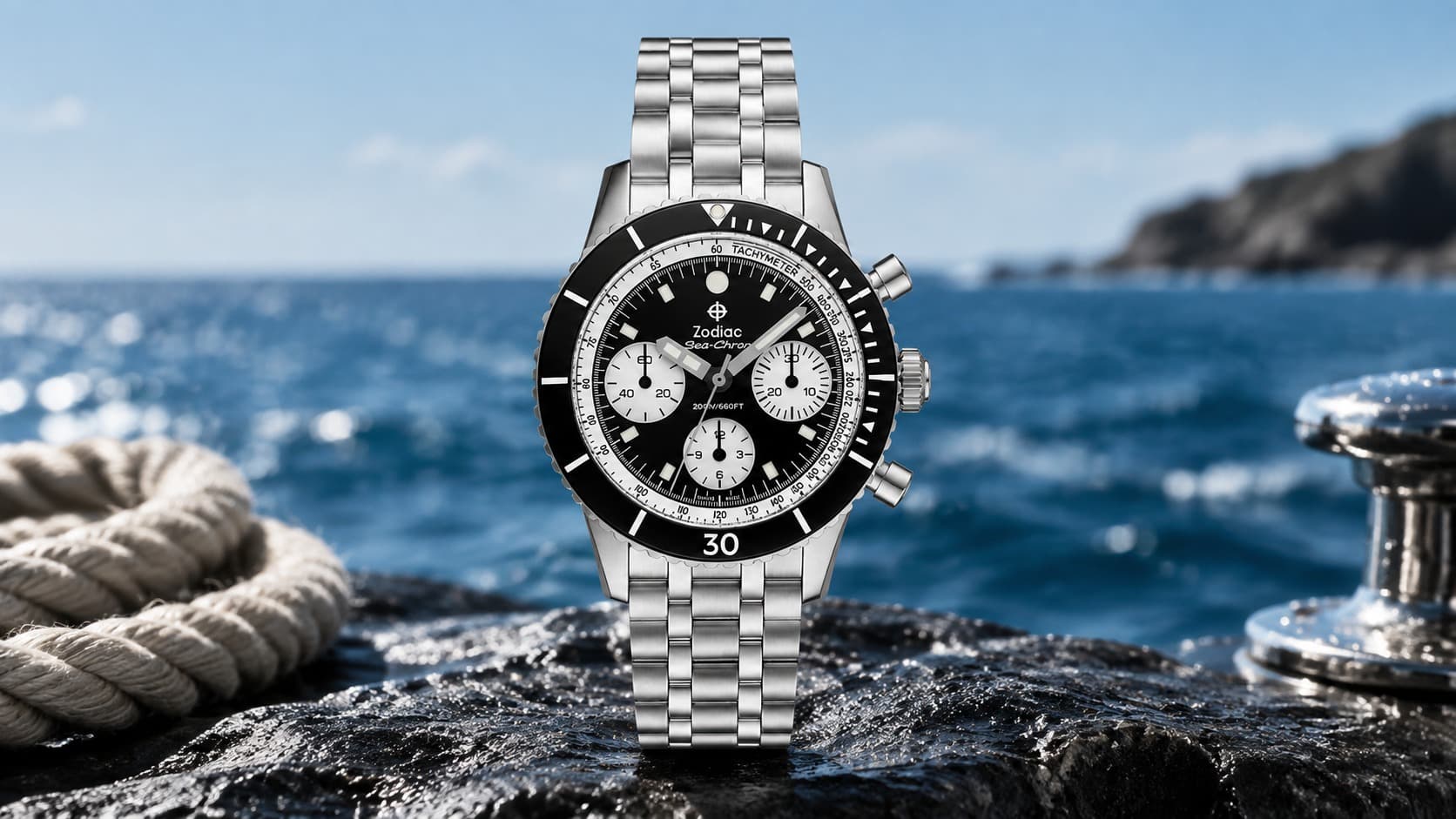
The Sea Wolf is Zodiac’s flagship dive watch and the one most people picture when they hear the brand name. Modern versions keep the round case, bold numerals, and colorful dial options that made the original famous in 1953, while adding automatic Swiss movements and better water resistance.
These watches typically use a rotating dive bezel, a stainless steel case, and either a bracelet or a rubber/leather strap. They are built for daily wear rather than sitting in a safe.
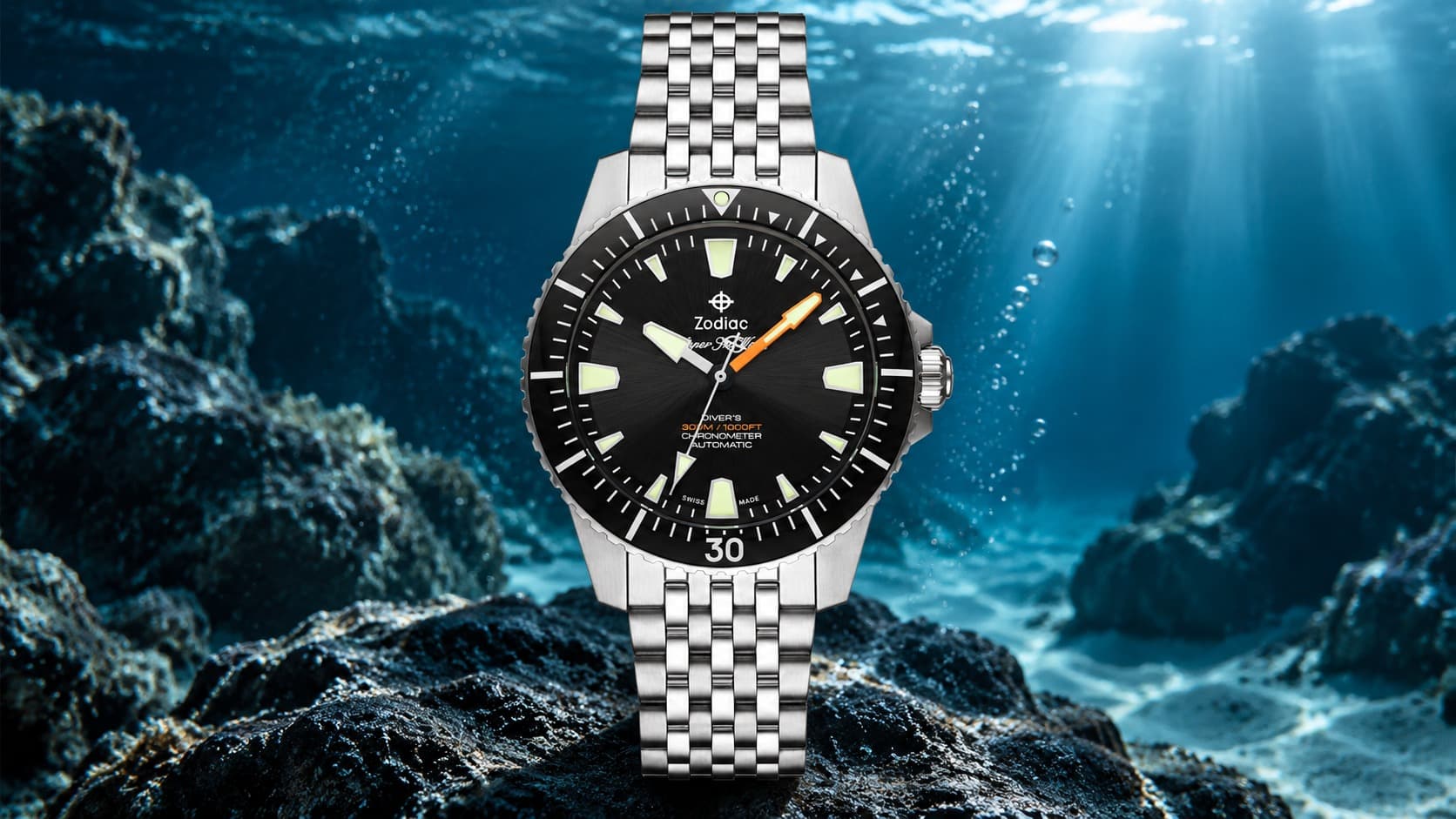
Zodiac Super Sea Wolf
The Super Sea Wolf is a slightly larger, more heavy-duty version of the standard Sea Wolf, first introduced in the 1970s. Today it comes in several styles, including a “Compression” version with a distinctive crown guard design borrowed from vintage dive watches.
Many Super Sea Wolf models use ceramic bezels and COSC-certified movements, meaning they have passed official Swiss chronometer accuracy testing. This makes the Super Sea Wolf line the closest thing Zodiac offers to a premium, collector-focused watch.
The original Super Sea Wolf earned its reputation the hard way. In the early 1970s, a patented crown and case-back design pushed its water resistance from 200 meters up to a remarkable 750 meters, and U.S. Navy SEALs reportedly adopted it for real underwater missions because of that durability. Modern Super Sea Wolf models trade some of that extreme depth rating for ceramic and ceramic ionic-plated bezels, but they keep the same “built to actually get wet” spirit.
Zodiac Aerospace GMT
The Aerospace GMT line traces back to the 1960s and 70s, when Zodiac built watches for pilots and travelers who needed to track two time zones at once. A GMT watch has an extra hand and a rotating bezel marked with 24 hours, letting the wearer read a second time zone at a glance.
Modern Aerospace GMT models keep that traveler-friendly function while adding a retro look inspired by the original 1970s case shapes.
Zodiac built the original 1960 Aerospace GMT on the same case as the Sea Wolf, simply swapping the diving bezel for a two-color, 24-hour bezel. Vintage advertisements at the time marketed it as offering “twice the time for your money,” a clever nod to its dual time zone function. A related model called the Aerospace Jet followed in 1962, sharing the Sea Wolf’s waterproof case but displaying a single 24-hour cycle rather than the usual two trips around a 12-hour dial. That format found favor among Vietnam-era aviators, since reading a full day on one rotation reduced the chance of mixing up morning and evening hours mid-mission.
Zodiac Olympos
The Olympos is Zodiac’s answer to a classic dress watch, aimed at people who want something slimmer and quieter for the office or a formal event. It trades the dive bezel for a clean dial and a leather strap, showing that Zodiac’s design archive covers more than just tool watches.
The design is a reissue of a 1961 original nicknamed the “Manta,” for the way its asymmetrical, flared case resembles a manta ray. It runs on Zodiac’s own STP automatic movement, has a 44-hour power reserve, and carries a modest 50-meter water resistance, since it is built for looks and precision rather than swimming.
How Much Do Zodiac Watches Cost?
Most Zodiac watches sell for between $500 and $2,300, which places the brand firmly in the “accessible Swiss” category rather than the luxury tier occupied by Rolex or Omega.
| Model Line | Typical Price Range | Movement | Best For |
|---|---|---|---|
| Sea Wolf | $500–$1,000 | Automatic | Everyday wear, first Swiss dive watch |
| Super Sea Wolf | $900–$2,300 | Automatic (COSC on some) | Collectors who want ceramic bezels and accuracy |
| Aerospace GMT | $1,650–$2,200 | Automatic | Travelers who need a second time zone |
| Olympos | $795–$995 | Automatic | Dress occasions and office wear |
Zodiac has recently run steep discount sales tied to its parent company’s finances, so prices on the brand’s own site have swung lower than usual. Third-party dealers and resale marketplaces show a wider spread, depending on condition and whether a watch includes its original box and papers.
Is the Zodiac Watch Brand Still Operating?
Yes, Zodiac is still operating and its watches remain under warranty, but its parent company has gone through serious financial trouble that anyone considering a purchase should understand.
In October 2025, Fossil Group, which owns Zodiac along with Skagen and Relic, filed for a court-supervised debt restructuring in the United Kingdom, recognized in the United States under Chapter 15 bankruptcy rules. The filing was meant to address around $150 million in debt, not to shut the company down. On November 14, 2025, a UK court approved the restructuring plan, and reporting at the time indicated Fossil Group considered Zodiac, Skagen, and Relic core brands worth preserving through the process.
The practical result for shoppers has been a wave of deep discounts, with some Zodiac watches selling for 50 percent off through the brand’s own website and even showing up at off-price retailers. Buyers purchasing during this period should confirm the retailer is authorized, since that is what keeps a warranty valid.
There is a more encouraging update since then. Fossil Group’s second-quarter 2026 financial results, released in August 2026, came in better than the company itself had projected, with its portfolio of owned brands, Zodiac included, contributing to the improvement. That points toward a restructuring plan that is functioning as designed rather than a company sliding toward closure, though buying from an authorized retailer remains sensible while a parent company works through a turnaround.
Are Zodiac Watches Good Quality?
Zodiac watches use real Swiss automatic movements and solid stainless steel cases, which puts them a level above typical fashion watches, even though they cost far less than luxury Swiss brands.
What Movement Do Zodiac Watches Use?
Since 2012, Fossil Group has owned a majority stake in Swiss Technology Production (STP), a movement maker based in Manno, Switzerland. STP builds most of the mechanical movements used in Zodiac watches today, including the STP1-11 automatic caliber found in many Super Sea Wolf models. Some higher-end pieces carry COSC chronometer certification, which means an independent Swiss institute tested the movement for accuracy before it left the factory.
What Are Zodiac Watches Made Of?
Zodiac cases are typically stainless steel, sometimes finished with a black DLC coating for a darker look. Bezels range from aluminum to more durable ceramic on premium models. Water resistance on Sea Wolf and Super Sea Wolf watches commonly reaches 200 meters, which is more than enough for swimming, snorkeling, and recreational scuba diving.
How to Choose Between the Different Zodiac Models
Choosing between Zodiac’s current models comes down to intended use and budget rather than any single “best” option.
- First Swiss automatic watch: The standard Sea Wolf offers the best balance of price and history.
- Maximum accuracy and detail: A COSC-certified Super Sea Wolf with a ceramic bezel suits collectors who want documented precision.
- Frequent travel across time zones: The Aerospace GMT adds a genuinely useful second-time-zone function.
- Office or formal wear: The Olympos trades dive-tool looks for a slim, dressy profile.
- Shopping during a discount period: Purchasing from an authorized Zodiac retailer keeps the warranty protected.
Frequently Asked Questions
Is Zodiac a luxury watch brand?
Not exactly. Zodiac is a genuine Swiss-made brand, but it sits in the accessible price range, usually between $500 and $2,300, rather than the luxury tier where brands like Rolex or Patek Philippe operate.
Who owns Zodiac watches?
Zodiac has been owned by Fossil Group, an American company based in Richardson, Texas, since 2001. Watches are still manufactured in Bienne, Switzerland, which allows them to carry the “Swiss Made” label.
Are Zodiac watches good for diving?
Yes. The Sea Wolf and Super Sea Wolf lines are built as genuine dive watches, most rated to 200 meters with a rotating bezel for tracking dive time, which covers recreational scuba diving and snorkeling comfortably.
What is the most famous Zodiac watch?
The original Sea Wolf from 1953 is the brand’s most historically important watch, since it was one of the first purpose-built dive watches ever sold to the public, alongside the Blancpain Fifty Fathoms.
Is now a risky time to buy a Zodiac watch?
Not particularly, since Zodiac has been named a core brand in Fossil Group’s approved restructuring plan. Buying from an authorized retailer, rather than an unverified third-party seller, remains the safest way to keep a warranty valid.
The Bottom Line
Zodiac earned its reputation the hard way, by building genuinely useful dive watches in 1953 and sticking with that identity through decades of industry upheaval. The Sea Wolf and Super Sea Wolf remain the best starting points for anyone curious about the brand, offering real Swiss movements and dive-ready builds for a fraction of what competitors charge. The recent turbulence at parent company Fossil Group is worth watching, but it has not stopped Zodiac from making watches or honoring warranties, and the brand has been singled out as one Fossil intends to keep. For a shopper who wants Swiss watchmaking history without a luxury price tag, Zodiac still delivers exactly what it promised back in 1882: precise, honest tool watches built to be worn.