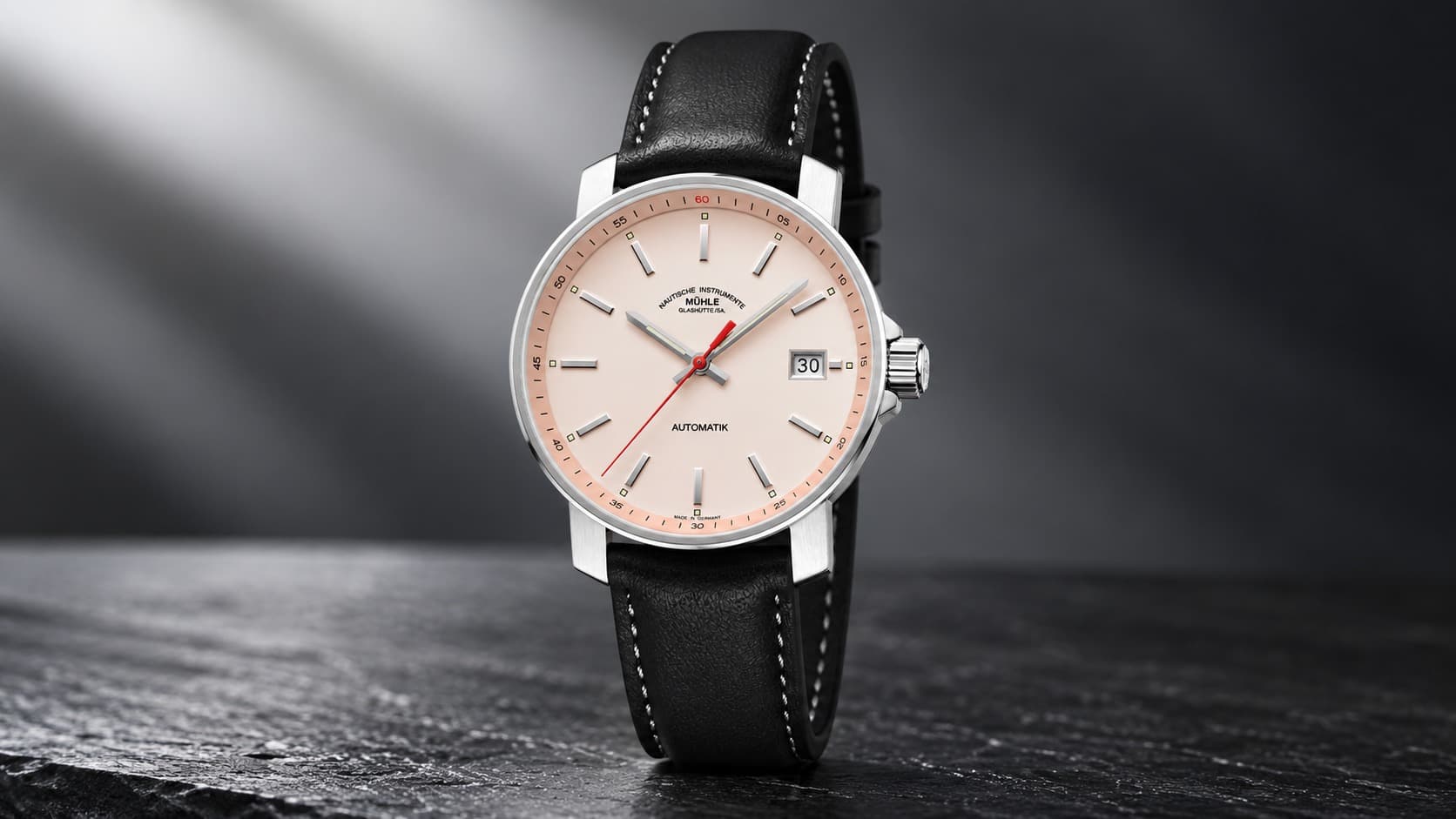
Most people who collect German watches know the big three names right away: A. Lange & Söhne, Glashütte Original, and Nomos. Mühle Glashütte rarely gets mentioned in the same breath, and that is a shame, because it is the only watchmaker still standing in the town of Glashütte that has stayed in the hands of one family for its entire history. The brand builds watches the way it once built measuring tools for sailors and pilots: sturdy, simple to read, and made to survive rough use rather than sit in a drawer. That background shapes everything the company makes today, from a dive watch trusted by real rescue crews to dressier pieces that borrow details from old ship instruments.
The History of Mühle Glashütte Watches
Mühle Glashütte is a family-run German watch company founded in 1869, though it only began making wristwatches in the mid-1990s. Robert Mühle started the business as a workshop building precision measuring instruments for other watchmakers in the town of Glashütte, Saxony, including the famous school of watchmaking located there. Before striking out on his own, Robert had trained as a precision toolmaker under Moritz Großmann, one of Glashütte’s most respected 19th-century watchmakers, which gave the new company instant credibility among the town’s watch workshops. For decades afterward, the Mühle family made tools, speedometers, and car clocks rather than watches people would wear on their wrists.
That long run was not smooth. The business survived two world wars and, during East Germany’s communist period, was folded into a state-run collective not once but twice, stripping the family of ownership each time. After German reunification, Hans-Jürgen Mühle rebuilt the company under its own name in 1994, and his son Thilo Mühle later took the business into full wristwatch production. The first Mühle wristwatches reached customers around 1996, built at the request of a shipyard that already used the company’s instruments. Since then, the brand has leaned hard into its nautical roots, supplying watches to Germany’s sea rescue service and building a reputation for tough, honest tool watches rather than flashy luxury pieces.
The company’s full legal name, Nautische Instrumente Mühle-Glashütte, still spells out that identity today, and Thilo Mühle now runs the business as the fifth generation of the family to do so. Unlike several of its neighbors in Glashütte, which were absorbed into larger Swiss or international watch groups after German reunification, Mühle has stayed independently family-run from Robert Mühle’s original workshop right through to today.
What Makes a Mühle Glashütte Watch Special
A Mühle Glashütte watch is built around function first, with a patented shock-protection system that keeps the movement running accurately even after rough handling. The company calls this its “woodpecker neck regulation,” a small spring-mounted part inside the movement that holds the balance wheel’s regulator steady even when the watch gets knocked around. Mühle patented the design in 2003, and it has since become the clearest fingerprint of a Mühle Glashütte movement, showing up in nearly every mechanical watch the brand builds or modifies rather than being saved for one or two flagship models.
The woodpecker neck regulator works like a tiny built-in shock absorber for the part of the watch that keeps time steady, stopping a hard knock from throwing off the watch’s accuracy.
Beyond that signature feature, several things set the brand apart from other German watchmakers:
- Real-world testing. Many models are developed with input from working sailors, pilots, or rescue crews rather than designed purely for looks.
- In-house movement development. The company began building its own movements from scratch starting with the MU 9411 caliber in 2011, after years of modifying Swiss base movements.
- Plain, readable dials. Mühle avoids busy designs, favoring large markers and high-contrast hands so the time is easy to read at a glance.
- Family ownership. Decisions about design and quality still run through five generations of the same family, without a large luxury group calling the shots.
Mühle Glashütte’s Reputation Explained
Mühle Glashütte’s reputation comes mostly from real working use rather than marketing. The brand’s ties to Germany’s DGzRS sea rescue service date back to 2002, when the S.A.R. Rescue-Timer entered active service with the organization’s crews, and that relationship continues today through special editions tied to DGzRS anniversaries. Long before it built its first wristwatch, the company also supplied marine chronometers and precision instruments to the German Navy, extending a nautical-instrument tradition that stretches back to Robert Mühle’s original 19th-century workshop.
That history shapes the kind of person who tends to wear one. Sailors, pilots, and outdoor professionals who want a dependable tool make up a larger share of Mühle’s audience than collectors chasing a famous name. It is a smaller, quieter following than brands like Rolex or Omega attract, built more on word of mouth among people who actually need a watch that can take a hit and keep working.
Best Mühle Glashütte Watch Collections
Mühle Glashütte organizes its watches into a handful of collections, each built around a different use, from search-and-rescue diving to flying and everyday wear.
S.A.R. Rescue-Timer
The S.A.R. Rescue-Timer is the watch that search-and-rescue sailors actually wear, built to survive being pulled out of rough seas. Mühle Glashütte developed this dive watch directly with captains from Germany’s DGzRS, the volunteer maritime rescue service, and the watch has been in active service with that organization since 2002. Every design choice has a practical reason behind it rather than just a stylistic one.
The case is rounded with no sharp edges, because a sharp case could injure a rescued swimmer being pulled from the water. The crown sits at the 4 o’clock position instead of the usual 3 o’clock spot, keeping it out of the way so it will not snag or dig into a wrist during a rescue. Inside sits a modified Sellita SW 200-1 automatic movement fitted with the woodpecker neck regulator, running at 28,800 vibrations per hour with roughly 41 hours of power reserve once fully wound. The case holds up to 100 bar of water pressure, equal to roughly 1,000 meters of depth, and a thick 4mm sapphire crystal with a built-in magnifier over the date window rounds out the tough-but-practical design.
Mühle has expanded the line beyond the original black-dial version over the years, adding a lightweight TITAN edition and a LUMEN version with a fully luminous dial for better visibility in the dark. The brand has also marked milestones in the rescue service’s own history with special editions, including a model released for the DGzRS’s 150th anniversary, with part of the proceeds going back to support the organization. Current retail prices for the Rescue-Timer line run from around $2,250 to $2,900 depending on strap, dial, and edition.
29er and 29er Big
The 29er is Mühle’s everyday three-hand watch, named after a fast two-person sailing dinghy used in competitive racing. It comes in two main sizes: the original 29er at about 36mm, aimed at smaller wrists or anyone who prefers a compact watch, and the 29er Big at roughly 42mm for those who want a larger presence on the wrist. Both share the same honest, no-nonsense design built around hour, minute, second, and date functions, with clean dials that borrow a nautical look from old ship instruments.
Within the 29er family, Mühle also offers a pointer-date version (where a separate hand points to the date around the dial edge rather than showing it in a small window), a small-seconds version, a day-date version, a GMT for tracking a second time zone, and a chronograph. Prices for the collection generally start around $1,550 for the simplest three-hand models and climb toward $3,800 for the chronograph versions.
In 2024, Mühle marked the 30th anniversary of the modern company’s founding with a limited 29er Big Bronze Edition 1994, built in a run of 155 pieces as a nod to the 155 years the family had then spent working in Glashütte. It’s a small but telling example of how the brand ties specific watches back to its own history rather than releasing limited editions purely for marketing’s sake.
Teutonia
Teutonia was Mühle’s first public watch collection, launched in 2002, and it leans more toward a dress watch than the brand’s sportier lines. Its dial layouts borrow visual cues from marine chronometers, the bulky, highly precise clocks ships once carried for celestial navigation, which gives Teutonia a classic, slightly formal look next to the rest of the Mühle catalog.
Over the years, Mühle has added complications to the Teutonia line that go beyond its sportier siblings, including a moon phase display, a GMT function, a chronograph, and even chronometer-certified models that have passed independent accuracy testing. The Teutonia IV Moonphase is a good example of how far the collection reaches, adding a moon phase indicator to the dial for a price well above the line’s simpler three-hand starting models. Because of this range, Teutonia prices stretch wider than other collections, from around $2,000 for an entry three-hand model up to several thousand dollars more for the moon phase and chronometer versions.
Terrasport
Terrasport is Mühle’s dedicated pilot’s watch collection, built for strong legibility and tough performance in the air rather than at sea. The Terrasport I Chronograph is the largest model in the line at 44mm across, designed with oversized markers and a bold minute scale so a pilot could read elapsed time at a glance. The design nods back to the earliest days of wristwatch production in Glashütte during the 1930s, when pilots carried dedicated chronographs, navigators used large observation watches, and the rest of the flight crew wore smaller, simpler three-hand pieces.
The chronograph version runs on Mühle’s own in-house MU 9413 movement, carries a 100-meter water resistance rating, and typically retails in the area of $3,100 to $3,800 depending on dial color and strap. That movement is built with a Glashütte three-quarter plate, a traditional style of movement architecture long associated with the town, where a single large plate covers most of the mechanism instead of the separate bridges used in many other automatic watches. A smaller 40mm Terrasport II offers a simpler three-hand and date version for those who find the Chronograph too large, while the 42mm Terrasport IV GMT adds a second time zone for frequent travelers.
Lunova and Panova
Lunova and Panova are Mühle’s more polished, dressier lines, aimed at people who want the brand’s precision without the tool-watch look of the Rescue-Timer or Terrasport. Introduced in 2017, Lunova was the first line to move away from Mühle’s usual brushed metal surfaces, building most of its cases with a high-polish finish that gives it a dressier, more urban feel than the brand’s outdoor-focused collections. Most Lunova models also use a transparent case back, letting the movement’s finishing show through rather than hiding it behind solid steel. The line includes date, day-date, and chronograph versions, along with a dedicated Lunova Lady model sized for smaller wrists.
Panova sits as the brand’s entry point, typically the most affordable way into a Mühle Glashütte watch, with prices starting around $1,100 to $1,200 for its simple three-hand automatic designs in a range of dial colors. It is a good starting place for someone curious about the brand but not ready to spend on the sportier, more specialized collections.
Notable Mühle Glashütte Collaborations
Mühle Glashütte has built a long-running relationship with Wempe, the Hamburg-based family jeweler that has carried Mühle watches since 2012. Both companies share deep roots in Glashütte’s watchmaking history, which makes the partnership a natural fit rather than a one-off marketing tie-in.
The brand has also released special editions with the airline Lufthansa over the years, including Terrasport and Lunova models finished with Lufthansa-blue dials and rotors engraved with the airline’s logo. One Lunova Chronograph Lufthansa Edition was limited to 350 pieces, continuing Mühle’s habit of releasing genuinely exclusive variants to mark a partnership rather than simply rebadging an existing model with a new color.
Mühle Glashütte Watch Prices
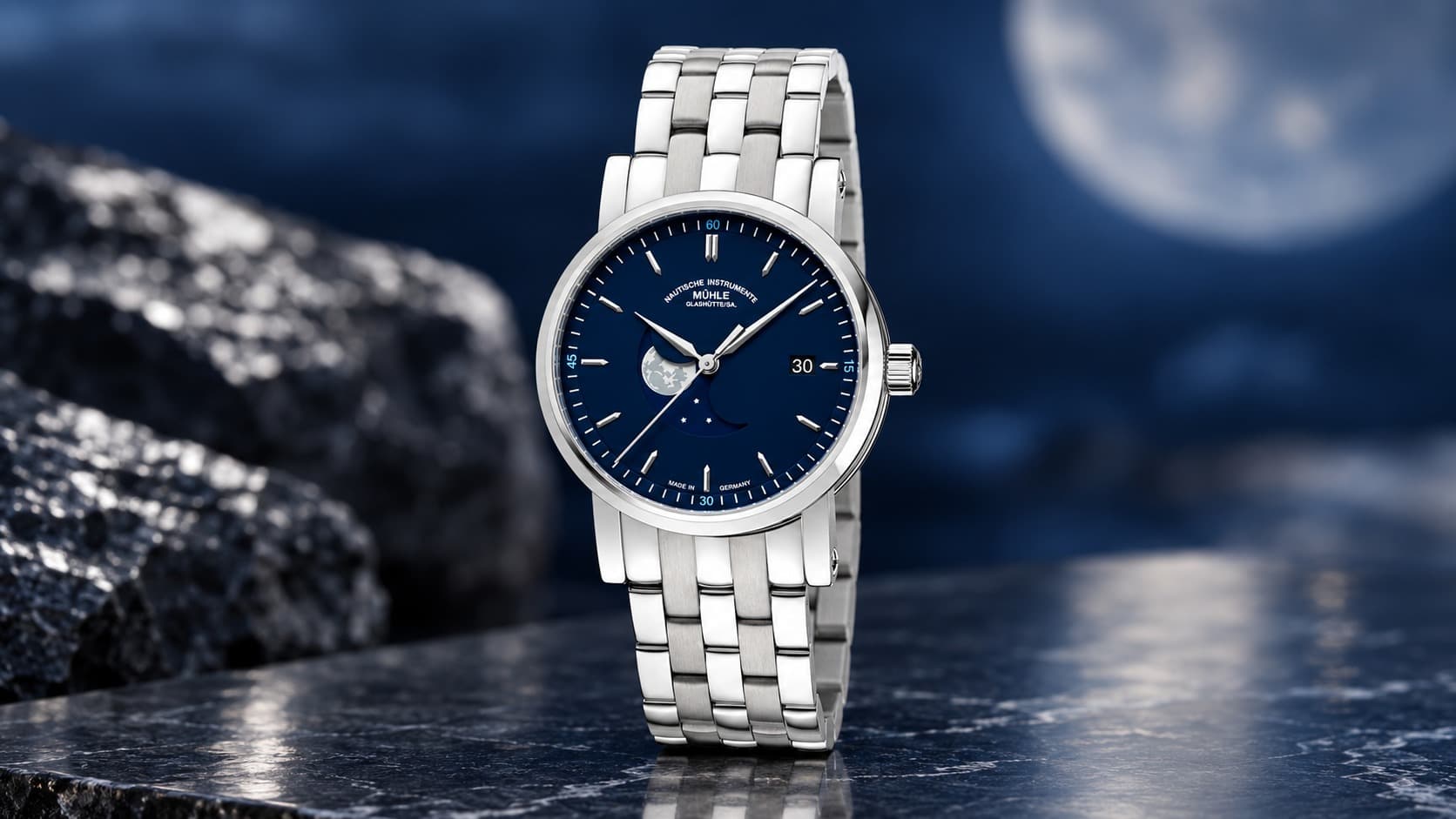
Mühle Glashütte sits in the accessible end of German fine watchmaking, priced below the likes of A. Lange & Söhne but above mass-market brands. Most models fall somewhere between $1,100 and $4,000, depending on the collection and complications involved.
| Collection | Typical starting price | Best for |
|---|---|---|
| Panova | ~$1,100–$1,600 | A first, affordable entry into the brand |
| 29er / 29er Big | ~$1,550–$2,900 | Everyday wear with a sporty, nautical look |
| S.A.R. Rescue-Timer | ~$2,250–$2,900 | Serious dive and water-resistance needs |
| Teutonia | ~$1,900–$5,000+ | A dressier look with available complications |
| Terrasport | ~$2,000–$3,800 | Pilot-style legibility and chronograph function |
| Lunova / Panova | ~$1,900–$3,300 | A more polished, elegant everyday watch |
Prices vary by retailer, currency conversion, and strap choice, so these figures are general ranges rather than fixed, current prices.
Frequently Asked Questions
Is Mühle Glashütte a good watch brand?
Yes. Mühle Glashütte has built watches for over 150 years as an instrument maker and nearly three decades as a wristwatch brand, with a strong reputation for durability and legibility. Its watches are used by Germany’s actual sea rescue service, which says a great deal about how the brand builds for function rather than just appearance.
Does Mühle Glashütte make its own movements?
Mühle Glashütte makes some of its own movements and modifies others. The brand produced its first fully in-house caliber, the MU 9411, in 2011, and has since developed further in-house movements such as the MU 9413 used in the Terrasport Chronograph. Many entry-level models still use modified Sellita base movements fitted with Mühle’s own regulator and finishing.
What is the woodpecker neck regulation?
It is a patented shock-protection mechanism built into many Mühle Glashütte movements, designed to keep the watch’s timekeeping accurate even after a hard knock. The part acts like a small built-in shock absorber for the regulator, the component that fine-tunes how fast or slow a watch runs.
Where are Mühle Glashütte watches made?
All Mühle Glashütte watches are made in Glashütte, Saxony, Germany, the same small town long associated with high-end German watchmaking. The company remains family-owned and operated, now run by the fifth generation of the Mühle family.
What is the best Mühle Glashütte watch for a beginner?
The Panova and 29er collections make the most sense for a first Mühle Glashütte watch, offering the brand’s core design language and build quality at a lower price point than the more specialized Rescue-Timer or Terrasport lines. They also work well as everyday watches rather than tools built for one specific job.
The Bottom Line
Mühle Glashütte earns its place among German watchmakers by staying close to its roots as an instrument maker rather than chasing trends. Whether the goal is a tough dive watch trusted by actual rescue crews, a pilot-style chronograph built for quick reading, or a dressier everyday piece like the Lunova or Teutonia, the brand’s lineup covers a wide range of needs while keeping its focus on legibility, durability, and honest design. For anyone drawn to the idea of a watch built to be used rather than just admired, Mühle Glashütte is worth a serious look.