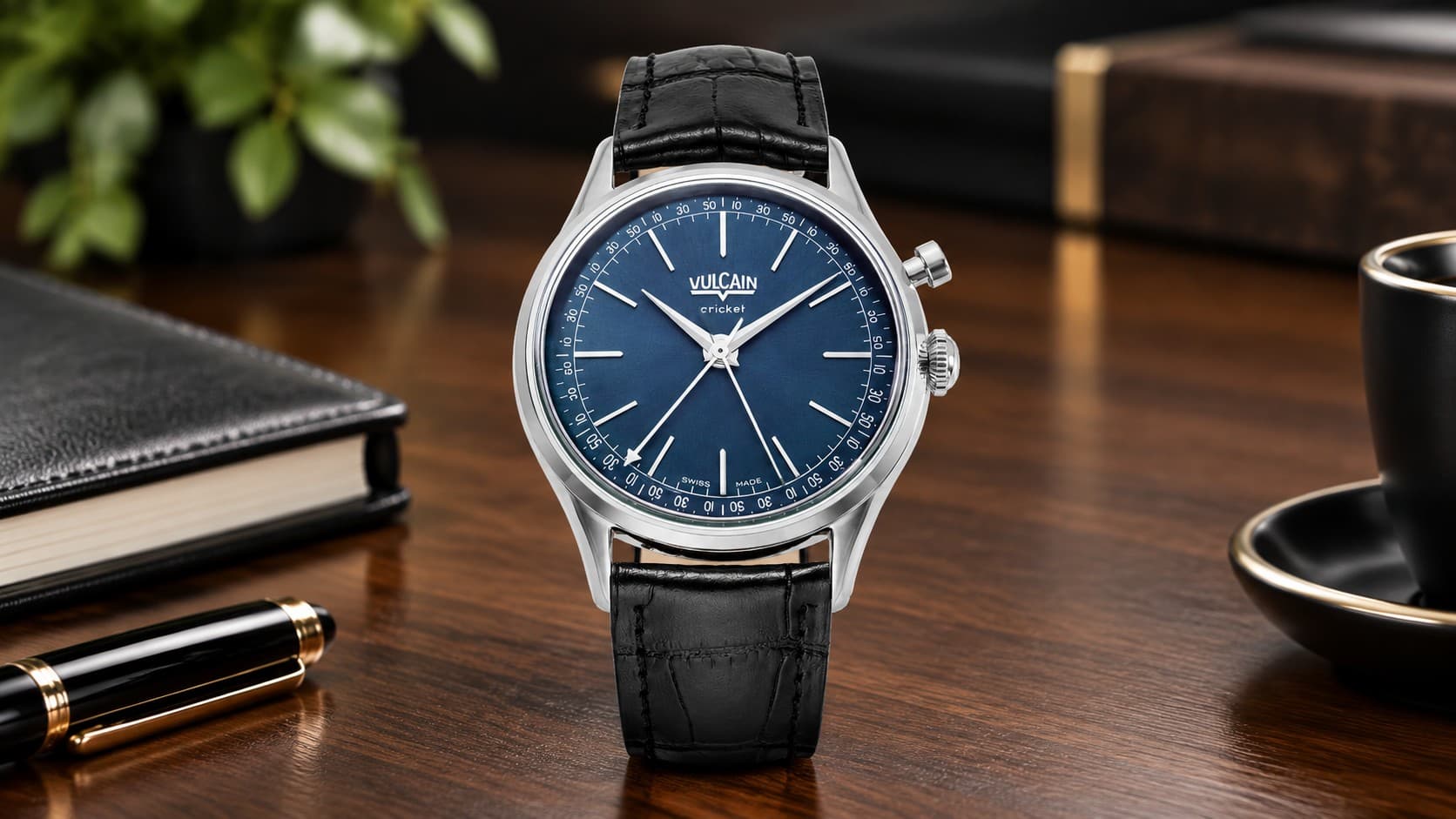
Best Vulcain Watches: Cricket Alarm Complications

Vulcain Cricket watches combine presidential heritage with mechanical alarm complications, featuring manufacture movements and prices from $3,900 to $49,000.

We include products we think are useful for our readers. If you buy through links on this page, we may earn a small commission.

Read more

Affiliate Disclosure: This post may contain affiliate links, which means we may receive a commission if you click a link and purchase something that we have recommended. While clicking these links won't cost you any extra money, they help us keep this site up and running. We only recommend products or services that we genuinely believe will add value to our readers. Thank you for supporting us!

Transparency: We are a participant in various affiliate programs, including the Amazon Services LLC Associates Program, an affiliate advertising program designed to provide a means for us to earn fees by linking to Amazon.com and affiliated sites. Our editorial content is not influenced by affiliate partnerships, and we strive to provide honest and unbiased reviews and recommendations.

To learn more about our vetting process, please visit our Affiliate Disclosure Statement

Article Content

Vulcain Grand Prix 39mm watch with green dial, Arabic numerals, small seconds subdial, and stainless steel case on black leather strap

Vulcain stands as one of Switzerland’s most fascinating yet underappreciated watchmakers, having carved out a unique niche in horological history with the Cricket, the world’s first practical mechanical alarm wristwatch. Introduced in 1947, this distinctive complication has graced the wrists of U.S. Presidents from Harry Truman to Joe Biden, earning the nickname “The Presidents’ Watch” through genuine use rather than paid endorsement. While giants like Rolex and Patek Philippe dominate mainstream conversation, Vulcain quietly continues producing in-house alarm movements at prices far below comparable complications from brands like Jaeger-LeCoultre. The Cricket’s distinctive chirping sound, created by a hammer striking a pin roughly 1,300 times over 20 seconds, delivers functionality that purely mechanical watches rarely attempt. For watch enthusiasts seeking something genuinely different, a timepiece with presidential pedigree and manufacture credentials without inflated premiums, Vulcain offers compelling value in 2026.

The History of Vulcain Watches and the Cricket Alarm

Vulcain’s journey from 19th-century pocket watch specialist to the “Presidents’ Watch” manufacturer spans over 167 years of Swiss watchmaking tradition, marked by remarkable innovation, presidential endorsements, near extinction, and an ongoing revival. The Cricket alarm complication introduced in 1947 represents not just the brand’s signature achievement but one of the most significant horological innovations of the 20th century. This history helps explain why these watches punch far above their weight in terms of technical sophistication and historical significance, even as they remain relatively unknown compared to mainstream luxury brands.

  • The Ditisheim brothers Maurice and Jacques founded their watchmaking workshop in La Chaux-de-Fonds in 1858, settling in the heart of Switzerland’s Jura Mountains where the country’s finest timepieces were born. The family focused on complicated pocket watches, crafting minute repeaters, perpetual calendars, and precision chronometers that competed with the era’s most respected makers. Their reputation grew on technical excellence and chronometric precision rather than volume production, building a foundation of serious watchmaking that would carry through generations.
  • Vulcain pocket watches earned gold medals at the Geneva Observatory trials by 1894, proving chronometric accuracy that matched Switzerland’s elite manufactures. These competition victories represented genuine proof of the Ditisheim family’s mastery in precision regulation and temperature compensation, not just marketing claims. The technical expertise gained from building observatory-grade pocket watches would become crucial when developing the Cricket’s complex dual-barrel alarm mechanism decades later.
  • In 1899, the family registered “Vulcain” as their official trademark, borrowing from Vulcan, the Roman god of fire, metalworking, and craftsmanship. This mythological reference captured both the forge-like precision of watchmaking and the brand’s ambition to create timepieces with lasting impact. The distinctive name helped separate them from Switzerland’s crowded watch market and would eventually become linked inseparably with mechanical alarm complications.
  • Engineer Robert Ditisheim achieved a genuine horological breakthrough in 1947 with the Cricket, solving a problem that had stumped other watchmakers for decades. Earlier attempts at wristwatch alarms failed because they either drained power too quickly or produced sounds too faint to wake anyone. Ditisheim’s solution was the Caliber 120’s dual-barrel architecture, using one mainspring for timekeeping and a completely separate mainspring dedicated solely to the alarm. The alarm mechanism used a hammer striking a pin roughly 1,300 times over 20 to 25 seconds, with vibrations amplified through a patented double caseback design featuring 16 perforations that created a resonance chamber. The result was a penetrating chirping sound loud enough to wake the wearer across a room, naturally earning the watch its Cricket name.
  • The “Presidents’ Watch” legacy started in 1953 when the White House Press Photographer’s Association gifted President Harry S. Truman a 14-karat gold Cricket engraved “One More Please.” This phrase referenced photographers constantly requesting additional shots and marked the beginning of a tradition that would define Vulcain’s identity for decades. The connection wasn’t manufactured marketing but genuine appreciation from professionals who valued the Cricket’s practical alarm function in an era before digital reminders existed.
  • President Dwight D. Eisenhower wore his Cricket both before and during his presidency, continuing the White House tradition. Historical accounts mention the alarm sounding during at least one press conference, creating a memorable moment that further linked the Cricket with American leadership. Eisenhower genuinely relied on the alarm function for scheduling, appreciating the mechanical reliability in an era when battery-dependent alternatives hadn’t yet been invented.
  • President Lyndon B. Johnson became Vulcain’s most devoted presidential supporter during the 1960s, first purchasing his own Cricket and then ordering roughly 200 pieces as official presidential gifts. Johnson distributed these watches to visiting dignitaries, cabinet members, and foreign leaders, transforming the Cricket into a symbol of American diplomatic friendship. He famously weaponized his Cricket during meetings, setting the alarm to create a polite excuse for leaving conversations he found unproductive. Secret Service agents initially mistook the buzzing for security threats until they learned to recognize the distinctive Cricket chirp that became part of Johnson’s presidential routine.
  • Beyond presidential wrists, Vulcain continued innovating with the Cricket Nautical in 1961, creating the world’s first alarm dive watch rated to 300 meters. This represented another genuine technical achievement since making an alarm function underwater required solving sound transmission through water. Engineers developed a triple-caseback construction that maintained the resonance chamber while providing proper water sealing. The Nautical featured a decompression scale on the dial, positioning it as a professional tool for divers who needed timed reminders during ascents to avoid the bends.
  • The 1970s quartz crisis hit Vulcain as hard as most traditional Swiss manufacturers. While competitors pivoted to electronic movements or shut down entirely, Vulcain tried maintaining its commitment to mechanical alarm complications. This principled stance proved commercially devastating as consumers embraced cheaper, more accurate quartz watches with electronic alarms. Production collapsed throughout the decade, forcing the company to merge with other struggling manufacturers in desperate attempts to pool resources and survive the industry upheaval.
  • The Vulcain name effectively vanished from new watch dials by the mid-1980s despite the brand’s technical achievements and presidential heritage. The Cricket that once graced presidential wrists became increasingly forgotten as the watch industry consolidated and marketing budgets determined survival more than horological merit. Original manufacture equipment scattered and watchmaking expertise dispersed as personnel sought employment with companies that had survived the crisis.
  • After years of declining sales and multiple ownership changes, operations stopped completely in 1999. The brand that had invented the mechanical alarm wristwatch and earned genuine presidential patronage appeared permanently relegated to history books. Collectors could still hunt vintage Crickets in estate sales and auctions, but new production had ended and the manufacture that created them no longer functioned as an operating entity.
  • Swiss watch industry veteran Bernard Fleury, leading investment group PMH SA, acquired the dormant brand in 2001 and relaunched production in 2002. Operations moved from the original La Chaux-de-Fonds facility to Le Locle, another historic watchmaking town in the Jura Mountains. The revival centered on recreating the Cricket using modern manufacturing techniques while preserving the essential dual-barrel alarm architecture that Robert Ditisheim had perfected. New models featured updated aesthetics, improved water resistance, and contemporary case sizes but retained the distinctive mechanical alarm that defined the brand’s identity.
  • Ownership changed hands to Excellence Holding AG in 2009, then to Luxembourg-based investment firm Promobe SA in 2017. Each transition brought fresh capital and different strategic visions, with varying success in reestablishing Vulcain in the modern market. The company maintained independent manufacture status throughout these changes, continuing to develop and produce alarm calibers in-house even as the watch industry increasingly consolidated into large conglomerate groups like LVMH and Richemont.
  • The most important recent development arrived in 2022 when French entrepreneur Guillaume Laidet joined as strategic consultant. Laidet had proven himself through successful revivals of dormant brands Nivada Grenchen and Excelsior Park, demonstrating deep knowledge of both vintage watch collectors and modern marketing. His influence showed immediately in product development, with refreshed Cricket collections featuring improved finishing, vintage-inspired aesthetics honoring the 1950s and 1960s golden age, and carefully curated limited editions targeting serious collectors rather than mass market consumers.
  • The tradition of presidential ownership continues into modern times, with President Richard Nixon having received his Cricket in 1955 as Vice President, President Gerald Ford accepting one, and President Ronald Reagan wearing a Cricket during his administration. President George H.W. Bush maintained the tradition, as did President Bill Clinton. President Barack Obama received an Anniversary Heart model with skeletonized dial revealing the alarm mechanism. Most recently, President Joe Biden received a Cricket, though notably President George W. Bush represents the only recent exception to this unbroken chain of presidential ownership spanning seven decades.

Today’s Vulcain operates as a small, independent manufacture producing limited quantities of in-house alarm movements while competing against conglomerates with vastly larger marketing budgets. The brand works from Le Locle under Promobe SA ownership, with current leadership showing Marc Jean Streibel as sole administrator. Production focuses primarily on Cricket alarm models using the manufacture V-10 and V-11 calibers, supplemented by more affordable non-alarm models using outsourced ETA and Landeron movements. This approach allows Vulcain to offer entry-level timepieces while preserving genuine manufacture credentials for alarm-equipped references. The Cricket’s distinctive sound, presidential pedigree, and genuine technical innovation continue attracting enthusiasts who value horological substance over brand recognition, even as the watches remain relatively unknown compared to mainstream luxury brands. This history of innovation, presidential association, near extinction, and gradual revival explains why vintage Crickets trade at fractions of comparable Jaeger-LeCoultre Memovox prices despite equivalent technical sophistication, and why knowledgeable collectors increasingly view Vulcain as one of modern watchmaking’s most undervalued opportunities.

What Sets Vulcain Watches Apart from Other Brands

The Cricket’s mechanical alarm mechanism remains an engineering marvel 77 years after its debut, representing one of the few genuinely unique complications still produced by an independent manufacture. While most luxury watches differentiate themselves through finishing, brand prestige, or minor movement variations, Vulcain offers something fundamentally different: a wristwatch that can actually wake you up using purely mechanical means. This isn’t just a novelty feature but a fully functional complication that required solving genuine engineering challenges and continues to demand specialized manufacturing expertise that only a handful of watchmakers worldwide still possess.

  • The Cricket uses a patented dual-barrel architecture where two completely separate mainsprings power different functions within the same movement. One mainspring drives the timekeeping train exactly like a conventional watch, while the second mainspring exists solely to power the alarm mechanism. This separation means the alarm never drains power from timekeeping, solving the fundamental problem that defeated earlier alarm watch attempts. When you wind the Cricket, rotating the crown toward 6 o’clock winds the movement barrel, while rotating toward 12 o’clock winds the alarm barrel. This elegant single-crown bidirectional winding system uses a “rocker” mechanism that intelligently distributes winding force to the appropriate mainspring based on rotation direction.
  • The alarm mechanism itself uses a hammer striking a steel pin approximately 1,300 times over 20 to 25 seconds when triggered. This rapid striking transfers vibrations to the inner caseback, which acts as a resonance membrane similar to a drum skin. The outer caseback features 16 precision-drilled perforations arranged in a specific pattern, creating an echo chamber that amplifies the sound outward. This patented 1949 double-caseback design produces a volume owners consistently describe as loud enough to wake you and half the block. The sound carries across rooms and vibrates noticeably on the wrist, intentionally designed to mimic an actual cricket’s penetrating chirp that can be heard despite the insect’s tiny size.
  • The modern V-10 caliber measures 27.07mm in diameter and 5.60mm thick, containing 165 individual components and running on 25 jewels. The movement operates at 18,000 vibrations per hour, which is slower than many modern movements but provides 42 to 52 hours of power reserve depending on the specific variant. The alarm duration lasts approximately 20 seconds, with the exact timing varying slightly based on how fully the alarm barrel is wound. Each Cricket movement is assembled, adjusted, and tested by hand at the Le Locle manufacture, with particular attention paid to the alarm mechanism’s hammer tension and striking rhythm.
  • Vulcain’s proprietary Exactomatic system modifies the standard Incabloc shock protection endstones to equalize friction on the balance wheel axis across all positions. This technical innovation helps the movement maintain consistent amplitude whether the watch sits dial-up, dial-down, crown-up, or crown-down. The system partially compensates for the relatively slow 2.5Hz beat rate, delivering accuracy that competes with faster-beating movements. Most Crickets perform within +/- 10 seconds per day when properly regulated, which is respectable for a mechanical alarm watch where the added complication introduces additional variables affecting timekeeping.
  • Setting the alarm requires pushing the dedicated pusher fully inward, which causes the crown to pop out automatically. The alarm hand can then be rotated anticlockwise only to set the desired alarm time. Forcing the alarm hand clockwise damages the cannon pinion, so this directional limitation is a feature, not a bug. Once set, pushing the pusher again arms the alarm. When the time arrives, the alarm triggers automatically and sounds for its full 20-second duration. After the alarm sounds, you must wait roughly 30 minutes before rewinding the alarm barrel to prevent damage to the mechanism, as attempting immediate rewinding can strip gears still under tension.
  • The Cricket’s sound production relies on mechanical resonance principles rarely used in wristwatches. The double caseback construction creates a Helmholtz resonator, the same acoustic principle used in musical instruments like guitars and violins. The inner caseback vibrates at the hammer’s striking frequency, while the outer caseback’s perforations allow sound waves to escape while reinforcing certain frequencies. This explains why the Cricket sounds dramatically different from other mechanical alarms like the Jaeger-LeCoultre Memovox, which uses a different acoustic design. The Cricket’s chirping character comes from the specific striking speed, hammer weight, and resonance chamber dimensions that Vulcain refined through years of experimentation.
  • Vulcain maintains genuine independent manufacture status, meaning the company designs, produces, and assembles its Cricket calibers in-house at the Le Locle facility. The V-10, V-11, and V-21 alarm movements are not modified ebauches from movement suppliers but proprietary calibers developed specifically for Vulcain. This distinguishes the brand from many “Swiss Made” watches that simply assemble outsourced movements in Swiss facilities. The Cricket’s alarm complication cannot be purchased from ETA or any other movement supplier, giving Vulcain exclusive control over this specialized horological function.
  • The value proposition compared to competitors becomes striking when examining prices. A Vulcain Cricket President retails at approximately $5,300, while a Jaeger-LeCoultre Memovox Master Control starts around $10,700 for similar functionality. Both offer mechanical alarm complications from established Swiss manufactures, but the Vulcain costs roughly half as much. The price gap widens further in the vintage market, where an 18-karat gold Vulcain Golden Voice trades under €2,000 while comparable gold Memovox pieces command €6,500 to €9,000. For collectors prioritizing the complication over brand prestige, the Cricket delivers equivalent technical sophistication at 20 to 50 percent of comparable alternatives.
  • The presidential heritage adds intangible value beyond technical specifications. Owning a Cricket means wearing the same complication that Harry Truman, Dwight Eisenhower, Lyndon Johnson, and other presidents chose for practical daily use. This wasn’t celebrity endorsement or paid sponsorship but genuine adoption by people who needed reliable mechanical alarms before electronic alternatives existed. The engraved casebacks on many vintage presidential gift Crickets document this history, with inscriptions noting specific occasions or recipients. Modern Crickets continue this tradition, with each watch carrying the legacy of being the timepiece that woke presidents and timed diplomatic meetings during the Cold War era.
  • Limited production numbers make Vulcain ownership more exclusive than mainstream luxury brands. While Rolex produces roughly one million watches annually and Omega several hundred thousand, Vulcain’s annual production likely numbers in the low thousands at most. The brand doesn’t publish exact figures, but the small manufacture facility, limited distribution network, and specialized nature of alarm movements suggest genuinely limited availability. This scarcity isn’t artificial marketing but the natural result of being a small independent manufacture producing complicated movements by hand. Finding specific Cricket references often requires patience, and certain limited editions sell out quickly despite modest marketing budgets.
  • The Cricket serves genuine practical purposes beyond horological appreciation. The mechanical alarm provides a phone-free wake-up option, important for people trying to keep smartphones out of bedrooms for better sleep hygiene. The alarm works reliably without batteries, eliminating the anxiety of electronic alarms failing due to dead batteries or power outages. Travelers appreciate the alarm for navigating time zones without depending on hotel wake-up calls or phone alarms that might not adjust properly. The physical ritual of winding the alarm barrel and setting the alarm hand creates mindful engagement with timekeeping that digital devices cannot replicate.
  • The Cricket’s distinctive aesthetics make it instantly recognizable to those familiar with alarm watches. The additional alarm hand, often in contrasting color, adds visual interest to the dial. The alarm setting pusher creates case asymmetry that breaks from conventional watch design. The perforated caseback, visible when removing the watch, hints at the mechanical complexity within. These design elements aren’t decorative but functional requirements of the alarm complication, giving the Cricket an honest, tool-watch character despite its frequent use in dress watch contexts.

The Cricket represents what independent watchmaking can achieve when technical innovation matters more than marketing budgets. Vulcain survived near extinction, multiple ownership changes, and the quartz crisis by remaining committed to a complication that requires genuine expertise to manufacture. The watches offer presidential heritage, manufacture movements, and genuinely useful functionality at prices that seem almost anachronistic given current luxury watch market inflation. For collectors seeking something different from the standard Rolex-Omega-TAG Heuer rotation, the Cricket delivers a conversation-starting complication with seven decades of refinement behind it. The mechanical alarm might seem quaint in an age of smartphone notifications, but there’s something deeply satisfying about a watch that can wake you using nothing but springs, gears, and 19th-century acoustic principles perfected in 1947 and still produced today.

Top 10 Best Vulcain Watches to Buy

Vulcain’s current catalog and vintage market offer diverse options from affordable entry pieces to haute horlogerie limited editions, though the Cricket alarm models remain the brand’s heart and soul. The modern collection balances heritage reissues honoring the 1950s golden age with contemporary designs addressing modern tastes for larger cases and dive watch aesthetics. Vintage Crickets offer access to genuine presidential-era timepieces at surprisingly accessible prices, while new production delivers manufacture warranties and updated water resistance. This selection covers the ten most significant Vulcain models available in 2026, representing the best combinations of value, historical importance, and mechanical interest across price ranges from under $2,000 to over $20,000.

  • Vulcain Cricket President 39mm stands as the flagship dress alarm watch and the closest modern equivalent to the Crickets worn by presidents from the 1950s through today. The 39mm stainless steel case houses the manufacture V-10 H0 caliber delivering 52 hours of power reserve with 5 ATM water resistance suitable for daily wear. The dial features applied indices, dauphine hands, and the distinctive red-tipped alarm hand that’s become a Cricket signature. Retail pricing sits at approximately $5,300 to $5,560 depending on dial color, with options including classic white, elegant blue, distinctive pistachio green, and limited-run salmon. The finishing quality reflects modern manufacture standards with polished case flanks, brushed lugs, and a movement visible through the sapphire exhibition caseback showing the dual-barrel architecture. This represents the quintessential Cricket experience, balancing wearable size, dress watch elegance, and the full presidential heritage in a package suitable for both business meetings and formal occasions.
  • Vulcain Cricket Tradition and Classique 36mm/39mm offer the most accessible entry into Cricket ownership with authentic alarm complications at starting prices of CHF 3,600 for the 36mm version and CHF 3,900 for the 39mm variant, translating to roughly $3,900 and $4,300 respectively. Both sizes house the V-10 caliber with 50-meter water resistance and box-shaped sapphire crystals that evoke vintage Cricket aesthetics. The Classique variants feature sector dials with painted Arabic numerals creating a vintage military watch character, while Tradition models offer cleaner dial layouts with applied markers. Limited salmon-dial editions restricted to 50 pieces each add collector appeal without dramatic price premiums. The 36mm size suits smaller wrists and vintage purists who appreciate the original Cricket proportions, while the 39mm accommodates modern preferences for larger watches without crossing into oversized territory. These models deliver the essential Cricket experience with manufacture movements and presidential heritage at the lowest possible price point.
  • Vulcain Cricket Nautical Heritage 42mm represents the brand’s most technically ambitious current production model, combining 300-meter dive watch capability with a functional underwater alarm. Priced at $4,862 to $5,390, the 42mm case measures 17.35mm thick to accommodate the triple-caseback construction required for alarm resonance at depth. The V-10 movement powers both timekeeping and alarm while the substantial case construction maintains water integrity that most alarm watches cannot achieve. The dial features a decompression scale honoring the original 1961 Cricket Nautical, which was the world’s first alarm dive watch. Modern versions offer black, blue, and tropical brown dial options, with Full Black limited editions of 50 pieces commanding premiums. The unidirectional rotating bezel, screw-down crown, and substantial water resistance make this a genuine tool watch, while the mechanical alarm provides practical functionality for dive timing that doesn’t rely on batteries. This model proves the Cricket isn’t just a dress watch curiosity but a serious sports watch capable of professional use.
  • Vulcain Cricket Aviator GMT 42mm combines the alarm complication with dual-timezone functionality for travelers who need both wake-up capability and world-time tracking. The 42mm case houses the V-11 caliber, which adds GMT hand and date display to the standard Cricket architecture. A 24-hour rotating bezel allows tracking a third timezone, while the alarm hand provides wake-up functionality regardless of which timezone you’re monitoring. Original retail pricing sat around $5,700, though the model appears discontinued or limited in current production. The pre-owned market offers these at $2,100 to $3,000, representing significant value for the complication stack. The combination of alarm, GMT, and date makes this among Vulcain’s most practical daily wearers for people who travel internationally and need mechanical solutions for jet lag and timezone management without resorting to smartphone dependence.
  • Vulcain 50s Presidents Chronograph Heritage occupies the highest price tier in Vulcain’s steel collection at $7,550, with 18-karat rose gold versions reaching $21,950. This model combines the Cricket alarm with a mono-pusher chronograph, creating a complication stack rarely seen in modern watchmaking. The COSC-certified V-57 caliber derives from La Joux-Perret architecture adapted specifically for Vulcain with added alarm function. The pulsometric scale on the dial adds vintage medical professional appeal, referencing an era when doctors used chronographs to measure patient pulse rates. The mono-pusher configuration operated through the crown creates cleaner case lines than dual-pusher chronographs, honoring 1940s chronograph design while housing thoroughly modern movement technology. Limited production numbers make this among the rarest current Vulcain references, appealing to collectors who want maximum complication density in a package that remains wearable at reasonable sizes.
  • Vulcain Skindiver Nautique 38mm provides the most affordable entry into Vulcain ownership at CHF 1,490 to 1,990, translating to approximately $1,640 to $2,190. The 38mm case measuring just 12.2mm thick houses an ETA 2824 automatic rather than a manufacture caliber, explaining the accessible pricing. The bidirectional ceramic bezel, 200-meter water resistance, and vintage-inspired design deliver legitimate dive watch capability in a compact package that wears comfortably on smaller wrists. Color options include orange, bronze, and gold PVD treatments that add character without dramatic price increases. While this model lacks the Cricket alarm that defines Vulcain’s identity, it offers access to the brand’s design language and Swiss watchmaking quality at prices competitive with microbrands. This serves as a gateway watch for buyers curious about Vulcain but not yet ready to commit to alarm complications or higher price points.
  • Vulcain Skindiver Chronograph 39.7mm launched for 2025 at €2,700 to €2,980, translating to approximately $3,020 to $3,265. The ETA Valjoux 7753 automatic chronograph movement provides 200-meter water resistance and 42-hour power reserve in a 39.7mm case that balances vintage proportions with modern wearability. The combination of dive watch water resistance, chronograph timing, and accessible pricing positions this as Vulcain’s sports watch value proposition. Limited editions include a 100-piece salmon dial variant and a meteorite dial version that adds exotic materials to the mix. Like the Skindiver Nautique, this model uses an outsourced movement rather than manufacture caliber, but the chronograph complication and dive capability deliver genuine functionality. This appeals to buyers who want Vulcain’s design approach and Swiss quality without paying for in-house movement development.
  • Vulcain Anniversary Heart appeared in 2008 for the brand’s 150th anniversary, featuring an open-worked dial revealing the Cricket alarm mechanism in action. The skeletonized design lets you watch the hammer strike the pin when the alarm triggers, transforming the hidden complication into visual theater. President Barack Obama received an Anniversary Heart model, continuing the presidential tradition with a modern interpretation. Pre-owned examples trade at $2,588 to $4,000 depending on condition and specific variant. The open-heart design appeals to collectors who appreciate mechanical exhibition, though it sacrifices some of the traditional Cricket’s elegant restraint. Production appears limited or discontinued in current catalogs, making these increasingly collectible as Vulcain focuses on more commercial models. The combination of presidential provenance, skeletonized movement display, and limited availability creates appeal for collectors seeking rarer Cricket variants.
  • Vulcain Cloisonné Enamel Collection represents the brand’s haute horlogerie peak, with hand-made cloisonné enamel dials by specialist Donzé Cadrans transforming Crickets into wearable art. “The World” in 18-karat white gold retails at $49,240 with production limited to just 30 pieces, featuring a hand-painted world map in vivid enamel colors. “The Panthers” commands $31,045 with enamel work depicting the big cats in meticulous detail. “Pegasus” in rose gold continues the theme of artistic dials with mythological subjects. These models prove Vulcain can compete in true luxury watchmaking when material quality and artistic craftsmanship justify prices approaching six figures. The cloisonné enamel technique requires weeks of hand work, with artisans placing tiny metal wires to create cell boundaries, filling each cell with colored enamel powder, and firing the piece multiple times at extreme temperatures. Each dial becomes unique even within limited editions due to the handmade process. These appeal to serious collectors who want Cricket complications in packages rivaling Patek Philippe or Vacheron Constantin artistic dial work.
  • Vulcain Grand Prix 39mm serves as the absolute entry point to Vulcain ownership at approximately $1,400 to $1,700. The 39mm case houses a Swiss Landeron automatic movement in classic dress watch format with no alarm complication. Water resistance sits at minimal levels suitable only for splash resistance. Green dial limited editions add collector interest to what otherwise functions as a straightforward three-hand automatic. This model makes sense primarily for buyers who want Vulcain’s name and design at minimum cost, or collectors who want to sample the brand before committing to Cricket prices. The lack of alarm functionality means missing Vulcain’s core identity, but the accessible pricing provides a trial option. Pre-owned examples trade even lower, sometimes appearing under $1,000, making this among the cheapest ways to own a Swiss manufacture’s product even though the movement itself isn’t in-house.

The diversity across these ten models demonstrates Vulcain’s strategy of serving multiple market segments while keeping the Cricket alarm at its core identity. The Cricket President, Tradition, Classique, Nautical Heritage, and Aviator GMT all feature manufacture alarm movements representing the brand’s genuine horological contribution. The Skindiver models and Grand Prix use outsourced movements but deliver Swiss quality at accessible prices. The Anniversary Heart and Cloisonné editions prove Vulcain can compete in artistic haute horlogerie when desired. Vintage Cricket models not covered here trade from $800 to $17,500 depending on era, material, and condition, offering historical alternatives to modern production. The key decision for most buyers centers on whether the Cricket alarm matters enough to justify the price premium over non-alarm models, and for enthusiasts seeking Vulcain’s true character, the answer typically points toward Cricket-equipped references that honor the brand’s presidential heritage and mechanical innovation.

What to Know Before Buying a Vulcain Watch

Purchasing a Vulcain requires different considerations than buying mainstream luxury watches, primarily because the Cricket alarm complication introduces functional, maintenance, and value questions that don’t apply to conventional three-hand automatics. The brand’s small production volume, limited dealer network, and mix of in-house and outsourced movements create a buying landscape that rewards research and patience. Whether you’re considering a modern manufacture piece with full warranty or a vintage Cricket with presidential-era provenance, several key factors determine whether you’re making a smart purchase or overpaying for a watch that doesn’t match your needs. Budget clearly matters, but so do practical questions about complication preference, movement authenticity, intended use, and long-term ownership costs that can surprise buyers accustomed to more common Swiss brands.

  • Budget planning across the Vulcain range starts with the Grand Prix automatic at roughly $1,400 and extends to cloisonné enamel limited editions exceeding $49,000, creating a price spectrum wider than many collectors expect from a relatively unknown brand. The critical threshold sits around $3,600 to $4,000, where Cricket alarm models begin. Below this price, you’re buying Vulcain design and Swiss assembly but missing the alarm complication that defines the brand’s identity. Between $4,000 and $6,000, you access the full Cricket experience with manufacture V-10 or V-11 movements in various case sizes and dial configurations. The $7,000 to $8,000 range adds chronograph complications to the Cricket alarm, while anything above $20,000 enters precious metal or artistic enamel territory. Most buyers find the sweet spot between $4,000 and $6,000, where you get genuine manufacture credentials, presidential heritage, and functional alarm complications without paying for complications you might never use or precious metals that dramatically increase cost.
  • Cricket versus non-Cricket decision making represents the most important choice when buying Vulcain. Cricket alarm models command 30 to 100 percent premiums over comparable non-alarm watches from the same brand, meaning a Cricket President at $5,300 costs roughly double what a Skindiver Nautique commands at $2,190. The alarm complication defines Vulcain’s historical significance, presidential heritage, and genuine manufacture status. Non-Cricket models like the Skindiver series deliver excellent Swiss dive watches but sacrifice what makes Vulcain unique. If budget constraints force choosing between a Cricket alarm from Vulcain or a conventional automatic from a more prestigious brand like Omega or Tudor, the decision depends on whether you value having something genuinely different versus brand recognition. The Cricket alarm offers functionality and conversation value that conventional watches cannot match, but only if you’ll actually use the alarm rather than treating it as a novelty that wears off after initial fascination.
  • Case size considerations matter more for Vulcain than many brands because vintage Crickets measured 34mm while modern production spans 36mm to 42mm. The original 1950s Cricket proportions suit smaller wrists and vintage purists, but most modern wearers find 34mm uncomfortably small for daily use. The 36mm Cricket Tradition offers authentic vintage sizing in modern production, perfect for wrists under 6.5 inches or those preferring understated proportions. The 39mm Cricket President hits the sweet spot for versatility, wearing comfortably on wrists from 6.5 to 7.5 inches while maintaining dress watch elegance. The 42mm Nautical Heritage and Aviator GMT cross into sports watch territory, suitable for wrists above 7 inches or those preferring bold presence. Trying before buying proves difficult given limited authorized dealer networks, so studying detailed measurements and comparing to watches you already own becomes essential. The Cricket’s double caseback construction adds thickness regardless of diameter, so models that look reasonably sized in photos may wear taller than expected on the wrist.
  • Movement authenticity and manufacture status requires careful attention because Vulcain’s catalog mixes genuine manufacture calibers with outsourced movements. The V-10, V-11, and V-21 Cricket alarm movements are proprietary in-house calibers designed, produced, and assembled in Le Locle. These represent authentic manufacture watchmaking and justify premium pricing. Non-alarm models use outsourced movements including ETA 2824 in the Skindiver Nautique, ETA Valjoux 7753 in the Skindiver Chronograph, and Swiss Landeron in the Grand Prix. These aren’t inferior movements but they’re available to any brand willing to buy them, meaning you’re paying primarily for case design and Vulcain’s name rather than exclusive horological development. For collectors prioritizing manufacture credentials and unique complications, Cricket models represent the authentic Vulcain experience. For those seeking Swiss quality at accessible prices without caring about movement provenance, the non-alarm models deliver legitimate value.
  • Intended use scenarios should guide model selection because different Crickets serve different purposes. The Cricket President in 39mm functions as a dress watch suitable for business formal environments, pairing well with suits and maintaining appropriate proportions under shirt cuffs. The Cricket Tradition and Classique in 36mm serve similar dress purposes with vintage character that appeals to collectors favoring historical accuracy over modern sizing. The Cricket Nautical Heritage qualifies as a genuine tool watch with 300-meter water resistance, suitable for actual diving, beach vacations, and rugged daily wear that would damage dress watches. The Cricket Aviator GMT targets travelers who need dual-timezone functionality and alarm capability across time zones. The chronograph models appeal to those who time events regularly and want alarm functionality as backup. Buying a delicate dress Cricket for construction site wear makes as little sense as buying a 42mm dive Cricket for black-tie events, so matching the watch to your actual lifestyle prevents buyer’s remorse.
  • New versus vintage purchasing decisions involve tradeoffs between warranty protection and historical character. New Crickets from authorized dealers include two-year international warranty covering manufacturing defects, modern water resistance suitable for daily wear, and sapphire crystals that resist scratching better than vintage acrylic. Vintage Crickets from the 1950s through 1970s offer genuine presidential-era provenance, often at lower prices than modern equivalents, with design details and proportions that some collectors prefer over contemporary interpretations. A vintage 1960s Cricket in steel trades at $1,200 to $2,500, while a new Cricket President costs $5,300, creating significant price gaps. However, vintage pieces require immediate servicing in most cases, may need parts that take months to source, and lack water resistance suitable for anything beyond careful hand washing. Collectors seeking investment potential or historical connection lean vintage, while those prioritizing reliability and daily wearability choose modern production.
  • Authenticity verification for vintage pieces becomes critical when buying pre-owned Crickets since the secondary market includes watches with replaced dials, incorrect movements, or outright fakes. Genuine Cricket alarm movements feature the distinctive dual-barrel architecture visible when opening the caseback, with one barrel significantly larger than the other. The alarm hand should rotate only anticlockwise when setting. If it moves bidirectionally, the cannon pinion is damaged and requires immediate repair. The double caseback construction remains essential for Golden Voice models, with the inner caseback featuring the resonance membrane and the outer caseback showing the perforated holes. Redials dramatically decrease value compared to original dials, even when the redial work is high quality. Period-correct hands, crown with stylized V logo on vintage pieces, and movement serial numbers matching the case era all confirm authenticity. Buying from reputable dealers who guarantee authenticity costs more upfront but prevents expensive mistakes that plague private party purchases.
  • Warranty terms and authorized purchase importance affects long-term ownership costs and resale value. Vulcain provides two-year international warranty covering manufacturing defects under normal use, including movement, hands, and dial issues. Coverage excludes theft, user damage, broken crystals, water damage from exceeding rated depth, non-original parts, and unauthorized service work. The warranty activates automatically when purchasing from authorized dealers, with no need for manual registration in most cases. Grey market sellers offer legitimate new watches at discounts of 10 to 30 percent but without manufacturer warranty, leaving you responsible for any defects that appear after purchase. Given that Cricket alarm movements require specialized service knowledge, having manufacturer warranty backing for the first two years provides peace of mind worth the price premium over grey market alternatives. The warranty also transfers if you sell the watch within the two-year period, adding value for future buyers.
  • Service infrastructure and long-term maintenance planning requires consideration before buying because Cricket alarm movements need watchmakers with specific expertise. Vulcain’s official European service center operates through Luis Míguez Relojeros in Spain, offering complete maintenance from €400 to €550 including full disassembly, cleaning, and worn parts replacement. US options include independent watchmakers experienced with alarm complications, typically charging $500 to $800 for complete service. The alarm mechanism adds complexity compared to conventional three-hand automatics, meaning not every watchmaker can properly service a Cricket. Parts availability for modern V-10 and V-11 movements remains good through Vulcain’s service network, but vintage Caliber 120 components may require months to source or fabrication from blank stock. Service intervals run every four to five years for regularly worn pieces, so budgeting $500 every five years for maintenance keeps the watch running properly. Neglecting service leads to worn pivots, dried lubricants, and eventual gear damage that costs far more to repair than preventive maintenance.
  • Limited edition evaluation and investment potential matters for buyers considering Crickets as collectibles rather than pure daily wearers. Vulcain produces numerous limited editions restricted to 30, 50, or 100 pieces, often with special dial colors or case materials. True limited editions with meaningful changes command premiums on the secondary market, particularly when production numbers stay below 50 pieces. However, many “limited editions” simply designate standard production runs rather than genuinely restricted offerings, meaning they don’t appreciate significantly. Cloisonné enamel pieces limited to 30 examples represent genuine scarcity and artistic value. Salmon dial variants limited to 50 pieces offer collector appeal at modest premiums. Standard Cricket Presidents with blue dials aren’t technically limited even though production numbers remain small. The secondary market shows mixed results, with most modern Crickets losing 40 to 60 percent of retail value immediately after purchase, while specific vintage references and rare limited editions appreciate. Buying for investment requires focus on vintage gold Crickets currently undervalued compared to Jaeger-LeCoultre equivalents, not modern production that depreciates like most luxury watches.

The key to smart Vulcain buying centers on clarity about what you actually want from the watch. If you’re drawn to the Cricket alarm complication, presidential heritage, and manufacture movement, budget accordingly for Cricket-equipped models starting around $4,000 and don’t compromise by buying non-alarm versions that save money but sacrifice the brand’s core identity. If you simply want attractive Swiss watches at fair prices, the Skindiver range delivers without premium costs for complications you won’t use. Size matters more than many buyers expect, so err toward smaller rather than larger if between sizes, since the double caseback adds thickness that makes Crickets wear larger than diameter suggests. Buy from authorized dealers when possible to secure warranty, or if buying vintage or pre-owned, verify authenticity through multiple sources before committing. Budget for service costs from the start rather than treating them as unexpected expenses, since alarm complications demand specialized maintenance. Most importantly, remember that Vulcain remains a small independent manufacture with limited marketing reach, meaning resale liquidity trails mainstream brands regardless of technical merit, so buy watches you genuinely want to own rather than viewing them primarily as investments.

Where to Buy Vulcain Watches

Finding Vulcain watches requires more effort than walking into any luxury mall boutique, since the brand operates without dedicated retail stores and maintains a deliberately selective authorized dealer network. The small production volumes and independent manufacture status mean distribution focuses on specialized watch retailers, online authorized dealers, and direct sales through the brand’s website rather than the widespread availability of brands backed by large conglomerates. This limited distribution creates challenges for buyers who want to see Crickets in person before purchasing, but it also means less price competition among dealers and occasional opportunities in the pre-owned market where the brand’s relative obscurity creates pricing inefficiencies. Whether buying new with full warranty or hunting vintage pieces with presidential-era provenance, knowing where to look and which sellers to trust makes the difference between smooth transactions and expensive mistakes.

  • Vulcain.ch official website serves as the primary direct purchase channel, offering the complete current collection with manufacturer warranty and international shipping to most countries. The site provides detailed specifications, high-resolution photography, and direct e-commerce checkout without requiring intermediary dealers. Newsletter signup typically provides a 10 percent welcome discount on first purchases, bringing a $5,300 Cricket President down to approximately $4,770 before shipping and import duties. The advantage of buying directly from Vulcain includes guaranteed authenticity, full two-year warranty activation, and access to the complete product range including limited editions that may not reach all authorized dealers. The disadvantage involves paying full retail without negotiation opportunity and handling your own import duties and taxes depending on shipping destination. Customer service operates primarily through email rather than phone support, so expect responses within 24 to 48 hours rather than immediate assistance. Returns and exchanges follow standard European consumer protection laws, generally allowing 14 days for returns on unworn pieces with original packaging intact.
  • Authorized dealers in the United Kingdom maintain both physical locations and online presence, offering manufacturer warranty and legitimate new stock. These retailers operate primarily with competitive pricing and financing options spreading payments over 6 to 12 months with approved credit. Physical locations in major cities allow in-person viewing and trying before buying for customers in those regions. UK dealers honor the full Vulcain warranty and can facilitate service through official channels when needed. UK pricing reflects VAT inclusion, so prices appear roughly 20 percent higher than US equivalents before tax. The advantage of buying within the UK includes easier returns under UK consumer law and avoiding import duties on shipments from Switzerland. These dealers typically stock core collection pieces like the Cricket President and Cricket Tradition but may need to special order limited editions or less common references.
  • European authorized retailers operate throughout the continent with both physical showrooms and online sales platforms. These dealers employ staff knowledgeable about independent brands and mechanical complications beyond mainstream offerings. Some European dealers offer extended warranties exceeding the standard two-year manufacturer coverage, providing additional peace of mind for buyers concerned about long-term reliability. Retailers operating from Switzerland near Vulcain’s manufacture occasionally offer factory tours or special access to limited production runs. European dealers generally price in euros with VAT included, so buyers from outside the EU can request VAT removal when shipping internationally, creating savings of approximately 20 percent off listed prices. Language support varies, with most offering English alongside local languages, though technical watch discussions sometimes benefit from working with native speakers who understand horological terminology.
  • United States authorized dealer network remains notably thin compared to European coverage, with only a handful of specialized retailers carrying Vulcain stock. This limited US presence reflects Vulcain’s small size and focus on European markets where the brand maintains stronger historical recognition. US authorized dealers typically specialize in independent and boutique watch brands, offering personal service and expertise beyond what typical jewelry stores provide. Pricing in US dollars eliminates exchange rate uncertainty but typically matches or slightly exceeds European pricing when accounting for currency conversion and VAT removal. The scarcity of US dealers means limited opportunity for in-person viewing before purchase, making the buying process more similar to purchasing from overseas dealers than domestic retail shopping. Import duties and taxes when buying from European sources often negate any price advantages, so working with US authorized dealers despite limited selection usually makes financial sense for American buyers.
  • Grey market considerations and tradeoffs involve purchasing legitimate new watches from non-authorized sellers who obtain stock through indirect channels. Grey market dealers occasionally list Vulcain models at 15 to 30 percent discounts compared to authorized dealer pricing, creating tempting savings on already-reasonable retail prices. A Cricket President that retails for $5,300 might appear on grey market sites for $3,700 to $4,200, saving $1,000 or more. However, these savings come without manufacturer warranty, meaning any defects appearing after purchase become your financial responsibility. Grey market watches are genuine, not fake, but Vulcain won’t honor warranty claims on pieces sold through unauthorized channels. Given that Cricket alarm movements require specialized service and replacement parts exclusively available through Vulcain’s service network, losing manufacturer warranty creates meaningful risk. The potential $1,000 savings evaporates quickly if you need $600 service work within the first two years. Grey market makes sense primarily for buyers with watchmaker relationships who can handle service independently, or those willing to accept financial risk in exchange for upfront savings.
  • Online marketplace platforms host thousands of Vulcain listings ranging from heavily worn vintage pieces under $500 to rare collectibles and new limited editions exceeding $60,000. These platforms mix professional dealers, authorized retailers clearing older stock, and private sellers liquidating personal collections. Vintage 1960s Cricket Caliber 120 examples trade between $782 and $2,108 depending on condition, originality, and completeness. Factory-new Cricket President 39mm pieces from official dealers using these platforms as sales channels list at prices essentially matching authorized dealer pricing while providing platform buyer protection. Platform escrow services hold payment until you receive and inspect the watch, then release funds to the seller, providing transaction security that direct private sales lack. The challenge involves authenticating vintage pieces and assessing condition from photographs, since redials, replacement parts, and undisclosed service history plague the pre-owned market. Buying from verified official dealer listings provides warranty protection, while vintage purchases require careful inspection or acceptance that immediate service will likely be necessary.
  • Professional pre-owned dealers authenticate, service, and warranty used luxury watches before resale. These businesses operate globally or focus on specific markets, occasionally stocking Vulcain pieces authenticated by in-house watchmakers and backed by warranties ranging from one to two years. Pre-owned specialists charge premium pricing compared to private party sales but eliminate authenticity concerns and provide warranty backing similar to new watches. A vintage Cricket that might sell for $1,500 in private sale could list for $2,200 through professional dealers, but the $700 premium buys professional authentication, likely service including cleaning and regulation, and warranty coverage if problems arise. For buyers lacking watchmaker relationships or expertise in vintage authentication, this premium represents insurance against expensive mistakes. These dealers typically maintain detailed condition reports, service records, and transparent policies about returns and exchanges that private sellers cannot match.
  • Auction house opportunities through major international houses and regional auction platforms provide access to rare vintage Crickets and special editions unavailable through retail channels. Cricket Nautical references from the 1960s have sold for CHF 17,500 at major auctions, demonstrating strong demand for rare vintage sport models. Regional auctions regularly feature Cricket lots selling between $1,250 and $3,000 depending on condition and provenance. Some European auction houses have moved Crickets ranging from $416 for rough examples needing service to $2,950 for excellent-condition pieces with original boxes. Auction buying requires expertise in condition assessment, authenticity verification, and realistic value estimation since hammer prices exclude buyer’s premiums typically adding 20 to 25 percent to final costs. The advantage includes access to references never available retail and occasional undervalued lots when other bidders overlook Vulcain in favor of more famous brands. The risks involve buying sight-unseen based on catalog descriptions that may downplay condition issues, no warranty or return options, and competition from knowledgeable collectors who’ve researched the same lots.
  • Private sales through forums and collector groups on dedicated watch platforms and social media communities occasionally surface Crickets from collectors liquidating pieces or rotating their collections. Private party pricing typically runs 20 to 40 percent below dealer pricing since sellers avoid dealer margins and transaction fees. A Cricket President might sell privately for $3,000 to $3,500 compared to $5,300 retail, creating significant savings for buyers comfortable with peer-to-peer transactions. The challenges include authentication falling entirely on the buyer, no warranty or return options, payment security requiring trust or using escrow services that add fees, and limited recourse if undisclosed problems appear after purchase. Successful private buying requires ability to authenticate watches yourself or access to watchmakers who can inspect before finalizing transactions. Building reputation within collector communities through helpful posts and transparent dealings eventually creates access to better private sale opportunities from trusted sellers, but new buyers entering these spaces face legitimate skepticism and should expect to make several purchases from dealers before establishing credibility for private transactions.
  • What to avoid and red flags in any channel include prices far below market averages suggesting stolen merchandise or frankenwatches assembled from parts, sellers unwilling to provide additional photographs or movement shots, refusal to use secure payment methods with buyer protection, pressure tactics demanding immediate decisions without inspection periods, and sellers with no transaction history or negative feedback. Vulcain counterfeits exist but remain relatively uncommon compared to mainstream luxury brand fakes, since the brand’s limited recognition makes counterfeiting less profitable. The greater risk involves franken-watches built from genuine Vulcain cases with incorrect movements, redials presented as original, or watches described as fully functional when alarm mechanisms are broken. Always request clear photographs of the movement through the caseback, confirmation that the alarm sounds for the full 20 to 25 seconds, and disclosure of any service history or known issues. Sellers who become evasive when asked direct questions about condition, service history, or provenance should trigger immediate caution. Legitimate sellers understand that informed buyers ask detailed questions and welcome inquiries as signs of serious interest rather than treating questions as suspicious or annoying.

The fragmented Vulcain buying landscape reflects the brand’s small size and independent status, creating both challenges and opportunities compared to walking into a mainstream boutique for instant gratification. Buyers prioritizing warranty protection and convenience should stick with authorized dealers or direct purchase from Vulcain despite paying full retail, since the peace of mind and service access justify premium pricing for complicated alarm movements. Those comfortable with pre-owned markets can find excellent values on vintage Crickets trading below their horological merit, particularly 18-karat gold examples selling for fractions of equivalent pieces from competing brands. The key involves matching buying channel to your expertise level and risk tolerance, purchasing from authorized dealers when new to vintage watches or alarm complications, graduating to pre-owned platforms with authentication services as you develop knowledge, and only attempting private party purchases after building sufficient expertise to authenticate independently. The limited dealer network means patience often rewards buyers, since watching multiple channels over weeks or months surfaces better examples at better prices than impulsive purchases driven by scarcity anxiety.

Vintage Vulcain Cricket Values and Investment Potential

Vulcain Nautique GMT dive watch with purple gradient dial, 24-hour bezel, date window, red GMT hand, and stainless steel bracelet with 200m water resistance

Vulcain watches occupy an unusual position in the collector market where technical merit, historical significance, and presidential provenance haven’t translated into strong resale values or investment performance comparable to mainstream luxury brands. The Cricket alarm complication represents genuine horological innovation that required solving real engineering challenges, yet vintage examples trade at fractions of what comparable complications from better-known manufacturers command. Modern production Crickets depreciate steeply upon purchase like most luxury watches, losing 40 to 60 percent of retail value in secondary markets despite manufacture movement credentials. This creates a paradox where knowledgeable collectors view Vulcain as undervalued relative to technical sophistication, while the broader market shows limited interest that keeps prices depressed. For buyers, this means poor short-term investment prospects but potential long-term opportunities if the brand gains recognition, and excellent value for those prioritizing horological interest over financial appreciation.

  • Current market positioning among collectors shows Vulcain occupying a niche category between affordable vintage finds and serious collector pieces. The brand lacks the widespread recognition that drives demand for mainstream Swiss manufacturers, meaning most watch buyers simply haven’t heard of Vulcain despite its presidential heritage. Dedicated collectors of independent brands, alarm watch enthusiasts, and vintage aficionados appreciate Crickets for their technical merit and historical significance, creating a small but devoted following. However, this specialized collector base doesn’t generate the broad demand that supports strong resale values. Online marketplace data shows Crickets sitting listed for months before selling, indicating limited buyer interest compared to pieces from brands with stronger marketing presence. The positive aspect involves less speculative buying and flipping, meaning most Vulcain owners genuinely appreciate the watches rather than treating them as investment vehicles.
  • Vintage Cricket valuations from the 1940s through 1970s vary dramatically based on era, material, condition, and specific reference. Standard stainless steel Crickets from the 1950s in 34mm cases trade between $1,200 and $2,500 when in good condition with original dials and working alarms. The same era pieces in 18-karat gold, particularly Golden Voice models with intact double casebacks, sell under €1,800 in European markets despite the precious metal content and historical significance. Cricket Nautical references from the 1960s with decompression scale dials command premium pricing from $5,000 to $17,500 depending on condition and completeness, as these represent the world’s first alarm dive watches and appeal to both vintage dive watch collectors and alarm complication enthusiasts. Standard Crickets from the 1970s trade at the lower end of the vintage spectrum, typically $500 to $1,500, as this era saw declining quality during the quartz crisis and less distinctive designs compared to earlier decades.
  • Condition premiums and value factors significantly impact vintage Cricket pricing beyond just the reference and year. Original dials command substantial premiums over redials, even when refinishing work is professionally executed, because collectors prize originality above cosmetic perfection. A Cricket with faded or lightly damaged original dial typically sells for 30 to 50 percent more than an identical reference with professional redial. Intact double casebacks prove essential for Golden Voice models, as the alarm resonance system depends on this construction and replacement with standard single casebacks destroys both functionality and collectibility. Working alarms that sound for the full 18 to 25 seconds add value, while non-functional alarm mechanisms reduce prices by 20 to 40 percent depending on estimated repair costs. Complete sets with original boxes and papers remain rare for vintage Crickets and add 15 to 25 percent to values when present, though most examples from the 1950s and 1960s survive as watch-only since boxes were commonly discarded.
  • Modern production resale realities paint a less attractive picture for recent buyers hoping to preserve value. New Crickets purchased from authorized dealers at full retail typically lose 40 to 60 percent of value within the first year of ownership based on secondary market pricing data. A Cricket President bought new at $5,300 commonly resells for $2,000 to $3,200 in the pre-owned market, even when in excellent condition with complete box and papers. This depreciation reflects limited brand recognition, small collector base, and absence of waiting lists or artificial scarcity that supports resale values for mainstream luxury brands. The Cricket Nautical Heritage shows slightly better value retention at 50 to 60 percent of retail, likely because dive watches generally hold value better than dress watches and the 300-meter water resistance with alarm complication creates unique appeal. Limited editions with production under 50 pieces perform marginally better, retaining 50 to 70 percent of retail, though even these don’t appreciate in the short term.
  • Comparison to competing alarm watches reveals the most striking value discrepancies in the vintage market. A vintage 18-karat gold Cricket Golden Voice from the 1950s trades under €1,800, while a comparable gold Memovox from the same era commands €6,500 to €9,000, creating a price gap of roughly 3.5 to 5 times for functionally equivalent watches. Both feature mechanical alarm complications from respected Swiss manufactures, both come in gold cases with similar dimensions, and both represent the peak of 1950s alarm watch development. The difference lies purely in brand recognition and collector demand rather than technical superiority. Stainless steel vintage Crickets sell for $1,200 to $2,500 while steel Memovox examples fetch $3,000 to $6,000, again showing 2 to 3 times price differential. Expert analysis notes this gap as undeserved based on horological merit, suggesting Vulcain either represents exceptional value or the market correctly prices the brand’s limited recognition and smaller collector base.
  • Investment thesis for undervalued references centers on vintage gold Crickets trading at seemingly irrational discounts to comparable pieces from better-known brands. The argument suggests that as collector knowledge deepens and appreciation for independent manufactures grows, the Vulcain-to-competitor price gap should narrow. If vintage gold Crickets currently trading under €2,000 appreciated to even half the price of equivalent gold Memovox pieces at €3,250 to €4,500, early buyers would see 60 to 125 percent gains. The Cricket Nautical represents another potentially undervalued reference as the first alarm dive watch with genuine professional capability, currently trading far below pioneering dive watches from mainstream brands. The risk involves this revaluation never occurring if Vulcain remains permanently overshadowed by brands with larger marketing budgets and stronger distribution networks.
  • Market trends and collector interest evolution show gradually increasing awareness of Vulcain among serious collectors, particularly following Guillaume Laidet’s involvement and the brand’s renewed focus on heritage-inspired designs. Online discussion forums show more Cricket content in recent years, vintage market listings have increased as collectors hunt pieces to restore and flip, and auction results occasionally surprise with strong bidding on rare references. However, this growing interest remains confined to watch enthusiast circles and hasn’t penetrated mainstream luxury watch buyers who drive mass-market demand. The trend toward appreciating independent manufactures over conglomerate-owned brands favors Vulcain’s long-term prospects, as does increasing collector focus on complications and technical innovation rather than pure brand prestige. Whether these trends translate to measurable price appreciation remains uncertain, though the trajectory appears more positive than five years ago.
  • Long-term outlook and appreciation potential depends heavily on Vulcain’s continued operation and product quality under current ownership. The brand has survived multiple near-death experiences, and continued independent operation isn’t guaranteed if sales don’t justify ongoing investment. Acquisition by a larger group could boost distribution and marketing but might dilute the manufacture status by shifting to outsourced movements for cost savings. The best-case scenario involves steady growth building on current momentum, with limited editions selling out quickly, waiting lists developing for popular references, and vintage market prices gradually rising as collector awareness expands. The worst-case involves another ownership crisis leading to production cessation, which would likely cause vintage prices to stagnate or decline as the brand fades from memory. The middle-ground realistic scenario suggests modest growth in collector interest supporting slow appreciation for the rarest vintage references while modern production continues depreciating normally.
  • Best models for investment focus prioritize vintage references with unique features and lowest current pricing relative to horological significance. Vintage 18-karat gold Golden Voice Crickets under €2,000 represent the strongest value play, offering precious metal content, presidential-era provenance, and alarm complications at prices that seem disconnected from these attributes. Cricket Nautical references from the 1960s with original dials and working alarms appeal to both dive watch collectors and alarm enthusiasts, creating dual demand that supports value. First-generation Crickets from the late 1940s and early 1950s in any condition attract collectors interested in pioneering alarm watch development, though finding examples with original parts and working mechanisms proves challenging. Modern limited editions under 30 pieces with artistic elements like enamel dials may appreciate if Vulcain gains recognition, though these require holding periods measured in decades rather than years. Standard modern production Crickets make poor investments but excellent user watches, offering manufacture complications and presidential heritage at depreciated prices that favor buyers over sellers.
  • Liquidity considerations and selling challenges affect investment calculations beyond pure price appreciation potential. Vulcain’s limited collector base means watches take longer to sell than mainstream brands, with listings often sitting for months before finding buyers. Private party sales prove particularly challenging since potential buyers may not know enough about Vulcain to assess fair pricing and often lowball offers assuming obscurity equals low value. Selling through dealers or auction houses provides access to knowledgeable buyers but involves commissions of 10 to 25 percent that erode returns. The small market also means individual sales can significantly impact prices, with one or two similar Crickets listed simultaneously depressing values through oversupply. Buyers planning to resell should factor in potentially 6 to 12 months to find appropriate buyers at fair prices, compared to weeks or days for mainstream luxury brands with active markets.

The honest assessment positions Vulcain as poor short-term investment but potentially interesting long-term speculation for patient collectors with appropriate expectations. Modern production Crickets depreciate like most luxury watches and should be purchased for enjoyment rather than profit. Vintage Crickets, particularly gold examples and rare complications, trade below apparent value relative to comparable pieces from better-known manufacturers, creating theoretical upside if market recognition increases. However, this revaluation isn’t guaranteed and requires Vulcain maintaining operation, producing quality watches, and gradually building collector awareness over years or decades. The smartest approach treats Vulcain purchases as buying undervalued horological interest for personal enjoyment, with potential future appreciation as bonus rather than primary motivation. Collectors should budget for depreciation matching other luxury watches, celebrate if pieces appreciate beyond expectations, and most importantly enjoy wearing genuinely interesting watches with presidential heritage and mechanical innovation that punches far above the brand’s current market recognition.

Vulcain Watch Maintenance: Service Guide and Costs

Maintaining a Vulcain Cricket requires more specialized attention than conventional three-hand automatic watches because the alarm complication introduces additional mechanical complexity that demands specific expertise and careful handling. The dual-barrel architecture, hammer striking mechanism, and resonance chamber construction mean not every watchmaker can properly service a Cricket, and improper maintenance can cause expensive damage to components that may take months to source. Regular care extends beyond the movement itself to include the distinctive double caseback system that enables the alarm’s signature sound, specific winding protocols that prevent gear damage, and water resistance considerations that differ between dress Crickets and the dive-rated Nautical models. Whether you own a vintage presidential-era Cricket or a modern manufacture piece, following proper maintenance schedules and daily care practices makes the difference between decades of reliable service and premature mechanical failure requiring major repairs.

  • Recommended service intervals for Cricket alarm watches follow industry standards for complicated mechanical movements at every four to five years for regularly worn pieces. This timeline assumes normal daily wear without exposure to extreme shocks, magnetic fields, or water beyond the watch’s rated resistance. The alarm complication adds moving parts, additional lubrication points, and spring tension variables that degrade faster than simple time-only movements, making regular service particularly important. Watches worn occasionally or kept in storage can extend service intervals to six or seven years, though dried lubricants remain a concern even for unworn pieces as oils break down over time regardless of use. The service interval clock starts from the last complete overhaul, not from purchase date, so buying vintage or pre-owned Crickets without documented recent service means budgeting for immediate maintenance regardless of cosmetic condition.
  • Service costs and what’s included vary between official Vulcain service centers and independent watchmakers experienced with alarm complications. Official European service centers charge €400 to €550, translating to approximately $450 to $600, for complete maintenance including full disassembly, ultrasonic cleaning of all components, inspection for worn parts, replacement of degraded components, reassembly with fresh lubrication, regulation for accuracy, and water resistance testing where applicable. This service includes one-year guarantee on the work performed. Independent watchmakers in the United States typically charge $500 to $800 for equivalent service, with pricing depending on regional labor rates and whether replacement parts need ordering from Vulcain versus fabricating from blank stock. The alarm mechanism adds roughly $100 to $150 to service costs compared to simple automatic movements, reflecting the additional time required for proper hammer adjustment, striking rhythm verification, and resonance system inspection.
  • Finding qualified service providers proves more challenging than with mainstream brands because Cricket alarm movements require specialized knowledge that general watchmakers may lack. The official European service center operates through authorized workshops with direct access to Vulcain technical documentation, replacement parts, and factory training. Independent watchmakers capable of Cricket service typically advertise experience with complicated vintage movements and alarm mechanisms specifically. Local watchmakers should be questioned directly about alarm watch experience before entrusting a Cricket to their care, as attempting service without proper knowledge leads to damaged hammer mechanisms, stripped gears, or incorrect reassembly affecting alarm function. Watch collector forums and communities often maintain lists of recommended independent watchmakers by region who’ve successfully serviced Crickets, providing more reliable referrals than random online searches.
  • Parts availability considerations differ significantly between modern and vintage Crickets. The V-10 and V-11 calibers used in current production benefit from active manufacture support, with Vulcain maintaining parts inventory for ongoing service needs. Replacement mainsprings, balance staffs, cannon pinions, and alarm hammers can be ordered through authorized service channels, though lead times may extend several weeks for less common components. Vintage Caliber 120 movements from the 1940s through 1970s present greater challenges, as original parts haven’t been manufactured for decades. Watchmakers servicing vintage Crickets often need to fabricate replacement parts from raw stock, source components from donor movements, or adapt parts from similar-era movements with appropriate modifications. This scarcity adds both time and cost to vintage Cricket service, with complex repairs potentially requiring months to complete when specialized parts need custom manufacturing.
  • Critical daily winding protocols prevent the most common owner-induced damage to Cricket movements. The bidirectional crown winding system requires attention to rotation direction, turning toward 6 o’clock with crown pushed in to wind the timekeeping barrel, and rotating toward 12 o’clock with crown pushed in to wind the alarm barrel. Forcing the crown in the wrong direction for each function creates unnecessary wear on the rocker mechanism distributing winding force. The alarm hand must only rotate anticlockwise when setting alarm time, accessed by pushing the alarm pusher fully inward until the crown pops out automatically. Attempting to rotate the alarm hand clockwise damages or strips the cannon pinion, requiring immediate service to prevent complete alarm mechanism failure. After the alarm sounds, waiting 30 minutes before rewinding the alarm barrel prevents damage to gears still under residual tension from the striking sequence.
  • Alarm mechanism specific maintenance involves the hammer, striking pin, and resonance chamber system that conventional watches don’t require. The hammer must maintain precise tension to strike the pin at correct force, producing the characteristic chirping sound without excessive violence that could damage components. Over time, hammer springs can lose tension, causing weaker alarm volume that sounds for shorter duration or stops entirely. The striking pin experiences repeated impacts that can cause metal fatigue, though properly designed Crickets distribute stress to prevent pin failure under normal use. The inner caseback resonance membrane can develop small cracks or distortions from decades of vibration, reducing alarm volume and changing sound character. During service, watchmakers should specifically inspect and test these alarm-specific components rather than focusing solely on the timekeeping train that receives attention in conventional watch service.
  • Water resistance ratings and real-world limitations vary dramatically across the Cricket lineup. Standard Cricket President, Tradition, and Classique models carry 50-meter (5 ATM) ratings, which manufacturers consider suitable for splashes, rain, and hand washing but not swimming or showering. The screw-down crown provides some protection, but the alarm pusher creates an additional seal point that can leak if gaskets degrade. The Cricket Nautical Heritage with 300-meter rating qualifies for actual diving including alarm use underwater, achieved through triple-caseback construction that maintains resonance chamber functionality while providing proper sealing. Vintage Crickets with perforated outer casebacks require extreme caution around water, as the acoustic holes allow direct moisture ingress that vintage sealing technology cannot prevent. Any Cricket exposed to water beyond its rating should receive immediate service including movement drying, lubrication replacement, and seal renewal to prevent corrosion damage that worsens over time even after the watch appears dry externally.
  • Magnetic field exposure and demagnetization affects Crickets like all mechanical watches, with magnetic fields from smartphones, laptops, magnetic clasps, speakers, and induction cooktops potentially magnetizing steel movement components. Magnetization causes the balance spring coils to stick together, dramatically affecting timekeeping accuracy with sudden gains of several minutes per day appearing overnight. The alarm mechanism with its hammer spring and striking components may show increased sensitivity to magnetization compared to simple movements. Demagnetization requires a specialized device available to most watchmakers, with the process taking seconds and costing minimal fees during routine service appointments. Prevention involves keeping Crickets at least several inches away from strong magnetic sources, never placing the watch directly on laptop keyboards or smartphone screens, and storing away from magnetic jewelry boxes or bag clasps.
  • Storage recommendations for occasional wear involve watch boxes or cases maintaining stable temperature and humidity while protecting from dust, light exposure, and magnetic fields. Automatic Crickets benefit from watch winders maintaining movement operation during storage, preventing lubricants from settling and mainspring tension from completely releasing. However, winders should be set for minimal rotations per day rather than constant winding, as excessive winding accelerates wear. Manual-wind Crickets can sit unwound during storage without damage, though winding once monthly and allowing the alarm to sound exercises the mechanism and prevents lubricant migration. Humidity control proves particularly important, with ideal storage between 40 and 60 percent relative humidity preventing both moisture damage and excessive dryness that degrades lubricants. Silica gel packets in storage boxes help maintain stable humidity in variable climates.
  • Common issues and warning signs that indicate necessary service include alarm duration shortening below 15 seconds suggesting weakening alarm mainspring or increased friction from dried lubricants, timekeeping accuracy degrading beyond 15 to 20 seconds daily variation pointing to regulation needs or magnetization, visible condensation under the crystal indicating compromised water resistance requiring immediate attention, and difficulty winding either barrel suggesting degraded crown seals or internal friction. The alarm hand moving bidirectionally instead of only anticlockwise confirms cannon pinion damage requiring immediate service before the problem worsens. Unusual sounds during winding or running, such as grinding or clicking not present when new, suggest loose components or inadequate lubrication. Any of these symptoms warrant professional evaluation rather than continued wear hoping the problem resolves itself, as mechanical issues worsen over time and early intervention prevents minor problems from becoming expensive major repairs.
  • Special considerations for vintage Cricket ownership include accepting higher maintenance frequency and costs compared to modern production. Vintage movements may need service every three to four years rather than five due to older metallurgy, seal materials that degrade faster than modern compounds, and accumulated wear from decades of operation. Finding watchmakers willing to work on 50 to 70-year-old alarm movements requires patience and possibly shipping to specialists rather than using local repair services. Parts fabrication for unavailable components adds both time and expense, with complex vintage restorations potentially costing $800 to $1,500 when major components need replacement or manufacturing from blank stock. However, properly maintained vintage Crickets can run reliably for decades more, making the investment worthwhile for pieces with historical significance or sentimental value.

The Cricket’s mechanical alarm represents a complication that rewards proper care with decades of reliable service but punishes neglect with expensive repairs. New owners should budget approximately $500 every five years for routine service as part of ownership costs, similar to maintaining a quality mechanical watch of any brand. The bidirectional winding protocol and alarm hand setting restrictions require attention until they become habitual, but following proper procedures prevents the most common damage scenarios. Finding qualified service providers before problems arise saves scrambling during emergencies when the watch stops running or the alarm fails. Most importantly, the Cricket deserves regular use rather than safe storage, as mechanical watches generally run better when worn regularly and exercised. The alarm complication provides genuine utility for wake-ups, meeting reminders, and cooking timers, transforming the Cricket from pure horological curiosity into functional daily tool that happens to carry presidential heritage and manufacture movement credentials. Proper maintenance ensures this functionality continues for generations, allowing today’s owners to eventually pass working Crickets to future collectors who’ll appreciate both the mechanical ingenuity and the history of watches that once woke presidents.

Common Vulcain Watch Questions and Answers

The Cricket alarm complication raises specific questions that conventional watches don’t encounter, from practical concerns about alarm loudness and battery requirements to historical curiosities about presidential connections and technical details about mechanical operation. New Vulcain owners and prospective buyers consistently ask similar questions about functionality, value, service needs, and differences between vintage and modern production. These answers address the most common concerns to help you make informed decisions and properly care for your Cricket.

How did Vulcain become known as the Presidents’ Watch?

The presidential connection started in 1953 when the White House Press Photographer’s Association gave President Harry S. Truman a 14-karat gold Cricket engraved “One More Please.” President Lyndon B. Johnson became the biggest supporter, buying his own Cricket and ordering roughly 200 pieces as diplomatic gifts. He famously set his alarm during meetings to create excuses for leaving boring conversations. This tradition continued through most presidents from Truman to Biden, with only George W. Bush as an exception.

How loud is the Cricket alarm?

Owners consistently describe it as loud enough to wake you and anyone sleeping nearby. The alarm sounds for 20 to 25 seconds and can be heard across rooms and through closed doors. The sound resembles an actual cricket’s chirping rather than a pleasant musical tone. It also vibrates noticeably on your wrist.

Can you turn off the alarm or does it always sound?

The alarm only activates when you push the alarm pusher after setting the time. Simply setting the alarm hand doesn’t arm it automatically. You must push the dedicated pusher to activate it. Once triggered, the alarm sounds for its full 20 to 25-second duration without any way to silence it early. After sounding, it automatically disarms and won’t sound again until you reactivate it.

Are Vulcain watches good investments?

Modern Crickets depreciate 40 to 60 percent immediately after purchase, similar to most luxury watches. A $5,300 Cricket President typically resells for $2,000 to $3,200 within the first year. Vintage gold Crickets trading under €2,000 appear undervalued compared to similar alarm watches from competitors that cost €6,500 to €9,000, but appreciation isn’t guaranteed. Buy Vulcain for horological interest and enjoyment, not as financial investment.

What’s the difference between vintage and modern Crickets?

Vintage Crickets from the 1940s through 1970s have smaller 34mm cases, acrylic crystals, and minimal water resistance. Modern versions use larger 36mm to 42mm cases, scratch-resistant sapphire crystals, improved water resistance up to 300 meters, and come with manufacturer warranty. The alarm mechanism functions identically, producing similar sound when properly maintained. Vintage pieces offer presidential-era history while modern versions provide better daily reliability.

How often should I use the alarm function?

Using the alarm weekly or monthly keeps the mechanism in good condition by exercising the components and preventing lubricants from settling. Daily use over years can accelerate wear. Use it when genuinely needed rather than as constant daily necessity or complete novelty. Remember to wait 30 minutes after the alarm sounds before rewinding the alarm barrel.

Is Vulcain an independent watchmaker?

Yes. Vulcain operates independently under Luxembourg-based Promobe SA ownership rather than being part of large groups like LVMH or Swatch Group. The company designs and produces Cricket alarm movements in-house at its Le Locle facility. Non-alarm models use outsourced movements, but Cricket calibers are genuine manufacture movements not available to other brands.

What is the entry price for a Cricket with alarm?

New Cricket alarms start at CHF 3,600 (roughly $3,900) for the 36mm Cricket Tradition or Classique models. The 39mm versions cost CHF 3,900 (approximately $4,300). Pre-owned modern Crickets trade between $2,000 and $3,000. Vintage steel Crickets from the 1960s and 1970s start around $800 to $1,200 but typically need immediate service adding $500 to $800.

Can any watchmaker service a Cricket?

No. Cricket alarms require watchmakers with specific expertise in alarm complications. General watchmakers servicing simple automatics often lack knowledge to properly adjust the hammer, verify striking rhythm, and inspect the resonance system. Use official Vulcain service centers or independent watchmakers with verified alarm watch experience. Improper service damages components and creates expensive repairs.

How does the mechanical alarm work?

Two separate mainsprings power timekeeping and alarm independently. When alarm time arrives, the alarm mainspring drives a hammer that strikes a steel pin roughly 1,300 times over 20 to 25 seconds. Vibrations transfer to the inner caseback acting as a resonance membrane. The outer caseback has 16 perforated holes creating an echo chamber that amplifies sound outward. This purely mechanical system requires no batteries or electronics.

Why is it called a Cricket?

The name comes from the distinctive chirping sound the alarm produces, deliberately designed to mimic an actual cricket insect. The rapid hammer strikes create a penetrating chirp that carries across distances despite originating from a small wristwatch, just as real crickets produce disproportionately loud sounds from tiny bodies.

Do Cricket watches need batteries?

No. The Cricket operates as a purely mechanical watch using mainsprings for both timekeeping and alarm power. You wind it manually using the crown, rotating toward 6 o’clock for the movement and toward 12 o’clock for the alarm. No batteries or electronic components exist in the mechanism.

Can you swim with a Cricket watch?

Standard Cricket models have 50-meter water resistance suitable for splashes and rain but not swimming. The Cricket Nautical Heritage with 300-meter rating qualifies for actual diving including underwater alarm use. Vintage Crickets with perforated casebacks should avoid all water exposure as the acoustic holes allow moisture inside.

What happens if you wind the alarm the wrong direction?

The crown uses bidirectional winding where direction matters. Rotating toward 6 o’clock winds the movement, while rotating toward 12 o’clock winds the alarm. Winding in the wrong direction for each function creates wear on the rocker mechanism but won’t immediately break anything. The greater danger involves rotating the alarm hand clockwise when setting alarm time, which damages or strips the cannon pinion requiring immediate repair.

How long does the alarm power reserve last?

The alarm mainspring provides enough power for the alarm to sound once after being fully wound. After the alarm triggers and sounds for its full 20 to 25 seconds, you must rewind the alarm barrel for it to sound again the next time. The alarm barrel holds enough reserve for one activation, not multiple days of alarms.

These questions cover what most buyers want to know before purchasing a Cricket and what new owners need for proper operation. The alarm complication works differently from any smartphone notification or electronic alarm, requiring some learning but providing genuinely useful mechanical functionality once you understand the winding protocols and activation procedures. The presidential history fascinates people discovering Vulcain for the first time, while technical operation appeals to watch enthusiasts appreciating mechanical solutions to practical problems. Most importantly, knowing that modern Crickets depreciate significantly helps set realistic expectations, preventing disappointment when resale values don’t match purchase prices.

Conclusion

Balmain watches occupy a specific and honest position in the watch market: legitimate Swiss-made timepieces with genuine fashion heritage at accessible prices. The Swatch Group ownership since 1995 ensures manufacturing quality through ETA movements, sapphire crystals, and solid stainless steel construction that exceeds generic fashion brands while remaining more affordable than luxury tier Swiss watches. Pierre Balmain’s architectural design philosophy translates into distinctive case shapes and the signature arabesque dial patterns that connect modern timepieces to eight decades of haute couture history. Current collections span from elegant dress pieces like the Classic R through technical dive watches in the Ophrys line, offering genuine variety for different wearing occasions and style preferences.

The ideal Balmain buyer understands what these watches offer and what they don’t. They provide reliable Swiss quartz movements requiring minimal maintenance, thoughtful French-inspired design that stands apart from generic watches, and quality appropriate for their $300-$1,600 pricing. They don’t offer mechanical movements for enthusiasts who value traditional watchmaking, they won’t retain value or appreciate as investments, and they lack the prestige of luxury brands. Buyers seeking maximum horological credibility, investment potential, or status symbols should look to Rolex, Omega, or Patek Philippe. Those wanting distinctive style, proven Swiss reliability, and fashion heritage without luxury pricing will find Balmain delivers genuine value within realistic expectations.

Whether choosing an elegant Haute Elegance Vintage for formal occasions, a versatile Classic R for daily wear, or the capable Ophrys for active lifestyles, Balmain watches serve buyers who value personal style and wearing enjoyment over resale concerns. Purchase from authorized dealers for full warranty protection, maintain with regular cleaning and periodic service, and appreciate these watches for what they are: well-made Swiss timepieces that bring Parisian elegance to accessible price points. The brand continues evolving with new collections in 2025, showing Swatch Group’s ongoing commitment to developing Balmain as a viable option for style-conscious buyers wanting something more interesting than mass-market fashion watches but less expensive than traditional luxury timepieces.

Nobbier logo

Subscribe To Our Weekly Newsletter

Get notified about new articles