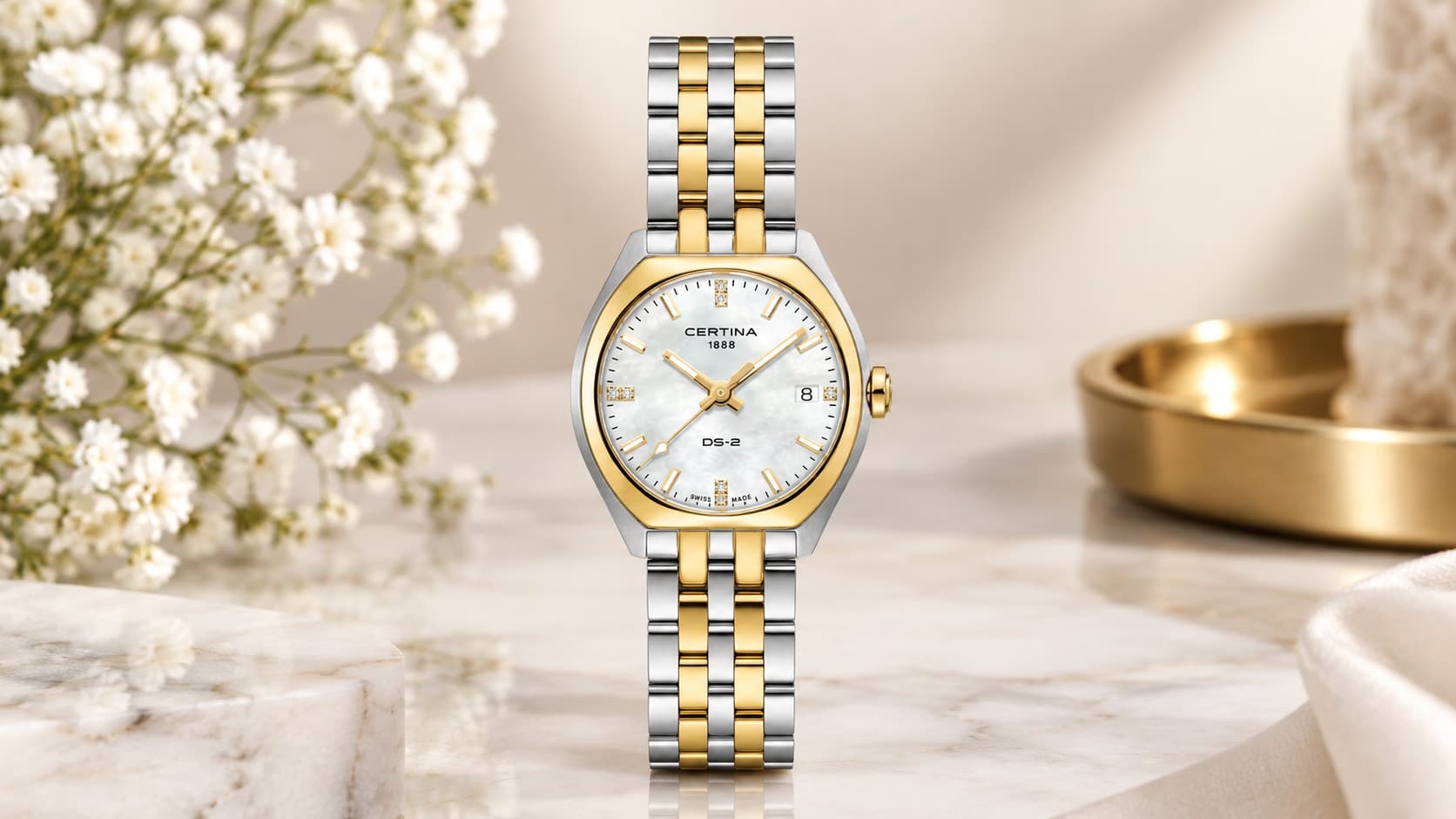
Certina is one of those brands that watch fans know well, but almost nobody else has heard of. That is strange, because it is one of the oldest Swiss watch companies still making watches today, and it has spent more than a century building a reputation for one simple thing: watches that refuse to break. From mountain expeditions to underwater pressure tests, Certina has quietly proven itself in places most fashion watches never go near. Its history, its Double Security engineering, and the models built on top of it explain why the brand has earned that reputation.
What Company Makes Certina?
Certina is a Swiss watch brand owned by the Swatch Group, the same company that owns Omega, Tissot, Longines, and Mido. Certina was founded in 1888 in Grenchen, Switzerland, by two brothers, Adolf and Alfred Kurth, who started out making watch movements and parts rather than finished watches.
The Kurth family ran the company for decades. Before the Certina name existed, the brothers sold their watches as “Grana,” a shortened version of Granacus, the old Latin name for Grenchen. The company only switched to “Certina” around 1938 to 1939, a name based on the Latin word certus, meaning “sure” or “certain.” That word choice was not random. Certina wanted its watches to be known for reliability above everything else, and that idea still shapes the brand today.
By the 1970s, Certina employed roughly 900 people and produced around 600,000 watches a year, making it a sizeable player in Swiss watchmaking. The rise of cheap, accurate quartz watches from Japan hit the company hard during that decade, forcing it to scale back sharply. In 1983, Certina was absorbed into the newly formed SMH group, the entity that would later be renamed the Swatch Group in 1999, where it still sits in the mid-price tier alongside Tissot and Mido.
When Was Certina Founded?
Certina has been making watch components since 1888, which makes it one of the oldest watch companies in Switzerland. Because the company spent its early decades focused on movements and parts rather than complete watches sold under its own name, some people assume Certina is a newer brand. It is not. The Kurth brothers’ workshop in Grenchen predates most of the famous Swiss names people recognize today.
The brand only started building its own identity as a finished-watch maker in the late 1930s, and it did not become widely known for toughness until 1959. That year changed everything for Certina, because it introduced the idea that would define the brand for the next six decades.
The company was inventive well before it became known for toughness. Certina moved into wristwatches for women in the early 1900s, at a time when men still generally preferred pocket watches. Some brand histories also credit Certina with building one of the earliest digital watches in the world in 1936, a spring-powered piece that displayed the time using rotating numbered discs instead of hands, though that specific claim is not well documented outside the brand’s own retellings.
What Is Certina’s DS Concept?
DS stands for Double Security, a system Certina introduced in 1959 to protect the watch movement from shocks, water, and everyday wear. It was one of the first serious attempts by any watchmaker to build real toughness into a wristwatch, at a time when most watches were still fairly delicate.
The Double Security system uses reinforced casebacks, O-ring seals around the crown and stem, and a shock-absorbing mounting for the movement inside the case. In simple terms, it is a set of extra barriers between the outside world and the delicate mechanical parts that keep the watch ticking. Certina still uses the same basic idea today, updated with modern materials, on nearly every watch it makes.
That comparison is not just marketing language. Certina describes the idea in similar terms itself: the turtle’s shell protects a soft body from the outside world, the same way Double Security protects the delicate movement inside a watch case. Certina adopted the turtle as its brand symbol in 1960, one year after DS launched, and the turtle shell still appears on the caseback of most Certina watches today.
Certina did not just claim its watches were tough; it put them in places designed to break normal watches. According to accounts of the brand’s history, early DS models were carried on a 1960 Swiss expedition to Dhaulagiri, an 8,167-meter peak in the Himalayas, and were later tested by U.S. Navy divers during the Sealab underwater habitat experiments of the 1960s. The same accounts state that NASA evaluated Certina watches in 1969 and 1970 for their ability to withstand pressure equivalent to depths of 500 and 1,000 meters, and that one Certina piece survived being worn by boxer Muhammad Ali in 1976. These claims come from brand-history retellings rather than independent verification, but they point to a consistent theme: Certina built its reputation around testing the DS concept in extreme conditions rather than only advertising it.
Certina’s Powermatic 80 Movement Explained
The Powermatic 80 is Certina’s automatic watch movement built to run for up to 80 hours on a full wind, roughly double what most automatic watches can manage. A typical automatic movement needs winding again after 38 to 42 hours if it sits still, which means it can stop overnight when it is taken off. The Powermatic 80 leaves far more buffer before that becomes a problem.
Certina achieves this by slowing the movement’s beat rate from the usual 28,800 vibrations per hour down to 21,600, which uses less energy per hour. Engineers also fitted a stretched mainspring and a Nivachron hairspring, a material more resistant to magnetism and temperature swings than traditional metal hairsprings. The Powermatic 80 is based on the well-known ETA 2824-2 movement and is shared across several Swatch Group brands, including Certina, Mido, and Hamilton, though Certina was one of the first to widely adopt it.
For someone who wears a watch only on weekends, an 80-hour reserve means it can sit in a drawer from Sunday night to Wednesday morning and still be running when it is picked back up.
Best Certina DS-1 Watches
The DS-1 is Certina’s flagship collection and the clearest example of what the brand does best: a classic three-hand watch with real Swiss engineering underneath a simple face. It comes in both automatic (Powermatic 80) and quartz versions, usually in a 40mm case, with clean dials and a date window.
The DS-1’s appeal comes from the mix of restraint and detail. The cases have a slightly domed sapphire crystal, a screw-down crown, and 100 meters of water resistance, which is more than enough for daily wear and swimming. Certina also released DS-1 Big Date models starting in 2020, with larger date windows and gradient dials, aimed at buyers who want a bit more personality without losing the collection’s understated look. Prices for a new automatic DS-1 typically land between $700 and $1,000, depending on the dial and case finish.
Best Certina DS Action Watches
The DS Action is Certina’s sportier everyday collection, built around a rotating dive bezel, thicker cases, and water resistance that typically runs from 200 to 300 meters. Where the DS-1 aims for a dressier look, the DS Action leans into a tool-watch feel, with sizes usually between 40 and 43mm and a heavier presence on the wrist.
Several DS Action models are certified to the ISO 6425 diver’s watch standard, which is a stricter test than ordinary water resistance. To earn it, a watch needs a one-way rotating bezel, visible lume in the dark, and a case pressure-tested to 25 percent beyond its stated depth rating, along with checks for magnetic resistance and shock resistance. The line also includes a DS Action GMT variant with a second time zone hand, powered by the Powermatic 80.661 movement, which makes it a reasonable option for frequent travelers who want one watch that reads two time zones. New DS Action models typically run from $600 to $900, with GMT versions landing closer to $1,000.
Best Certina Dive Watches
Certina’s dive watches carry the “PH” designation, which stands for hydrostatic pressure, and they are built specifically to survive deep water. The lineup ranges from the DS PH200M, rated to 200 meters, up through the DS Super PH1000M and the newer DS Super PH2000M, rated to an extreme 2,000 meters.
| Model | Water Resistance | Case Material |
|---|---|---|
| DS PH200M | 200 meters | Stainless steel |
| DS Super PH500M | 500 meters | Stainless steel |
| DS Super PH1000M | 1,000 meters | Stainless steel |
| DS Super PH2000M | 2,000 meters | Grade 2 titanium |
The original PH1000M launched back in 1970 and made headlines at the time for surviving pressure that would crush most watches. The modern versions carry that same reputation forward using titanium cases, ceramic bezels, and sapphire crystals that resist scratches better than older acrylic ones did.
The newest addition, the DS Super PH2000M, doubles the depth rating of earlier PH models to 2,000 meters and pairs a Grade 2 titanium case with the Powermatic 80 movement. One version, produced in a limited run of 1,959 pieces to mark the year the DS concept launched, is made with the Sea Turtle Conservancy, a marine conservation group Certina has partnered with for more than a decade. It fits naturally with the brand’s turtle emblem, and it is a rare case of a watch collaboration actually connecting back to the brand’s own symbolism rather than feeling bolted on.
Best Certina Chronographs
Certina’s chronograph watches combine a stopwatch function with the same DS toughness found across the rest of the lineup, usually built around automatic movements from the ETA/Valjoux family. The DS Chronograph Automatic, first launched as a heritage-inspired piece in 2020, borrows design details from Certina chronographs made in the 1940s, including a simple two-register layout and vintage-style hands, while running on the ETA A05.H31 movement, an updated Valjoux 7753 with a silicon balance spring and a 60-hour power reserve.
More recently, Certina introduced the DS-7 Chrono Auto, a sportier chronograph built around the closely related ETA A05.231 caliber, which stretches the power reserve to about 68 hours. One version of the DS-7 was designed around padel, a racquet sport Certina sponsors, with a dial pattern that echoes a padel court’s net. These watches are aimed at people who want a stopwatch function without an oversized case, since most Certina chronographs stay around 41 to 43mm, a size that suits most wrists. They typically sell new for $1,600 to $2,000, placing them well above the brand’s simpler three-hand and dive models, closer to what higher-tier Swiss brands charge for automatic chronographs.
How Much Are Certina Watches Worth?
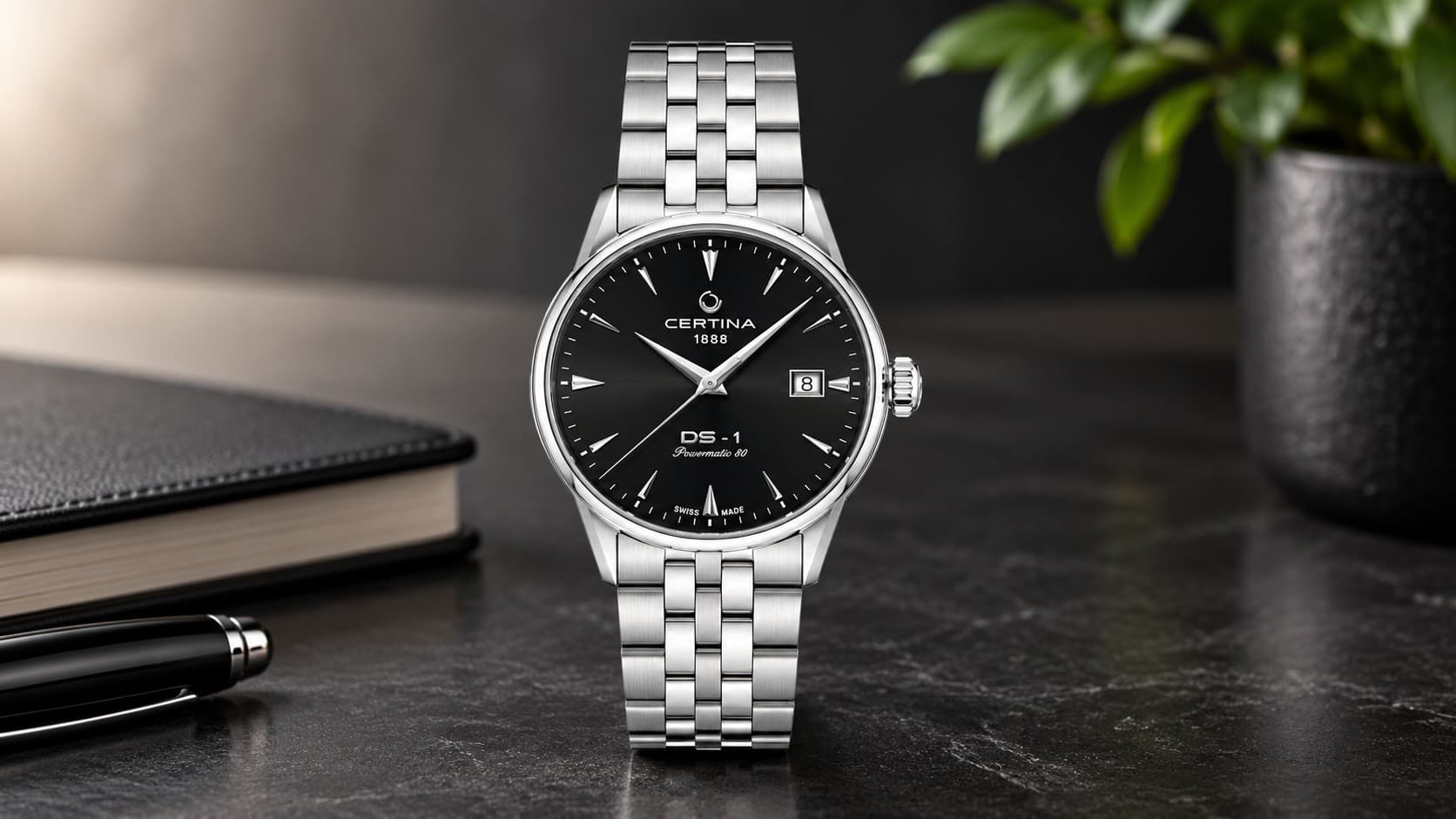
Most new Certina watches fall between $400 and $2,000, depending on the collection, case material, and movement. Entry-level quartz models like the DS Podium sit at the lower end, while automatic chronographs sit at the higher end.
Pricing varies clearly by collection and movement type:
- DS Podium (quartz): roughly $200 to $400
- DS-1 (quartz): roughly $400 to $600
- DS-1 (automatic, Powermatic 80): roughly $700 to $1,000
- DS Action / DS-2 (automatic): roughly $600 to $900
- DS Action GMT: roughly $900 to $1,100
- DS PH200M / Super PH500M: roughly $700 to $1,100
- DS Super PH1000M: roughly $900 to $1,300
- DS Super PH2000M (titanium): roughly $1,200 to $1,400
- DS Chronograph Automatic / DS-7 Chrono Auto: roughly $1,600 to $2,000
These figures reflect retail pricing for new watches and will shift over time with currency changes and material choices, but they give a fair sense of where Certina sits: solidly in the “affordable Swiss” bracket, well below brands like Omega or Longines, but above true budget quartz brands.
Why Isn’t Certina Well Known in America?
Certina has kept a very light footprint in the United States for decades, which is the main reason so few Americans have heard of a brand that is over 130 years old. Rather than a quality issue, this comes down to a business decision: Certina chose to focus its distribution on Europe, Asia, and other markets where the Swatch Group already had a strong retail presence, leaving the US mostly untouched.
That has started to change in recent years, with more authorized dealers and direct online sales bringing Certina back into American view. For now, though, buyers in the US often have fewer boutique or department-store options than they would for sister brands like Tissot, which explains why Certina can feel like an obscure discovery even though it is a well-established Swiss name almost everywhere else.
Is Certina a Trustworthy Watch Brand?
Yes, Certina is a well-regarded brand for anyone who wants genuine Swiss engineering without paying luxury prices. It earns that reputation through the DS concept, the Powermatic 80 movement, and a long track record of building watches that survive rough conditions rather than sitting safely in a display case.
Certina also backs that reputation with real sports partnerships rather than only marketing claims. The brand has supplied timing for Formula 1 teams, including a past partnership with the Sauber team, along with ties to the FIA World Rally Championship and Norwegian biathlete Ole Einar Bjørndalen, one of the most decorated athletes in Winter Olympics history. Those partnerships fit the brand’s identity: motorsport and biathlon both punish equipment with vibration, cold, and impact, which is exactly the kind of stress the DS concept was built to handle.
How Water Resistant Are Certina Watches?
Certina watches are water-resistant, not fully waterproof, and the exact depth rating depends on the model. Every watch has some limit to how much pressure it can handle, which is why the number stamped on the caseback matters. A DS-1 rated to 100 meters is fine for swimming and showering, while a DS Super PH1000M rated to 1,000 meters is built for serious diving. No watch, including Certina’s toughest divers, should be assumed safe at unlimited depth just because it looks rugged.
Do Certina Watches Resell Well?
Certina watches generally hold a modest amount of resale value but are not considered strong investment pieces the way some luxury brands are. Because they are priced as everyday Swiss watches rather than collector’s items, most buyers choose Certina for long-term wear and reliability rather than resale potential. Used prices for popular models like the DS Action or DS PH200M tend to sit not far below retail, which reflects steady demand rather than speculation.
Certina vs Other Swatch Group Brands
Certina sits in the middle of the Swatch Group’s lineup, positioned above brands like Swatch and Flik Flak but below Longines, Omega, and Breguet. Tissot and Mido occupy similar territory, which means shoppers often compare all three directly.
The clearest difference is focus. Tissot spreads across a wide range of styles, from dress watches to smartwatches, while Mido leans into architecture-inspired designs. Certina stays narrower and leans hard into durability and sport, which is why divers and chronographs make up such a large share of its lineup. Among the three, Certina stands out most clearly on toughness and water resistance.
Frequently Asked Questions
Is Certina owned by a bigger watch company?
Yes, Certina has been part of the Swatch Group since 1983, the same parent company behind Omega, Tissot, Longines, and Mido. Certina operates as its own brand with its own designs and identity, but it shares some movements, like the Powermatic 80, with sister brands inside the group.
Where are Certina watches made?
Certina watches are made in Switzerland and carry the official “Swiss Made” label. The brand’s roots trace back to Grenchen, and its watches today are assembled using Swiss movements and components, meeting the legal requirements for the Swiss Made designation.
Is Certina considered a luxury watch brand?
What is the difference between the DS-1 and DS Action?
The DS-1 is Certina’s dressier, more classic three-hand collection, while the DS Action is built with a sportier look and slightly more rugged case details aimed at daily, active wear. Both share the same DS toughness and often the same Powermatic 80 movement underneath, so the choice mostly comes down to whether someone wants a cleaner dress-watch look or a bolder sport-watch appearance.
How long will a Certina Powermatic 80 run without being worn?
A fully wound Certina Powermatic 80 movement can run for up to 80 hours, or roughly three and a half days, without being worn or wound again. That is nearly double the reserve of a standard automatic movement, which typically lasts 38 to 42 hours.
The Bottom Line
Certina’s story comes down to one consistent idea: build a Swiss watch that can take a beating and keep working. From the 1959 introduction of the Double Security concept to the modern Powermatic 80 movement and titanium dive watches rated to 2,000 meters, the brand has stayed focused on durability rather than chasing trends. For anyone who wants real Swiss watchmaking without a luxury price tag, and who cares more about a watch surviving daily life than sitting in a safe, Certina’s DS lineup remains one of the strongest options in its price range.