Iron Annie watches tell a story that started in the sky, not on a workbench. The brand borrows its name and its look from a rugged German airplane that carried passengers and cargo through some of the roughest decades in aviation history, and it turns that history into wristwatches with corrugated metal details, cockpit-style dials, and a distinctly German sense of order. For anyone who likes a watch with a real backstory instead of an invented one, Iron Annie sits in an interesting spot between budget-friendly pricing and genuine design substance.
Iron Annie Watch Brand Explained
Iron Annie is a German watch brand made by Pointtec, a family-run watch company based near Munich. The brand launched in 2017 and takes its name directly from the Junkers Ju 52, a three-engine transport plane that English-speaking pilots nicknamed “Iron Annie,” while Germans affectionately called it “Tante Ju,” meaning Aunt Ju.
Pointtec itself is much older than the Iron Annie brand. Watch enthusiast Wilhelm Birk started the company in 1987 in Ismaning, a small town just outside Munich, and it has since grown into a business that sells watches through dealers in around 40 countries. Pointtec also owns the Zeppelin watch brand, another line built around German aviation history, so this is not a company dabbling in the theme once. It has spent decades building watches around real flying machines.
Iron Annie copies small physical details straight from the real plane. The most obvious is the bumpy, ridged sheet metal that covered the aircraft’s body, called corrugated duralumin, which shows up as a wavy texture on some watch dials and case backs today. That corrugated skin wasn’t just decoration on the original plane, either. Bending the aluminum into a wave pattern gave the metal extra strength in a way a flat sheet couldn’t match, so the body held up without needing a heavier internal skeleton, which is exactly why the real Ju 52 could survive rough landings on unpaved airstrips for decades.
The plane earned its nickname the hard way. It carried mail, cargo, and as many as 17 passengers through the 1930s and 1940s, typically flying at speeds near 150 miles per hour, and kept working through conditions where lighter aircraft struggled. More than 4,800 were built in total before production ended in 1952, making it one of the most widely produced transport planes of its era.
Why Iron Annie Was Once Called Junkers
Iron Annie did not appear out of nowhere. Pointtec spent years building watches under a licensing deal with the family of aircraft engineer Hugo Junkers, selling them under the Junkers name. That arrangement ended in 2019 when the Junkers family asked for a much higher royalty fee to keep using the name, and Pointtec decided not to renew the license.
Instead of dropping aviation-themed watches altogether, Pointtec switched to a name it already had a claim to: the nickname of the exact plane its Junkers watches had been referencing all along. That let the company keep the same design language and the same corrugated-metal styling cues without missing a beat, since the aircraft behind both brands was always the same one.
There was a smaller, more practical reason for the switch too. Distributors in English-speaking markets had noticed that customers often mispronounced “Junkers” with a hard J, like the word “junk,” instead of the softer German pronunciation. “Iron Annie” sidestepped that problem completely and, if anything, sounded more appealing to English speakers than the old name ever did.
Today the two brands exist side by side. The Junkers family went on to launch its own separate watch line under the Junkers name, so a shopper researching German aviation watches will run into both. They trace back to the same aircraft and the same design heritage, but they are made and sold by two unrelated companies with no ownership connection.
This is also where Zeppelin fits into the picture, since shoppers often confuse the three brands. Zeppelin is not a rival company; it is Pointtec’s other aviation-themed line, built around the history of German airships rather than airplanes. So while Junkers and Iron Annie are two separate companies that happen to share a design inspiration, Iron Annie and Zeppelin are two separate brands made by the same company. Compared side by side, Zeppelin tends to lean more formal and airship-inspired, Junkers keeps closer to classic pilot-watch proportions, and Iron Annie is the one most likely to show off that corrugated metal texture directly on the dial.
Best Iron Annie Watch Collections
Iron Annie organizes its lineup around different chapters of the Ju 52’s working life. Each collection answers a slightly different question: rugged tool watch, cockpit instrument, jungle explorer, or clean-lined dress piece.
Wellblech
The Wellblech series sits at the center of the Iron Annie catalog, and it is the collection most directly copied from the plane’s exterior. “Wellblech” is simply the German word for corrugated sheet metal, and that ridged, wave-like texture appears on the dial or case back as a direct nod to the aircraft’s distinctive metal skin.
These watches tend to have a straightforward, tool-watch personality: large, easy-to-read numerals, simple hour and minute hands, and dials built for quick glances rather than decoration. That plain, functional look matches the job the real plane was built to do, and it is the reason most collectors point to Wellblech first when asked which Iron Annie collection best represents the brand.
Amazonas
The Amazonas line commemorates a genuinely specific chapter of the Ju 52’s career, and the story behind it is more interesting than it first appears. Lufthansa’s own preserved Ju 52, the plane now known as D-AQUI, was actually renamed “Amazonas” at one point in its working life, flying passengers for an Ecuadorian airline called Transportes Aéreos Orientales between 1957 and 1963. It then sat abandoned at an airport in Quito for years until an American pilot found it and shipped it to the United States, where it changed hands once more before Lufthansa eventually bought it in 1984 and restored it in Germany.
Watches in the Amazonas collection lean into warmer, earthier dial colors than the rest of the catalog, echoing the South American landscapes the aircraft once crossed. Where the rest of the lineup leans steel-and-black, Amazonas brings color and warmth to an otherwise fairly serious, utilitarian brand without straying from the aviation story at its core.
Cockpit
The Cockpit collection pulls its visual language from inside the plane rather than the outside. Instead of copying the corrugated fuselage, these dials borrow the busier, instrument-panel feel of an actual aircraft cockpit, where pilots once had to track engine performance across all three motors at a glance.
These watches typically offer more than a plain three-hand design. Many Cockpit models add features like a 24-hour scale, a double date window, or chronograph subdials, aimed at people who want a watch that does more than simply tell time. This collection is the closest Iron Annie gets to a genuine pilot’s tool watch rather than a design tribute.
Bauhaus
The Bauhaus collection steps away from aviation entirely and draws from a different, equally important slice of German design history. The Bauhaus school was founded by architect Walter Gropius in Weimar in 1919 and later moved to Dessau in 1925, and it became one of the most influential design movements of the 20th century. Its core idea was that form should be simple and honest, with no decoration that doesn’t serve a purpose, and Iron Annie applies that same philosophy to its dials.
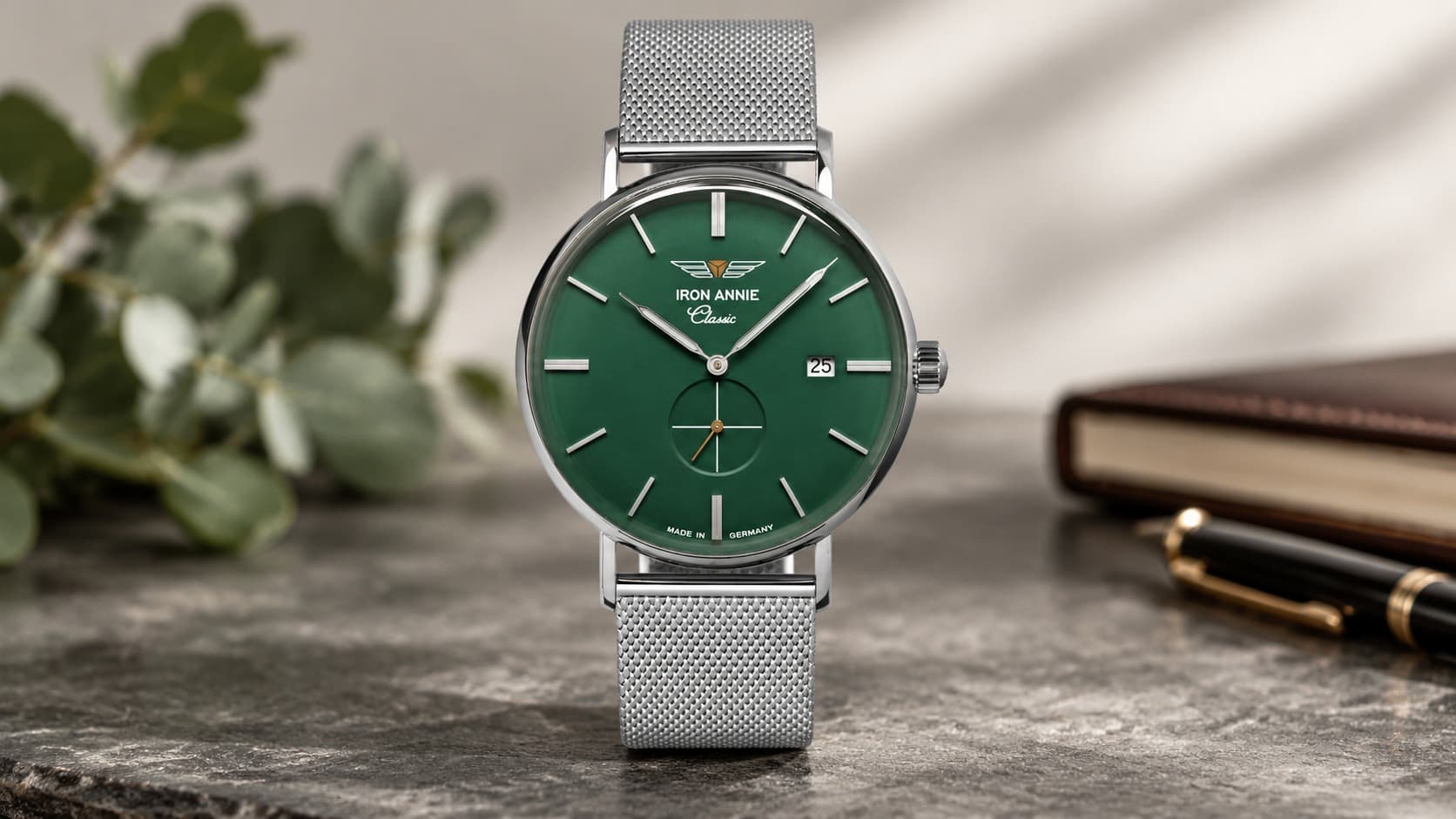
These are the dressiest watches Iron Annie makes, with clean, even layouts, thin hands, simple Arabic numerals, and date windows that blend neatly into the design instead of standing out. One well-known example, a model released in 2019 to mark the Bauhaus movement’s 100th anniversary, uses a quartz movement and offers 50 meters of water resistance, which is more than enough for daily wear even though the watch reads as a dress piece. One watch collector who reviewed that model called it a close cousin of a much pricier Junghans design classic, at a fraction of the cost.
Notable Iron Annie Models Worth Knowing
Collection names only tell part of the story, so it helps to look at a few actual watches to see how these design ideas play out on the wrist.
- Wellblech GMT (ref. 5842 / 5840 series): A 42mm stainless steel case with a Ronda 505.24H quartz movement, a day display, a second time zone hand, and 100 meters of water resistance. This is the model most people picture when they hear “Iron Annie,” and its dial texture is one of the clearest examples of the brand copying the plane’s corrugated skin directly.
- Cockpit Automatic (ref. 5162 / 5164 series): Built around a Japanese Miyota 821A automatic movement with 21 jewels and roughly 40 hours of power reserve, this model adds a date window and an exhibition case back so the movement is visible from behind. It sits at a genuinely affordable entry point for anyone who wants their first automatic watch rather than a battery-powered one.
- Bauhaus Automatic with power reserve (ref. 5060 series): This is one of the more feature-rich Bauhaus pieces, pairing a clean dial with an automatic movement and a power reserve indicator, a small dial that shows roughly how much longer the watch will keep running before it needs to be worn again. It costs more than the brand’s simpler quartz Bauhaus models, but it shows how far Iron Annie can push a minimalist design without cluttering it.
None of these are rare or hard to find, which is part of the point. They represent the everyday range most shoppers will actually encounter, rather than one-off limited editions that skew the picture of what owning an Iron Annie watch is really like.
Iron Annie Watch Materials and Movements
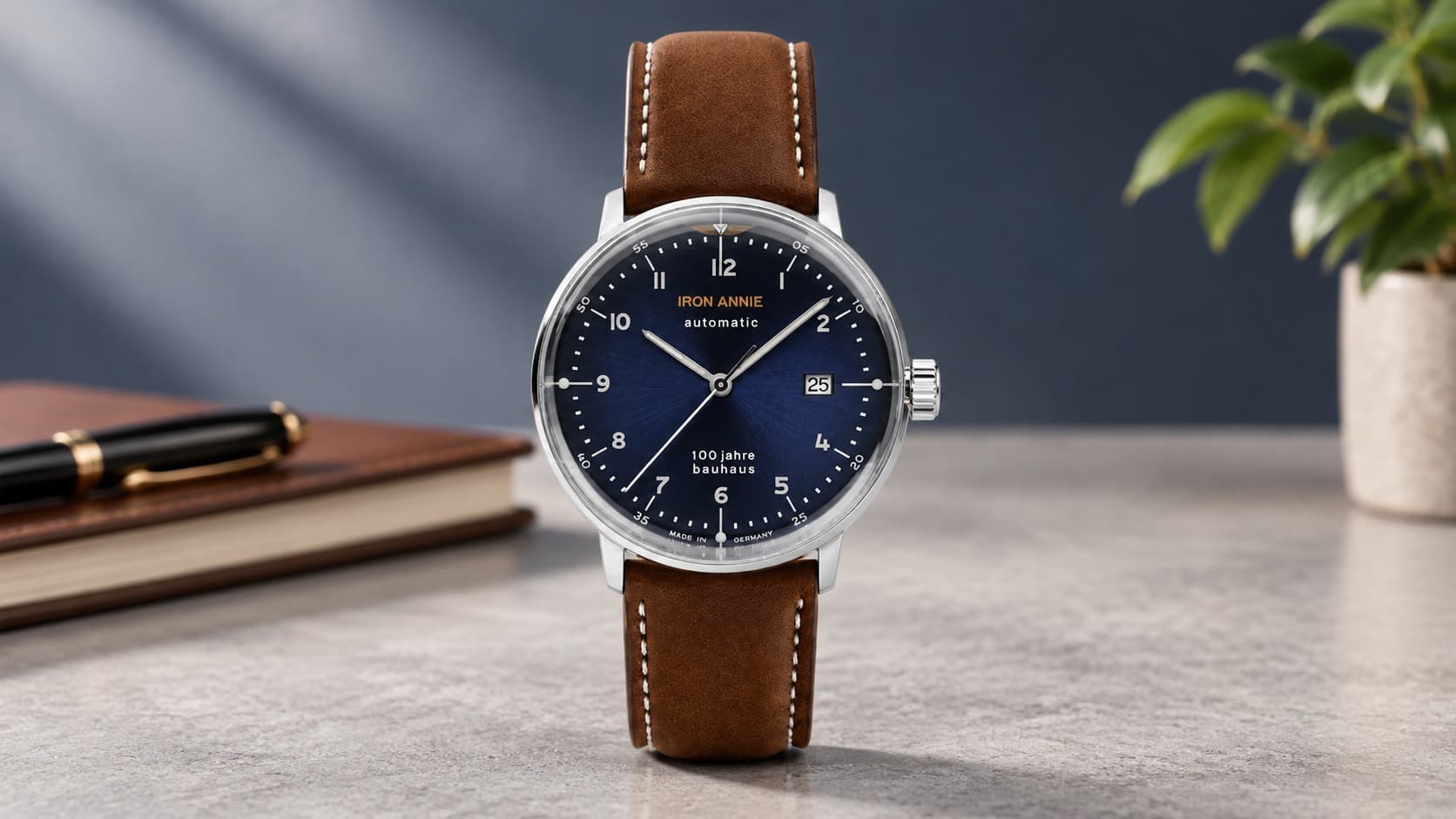
Iron Annie combines affordable materials with a choice of quartz or automatic movements, which keeps prices reasonable without cutting every corner. Cases are typically stainless steel, and most models use mineral glass rather than sapphire crystal, which is standard practice at this price level across the watch industry rather than a shortcut unique to this brand.
On the movement side, Iron Annie does not stick to a single supplier. Some models run on dependable quartz movements, which are battery-powered and highly accurate, while others use automatic movements that wind themselves through the natural motion of the wearer’s wrist. Depending on the specific model, those movements may come from Swiss or Japanese manufacturers, a common approach among mid-range watch brands that keeps quality consistent while controlling costs. A simple three-hand quartz watch, for example, might use a Swiss ETA-based movement, while an automatic model with a power reserve display is more likely to run on a Japanese Miyota caliber or a Chinese-made Seagull movement, both of which have solid reputations for reliability in this price range.
The two movement types differ in a few practical ways that matter when choosing a model:
| Feature | Quartz Iron Annie | Automatic Iron Annie |
|---|---|---|
| Power source | Battery | Wrist motion (self-winding) |
| Accuracy | Very high | Good, but slightly less precise than quartz |
| Maintenance | Battery swap every few years | Occasional professional servicing |
| Typical price | Lower | Higher |
| Seconds hand motion | Ticks | Sweeps smoothly |
How Much Do Iron Annie Watches Cost?
Iron Annie watches generally sit in the affordable to mid-range bracket, in similar territory to brands like Zeppelin or entry-level Citizen models. Quartz three-hand watches typically cost somewhere between $150 and $250, while automatic models with extra features, such as a power reserve display or a chronograph, usually run higher, often landing between $250 and $500 depending on the retailer and current exchange rates.
Limited editions and special anniversary pieces, including the Bauhaus centennial models, can carry a modest premium over standard catalog watches, though prices still stay well below what a Swiss luxury pilot watch would cost. Because Pointtec sells through a wide network of authorized dealers in different countries, prices can shift a little by region, so comparing a few listings before buying is a good habit.
Is Iron Annie a Good Watch Brand?
Iron Annie is a solid pick for anyone who wants a watch with genuine design meaning behind it without paying luxury-brand prices. New watches come with a standard international warranty, and the company behind the brand, Pointtec, has been making watches since 1987, so it has decades of experience rather than being a brand-new startup chasing a trend.
That long track record shows up in practical ways, like steady build quality and a dealer network that spans dozens of countries, rather than in flashy marketing claims. The plane the brand is named after backs up that reputation too. The real Ju 52 that Lufthansa restored and flew for decades, D-AQUI, carried more than 250,000 sightseeing passengers before it was finally retired from flying in 2018 and moved into permanent museum display in Frankfurt, which says something about how much trust people placed in this design for nearly 90 years.
The trade-off with the watches is that these are not high-horology pieces built by hand in small batches. Most models use mineral crystal instead of sapphire, and movements sourced from established outside manufacturers rather than built in-house. For the price these watches sell at, that is a fair and honest trade, which is likely why reviewers across the watch community tend to reach similar conclusions about where the brand fits: a good value pick with a real story, not a luxury contender.
Frequently Asked Questions
What does “Iron Annie” mean?
“Iron Annie” is the English nickname given to the Junkers Ju 52, a German transport aircraft from the 1930s and 1940s known for its tough, corrugated metal body and reliable performance in rough conditions. The watch brand takes its name directly from that nickname.
Is Iron Annie the same brand as Junkers?
No, though the two share history and a former business relationship. Pointtec produced Junkers-branded watches under license until 2019, when a licensing dispute led it to switch to the Iron Annie name instead. The Junkers family now makes its own separate line of watches under the Junkers name.
Are Iron Annie watches automatic or quartz?
Both. Iron Annie makes watches with quartz movements, which run on a battery and never need winding, as well as automatic movements, which wind themselves through the wearer’s wrist motion. Which type a given model uses depends on the collection and the specific reference.
Where are Iron Annie watches made?
Iron Annie watches are designed and assembled by Pointtec, a German company based near Munich. As with most watch brands at this price point, individual components such as movements are often sourced from established Swiss or Japanese manufacturers rather than built entirely in-house.
What is the most popular Iron Annie collection?
The Wellblech series is generally considered the brand’s signature collection, since it most directly references the corrugated metal skin of the Ju 52 aircraft that inspired Iron Annie in the first place.
The Bottom Line
Iron Annie earns its place in the aviation watch world by staying close to a real, well-documented piece of history instead of inventing a story to sell watches. From the rugged Wellblech line to the colorful Amazonas pieces named after a plane that genuinely once carried that name in South America, the busier Cockpit dials, and the pared-back Bauhaus collection, each one traces back to the same three-engine plane that earned its nickname through decades of hard, reliable flying. That combination of an honest backstory, sensible pricing, and a genuine choice between quartz and automatic movements is what makes Iron Annie worth considering for anyone who wants a watch with real meaning behind it, without paying a luxury price tag.