A luxury watch is one of the strangest things people spend money on, because a fifty-dollar quartz watch will actually tell better time than a $50,000 mechanical one. What people are really paying for is history, hand-finishing, and the name on the dial, and only a handful of watchmakers have earned that kind of respect over decades or even centuries. Some of these houses were founded before the United States existed, while others changed the entire course of the industry with a single watch. Real history, genuine industry impact, and true luxury status set these ten apart, not just the recognition that comes from ranking well in a search engine.
Luxury Watch Brand Comparison Table
Each brand is judged on heritage, craftsmanship, and lasting impact on the industry, not on how many watches it sells in a given year.
| Brand | Founded | Headquarters | Best Known For |
|---|---|---|---|
| Patek Philippe | 1839 | Geneva, Switzerland | Nautilus, complications |
| Vacheron Constantin | 1755 | Geneva, Switzerland | Oldest watchmaker, Overseas |
| Audemars Piguet | 1875 | Le Brassus, Switzerland | Royal Oak |
| Breguet | 1775 | Paris (founded), Switzerland (today) | Tourbillon invention |
| Rolex | 1905 | Geneva, Switzerland | Submariner, Daytona |
| Jaeger-LeCoultre | 1833 | Le Sentier, Switzerland | Reverso, Atmos clock |
| Blancpain | 1735 | Le Brassus, Switzerland | Fifty Fathoms, oldest brand |
| A. Lange & Söhne | 1845 | Glashütte, Germany | German finishing |
| Omega | 1848 | Biel/Bienne, Switzerland | Speedmaster, Moon landing |
| Cartier | 1847 | Paris, France | Santos, Tank |
1. Patek Philippe
Patek Philippe sits at the very top of the watch world because it has never stopped being independent, and it has never stopped inventing. The Stern family has owned it since 1932, and that steady hand let the brand build a reputation that money alone cannot buy.
Antoine Norbert de Patek and François Czapek started the company in Geneva in 1839, though it only took the name Patek Philippe & Cie in 1851, after watchmaker Adrien Philippe joined and brought his crown-winding invention with him. Before that, watches had to be wound with a separate key, so this single idea changed how every watch on Earth would later work. Patek Philippe went on to build the world’s first wristwatch with a perpetual calendar in 1925, and the company still holds many of the biggest sales records in watch history today.
In fact, the current record for the most expensive watch ever sold at auction belongs to Patek Philippe. In November 2019, a one-of-a-kind stainless steel Grandmaster Chime, packed with 20 complications, sold at the charity Only Watch auction in Geneva for 31 million Swiss francs, or roughly $31 million. All the proceeds went to research on Duchenne muscular dystrophy, and the sale doubled the previous world record almost overnight.
Patek Philippe famously tells buyers, “You never actually own a Patek Philippe. You merely look after it for the next generation.”
The brand keeps its production small on purpose, making roughly 60,000 watches a year, which is tiny compared to industrial-scale brands. That scarcity, combined with two centuries of technical firsts and record-breaking sales, is why a Patek Philippe on someone’s wrist still turns heads in any room full of watch experts.
2. Vacheron Constantin
Vacheron Constantin can claim something none of the world’s other watchmakers can: it has never once stopped making watches since the day it opened. Jean-Marc Vacheron began his workshop in Geneva in 1755, twenty years before the American Revolution, which makes this the oldest watch manufacturer still working today.
The company grew slowly through Vacheron’s descendants until 1819, when it partnered with businessman François Constantin, whose international sales connections pushed the brand’s watches into new markets across Europe for the first time. That partnership gave the house the name it still carries today. Vacheron Constantin has since built some of the most complicated watches ever made, including the Reference 57260 pocket watch, unveiled in 2015 with 57 separate complications, more than any mechanical watch built before it.
Every Vacheron Constantin movement carries the same small emblem, a Maltese cross, which the brand registered as its trademark in 1880 and which remains one of the most recognized symbols in fine watchmaking. Most of what the brand sells today, though, comes from the Overseas collection, its steel sports watch with an integrated bracelet and an interchangeable strap system, which plays the same role for Vacheron Constantin that the Royal Oak plays for Audemars Piguet and the Nautilus plays for Patek Philippe.
Richemont, the same luxury group that owns several other historic watchmakers, has owned Vacheron Constantin since 1996, but the brand’s daily work still centers on the same values: understated design, deep technical ambition, and a refusal to chase trends. For collectors who care about pure watchmaking pedigree rather than logos, this is often considered the deepest bench in the business.
3. Audemars Piguet
Audemars Piguet earned its spot here in 1972, the year it did something no serious watch brand had dared to do before: it made a steel sports watch and charged a gold-watch price for it. That watch, the Royal Oak, saved the brand and changed the entire industry.
Jules-Louis Audemars and Edward-Auguste Piguet founded the company in 1875 in the tiny village of Le Brassus, tucked in Switzerland’s Vallée de Joux. The two friends split the work simply: Audemars handled the technical side, Piguet handled sales, and together they built a reputation for complicated watches almost from day one. Designer Gérald Genta sketched the Royal Oak’s octagonal bezel and visible screws in a single night, and its integrated steel bracelet created a whole new category called the “luxury sports watch,” one that rivals are still chasing fifty years later.
Twenty years after the original, Audemars Piguet went even further. In 1993, a young designer named Emmanuel Gueit unveiled a bigger, tougher version called the Royal Oak Offshore, a 42mm watch so bold that collectors immediately nicknamed it “The Beast.” It was controversial at first, seen as too large and heavy for a dress-style luxury watch, but it went on to define an entire generation of oversized sports watches and remains one of the brand’s most popular lines today.
Audemars Piguet remains family owned, run by the fourth generation of the Audemars family, and it still produces around 50,000 watches a year from the same small valley where it began. It is often grouped with Patek Philippe and Vacheron Constantin as one of the “Big Three” of Swiss watchmaking, a nickname that reflects just how much technical trust these three brands have earned over the decades.
4. Breguet
Breguet earns its place among the greats because its founder did not just make watches, he invented half the vocabulary the entire industry still uses. Abraham-Louis Breguet opened his workshop on Paris’s Île de la Cité in 1775, and by the time he died in 1823, he had reshaped what a watch could do.
Breguet is credited with inventing the first self-winding watch mechanism in 1780, called the “perpétuelle,” and the tourbillon in 1801, a rotating cage that fights gravity’s pull on a watch’s accuracy and remains one of the most prestigious complications a brand can build today. He is also widely credited with creating the first wristwatch in 1810, made for Caroline Bonaparte, Napoleon’s sister and the Queen of Naples. His famous clientele included Queen Marie-Antoinette and Napoleon Bonaparte, and the elegant hour and minute hands with a small hollow circle near the tip, still called “Breguet hands,” appear on watches across the entire industry today.
One Breguet creation reads like a mystery novel. Around 1783, an admirer secretly commissioned the ultimate pocket watch for Marie-Antoinette, with instructions to spare no expense and include every complication known at the time. The watch, known as No. 160, took 44 years to finish, so long that both the Queen and Breguet himself died before it was ever completed. The finished piece later vanished in a 1983 museum theft in Jerusalem and stayed missing for 24 years before it was mysteriously recovered in 2007, a story so strange it inspired an entire novel.
The Swatch Group has owned Breguet since 1999, and its modern watchmaking now happens in Switzerland’s Vallée de Joux rather than Paris. Because so many of Breguet’s 18th-century inventions became industry standards, this brand’s influence stretches far beyond the watches it actually sells each year.
5. Rolex
Rolex is the brand almost everyone can name, and that is not an accident. Hans Wilsdorf built the company around one obsession: making the wristwatch, once dismissed as a fragile piece of jewelry, into something precise enough to trust with your life.
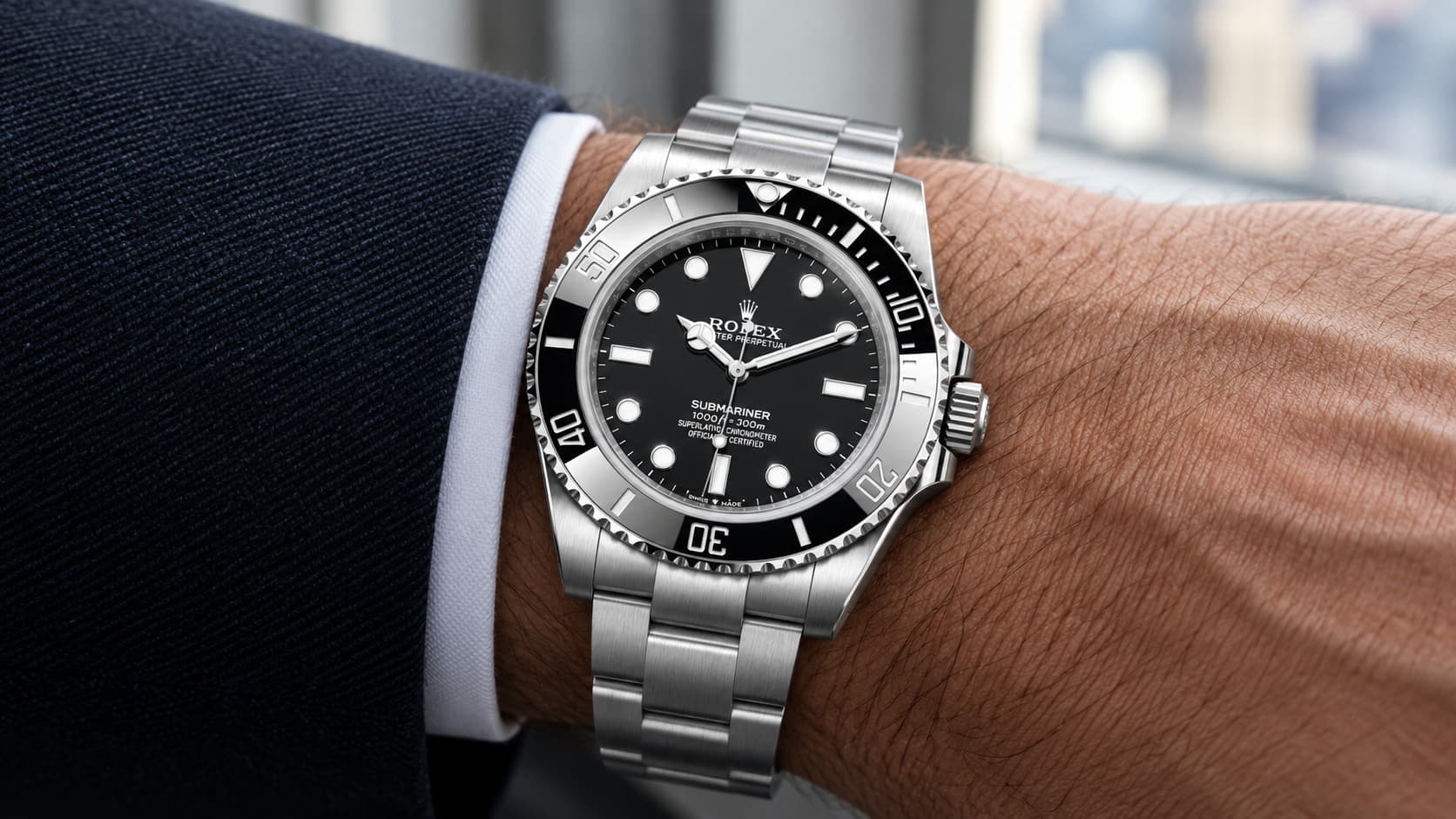
Wilsdorf founded the company in London in 1905, originally as a watch importer called Wilsdorf and Davis, and registered the name “Rolex” in 1908 because it was short and easy to say in any language. The brand moved to Geneva after World War One and built its reputation on tough, functional tool watches rather than delicate dress pieces. In 1926 it launched the Oyster, the first truly waterproof wristwatch case, and in 1953 the Submariner became the watch that professional divers actually trusted underwater.
One Rolex has a story almost as famous as the watch itself. In the 1960s, Rolex released an unusual “exotic” dial for its Daytona chronograph, and it sold so poorly that dealers struggled to move it. Actor and race car driver Paul Newman started wearing one anyway, a gift from his wife Joanne Woodward engraved “Drive Carefully Me” on the back, and decades later collectors nicknamed the design after him. In 2017, that exact watch sold at auction for $17.75 million, turning a once-unpopular dial into one of the most desired vintage watches in the world.
Rolex is privately owned by the Hans Wilsdorf Foundation rather than a public company or luxury conglomerate, which lets it control supply tightly and protect its resale value better than almost any other brand. It now makes over a million watches a year, an enormous number for a heritage watchmaker, yet its steel sports models still sell out instantly and often resell for more than their original price. That mix of huge scale and constant demand is something none of the other historic Swiss houses have managed to pull off.
6. Jaeger-LeCoultre
Jaeger-LeCoultre earns its nickname, “the watchmaker’s watchmaker,” because so many other luxury brands have historically bought movements or parts from its workshops. Few consumers know the name as well as Rolex, but almost every serious collector rates it among the finest technical houses alive.
Antoine LeCoultre founded his workshop in 1833 in Le Sentier, another small town in the Vallée de Joux, after inventing a precision measuring tool called the Millionomètre, capable of measuring a distance as small as one-thousandth of a millimeter. His company merged with Parisian watchmaker Edmond Jaeger in 1937, creating the combined name still used today. The brand’s most famous creation, the Reverso, was born in 1931 after polo players in India reportedly complained that regular watch glass kept shattering during matches, so Jaeger-LeCoultre built a case that flips over on its own axis to protect the dial.
The brand’s obsession with tiny, precise engineering reached an extreme with the Calibre 101, a movement so small it can fit inside a piece of jewelry, and it remains one of the smallest mechanical watch movements ever mass-produced. Jaeger-LeCoultre also makes the Atmos clock, a mechanism that has run since 1928 using nothing but tiny changes in room temperature to wind itself, meaning it almost never needs to be touched. The brand has produced more than 1,200 different watch movements over its history, an enormous number that reflects just how much engineering happens behind its relatively quiet public image.
7. Blancpain
Blancpain holds a simple, unbeatable record: it is the oldest watch brand still operating anywhere in the world. Jehan-Jacques Blancpain began making watches in 1735 in Villeret, Switzerland, working out of an upstairs room in his own house, four decades before Breguet even opened his Paris workshop.
The Blancpain family ran the business for generations, and in 1815 Jehan-Jacques’s great-grandson modernized production and introduced a more accurate cylinder escapement mechanism. Blancpain nearly disappeared entirely during the 1970s “quartz crisis,” when cheap battery-powered watches from Japan almost wiped out traditional Swiss mechanical watchmaking, but new owners revived it in 1983 with a bold promise: Blancpain would never make a single quartz watch. It has kept that promise ever since.
Blancpain’s most famous watch is the Fifty Fathoms, launched in 1953 as one of the first true dive watches, built after French military divers asked for a tool that could survive real underwater combat missions. In 1991, the brand marked its own history a different way, naming a highly complicated wristwatch simply “1735,” after the year it was founded, and packing it with a tourbillon, minute repeater, perpetual calendar, and moon phase in one case.
The Swatch Group has owned Blancpain since 1992, and the brand still leans heavily into its “innovation is our tradition” motto, a nod to the fact that being the oldest name in the room does not mean standing still.
8. A. Lange & Söhne
A. Lange & Söhne makes Germany’s case for a seat at the luxury watch table, and it does so with a level of hand-finishing that rivals anything coming out of Switzerland. Every movement is assembled twice: once to check that all the parts fit perfectly, then taken completely apart, decorated by hand, and reassembled a second time.
Ferdinand Adolph Lange founded the company in the small town of Glashütte, Germany, in 1845, turning it from a farming village into the center of German watchmaking almost single-handedly. The business thrived for a century under his descendants until Soviet forces seized the factory after World War Two, and the Lange family fled, leaving the brand dormant for over 40 years. When the Berlin Wall fell in 1989, Ferdinand’s great-grandson Walter Lange returned to Glashütte and relaunched the company almost exactly 145 years after it began.
Lange’s watches are instantly recognizable by their outsized date display, a large, easy-to-read date window that the brand patented shortly after its 1990s relaunch and still uses on flagship models like the Lange 1. Richemont acquired A. Lange & Söhne in 2000, giving the small German house the resources to keep building watches almost entirely by hand in the same town where it started. Its comeback story, from Cold War seizure to modern powerhouse, is one of the most remarkable in all of watchmaking.
9. Omega
Omega earns its place through sheer reach, since few brands have touched as many major moments in history while still building genuinely respected mechanical watches. Louis Brandt founded the company in 1848 in La Chaux-de-Fonds, Switzerland, originally assembling pocket watches from parts made by local specialists before the business grew into a full manufacturer under his sons.
Omega has served as the official timekeeper of the Olympic Games since 1932, timing the world’s biggest sporting event for nearly a century. Its most famous watch, the Speedmaster, earned its legendary status after NASA tested several chronograph brands for spaceflight and chose it as the only one to pass; Buzz Aldrin wore a Speedmaster Professional on the Moon during the Apollo 11 landing in 1969, making it the first watch ever worn there. Omega also holds a real technical milestone: in 1999, it became the first brand to industrialize the co-axial escapement, an entirely new way of reducing friction inside a watch movement invented by British watchmaker George Daniels, something the industry had not seen in 250 years.
The Swatch Group has owned Omega since the 1980s, and today it produces watches at a much larger scale than most heritage watchmakers, while still designing and manufacturing its own movements in-house. Between the Moon landing, the Olympics, and its own escapement breakthrough, Omega’s fingerprints are on more defining moments in modern history than almost any other watch brand.
10. Cartier
Cartier earns its place among the greats because it did not just make luxury watches, it helped invent the entire idea of the modern wristwatch as an everyday object rather than a piece of jewelry only women wore. Louis-François Cartier founded the house in Paris in 1847 as a jewelry workshop, and it built its early reputation making jeweled pocket watches and ornate brooch watches for European royalty.
The turning point came in 1904, when Louis Cartier’s friend, Brazilian aviation pioneer Alberto Santos-Dumont, complained that fumbling with a pocket watch mid-flight was dangerous and impractical. Cartier’s answer was the Santos, a flat wristwatch with exposed screws and a leather strap, widely considered one of the first purpose-built men’s wristwatches and the first true pilot’s watch. Cartier followed that success in 1917 with the Tank, a rectangular watch inspired by the aerial view of a World War One battle tank, which remains one of the most recognizable watch silhouettes ever created.
Cartier expanded into New York and London in the early 20th century and earned royal warrants from monarchies across Europe, cementing its reputation as, in King Edward VII’s own words, “the jeweler of kings and the king of jewelers.” Richemont has held full control of Cartier since the 1990s, and the brand today remains one of the very few houses equally famous for fine jewelry and for genuinely important watch design, a combination almost no other watchmaker can claim.
Honorable Mentions
A few more brands carry real weight in watchmaking, even if their history or industry impact doesn’t run quite as deep.
- Richard Mille (founded 2001) — Built an enormous modern impact using aerospace-grade materials and athlete partnerships like tennis champion Rafael Nadal, but with only 25 years of history, it can’t yet match the depth of houses that have operated for centuries.
- Piaget (founded 1874) — Holds genuine world records for ultra-thin movements, but its impact has stayed more of a technical specialty than an industry-shaping moment.
- IWC Schaffhausen (founded 1868) — A regular on more mainstream “best watch brand” lists, thanks to a strong pilot’s watch heritage and solid in-house engineering.
- TAG Heuer (founded 1860) — Known for motorsport chronographs and relatively accessible pricing within the luxury tier, with a loyal following built on more than 160 years of racing heritage.
Frequently Asked Questions
What makes a watch brand “luxury” instead of just expensive?
A luxury watch brand combines a long history, hand-finishing by skilled craftspeople, and technical achievements that are hard to copy, not just a high price tag. Many expensive watches are simply covered in diamonds or made from rare materials, but true luxury houses back that up with decades or centuries of genuine watchmaking innovation.
Which luxury watch brand is considered the best overall?
Patek Philippe is usually named the top luxury watch brand because of its independence, its continuous string of technical firsts, and the record prices its watches reach at auction. That said, “best” often comes down to personal taste, since Rolex leads in worldwide recognition and Audemars Piguet or Vacheron Constantin can rival Patek Philippe in pure craftsmanship.
Are Rolex and Omega actually considered luxury, or just popular?
Rolex and Omega are both genuinely luxury brands, not just popular ones, because each builds its own movements, controls its own manufacturing, and has more than a century of real technical innovation behind it. Their enormous popularity sometimes makes people assume they are less exclusive than smaller brands, but their craftsmanship and in-house engineering meet every standard of true luxury watchmaking.
Why are some luxury watches so much more expensive than others?
Price differences usually come down to how complicated the watch’s movement is, how much of it is finished by hand, and how rare the brand’s yearly production is. A simple hand-wound watch from an independent brand can cost far less than a heavily complicated automatic watch, even if both come from equally respected houses.
Do luxury watch brands still make watches by hand today?
Yes, most heritage luxury watch brands still rely heavily on hand-finishing, even though some machining is done with modern computer-controlled tools. Houses like A. Lange & Söhne assemble every movement twice by hand, first to test it and then again after hand-decorating the parts, which is part of why their production numbers stay so small each year.
The Bottom Line
These ten brands did not earn their reputations through marketing alone. Each one built something the rest of the industry had to react to, whether that was Patek Philippe’s crown-winding system, Audemars Piguet’s steel sports watch, Breguet’s tourbillon, Omega’s Moon landing, or Cartier’s invention of the everyday wristwatch. What ties them together is a refusal to cut corners, even when cutting corners would have made the watches cheaper and easier to produce. Luxury in watchmaking has never been about price alone. It has always been about how much genuine skill and history sit inside that small case on someone’s wrist.