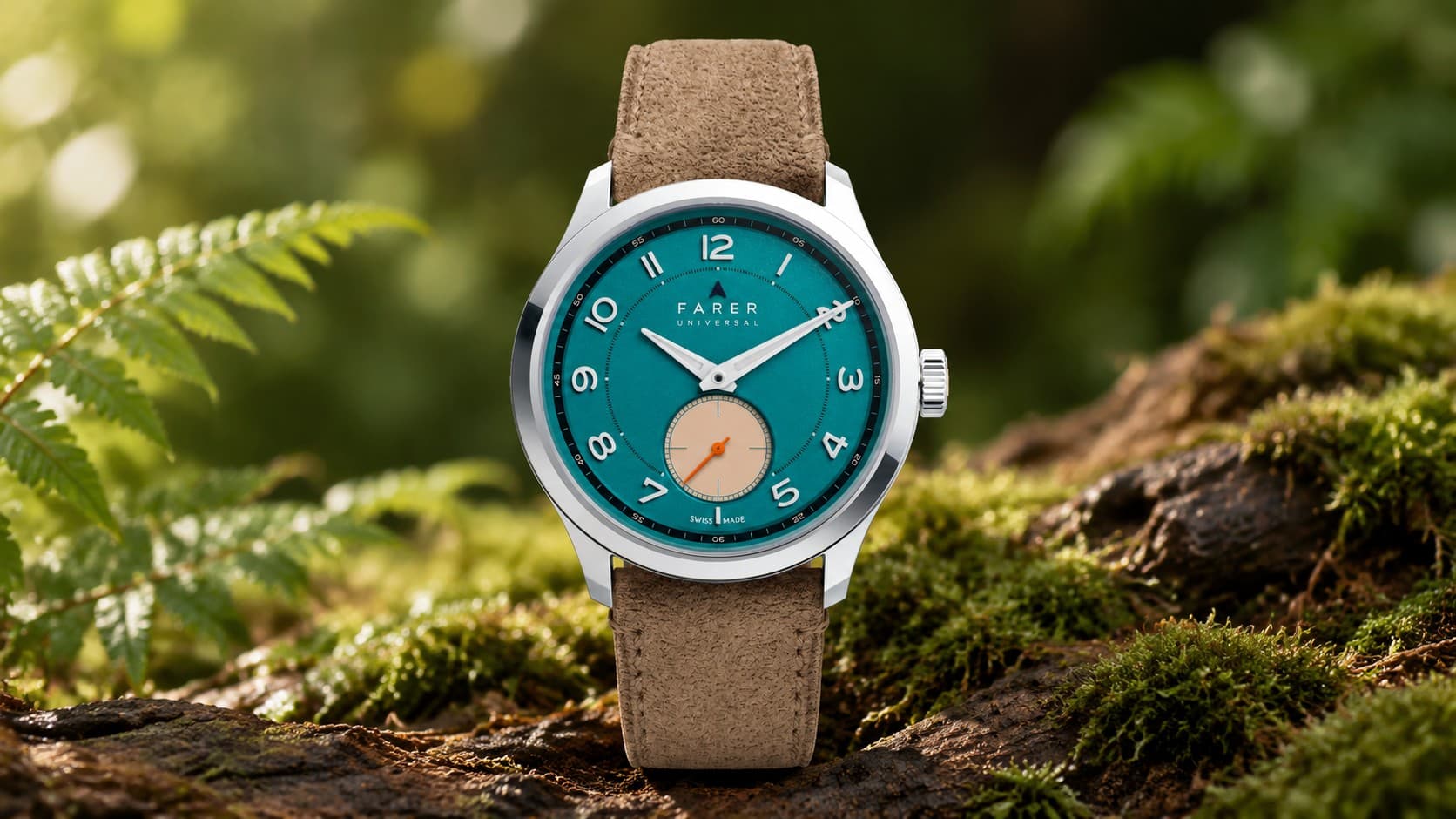
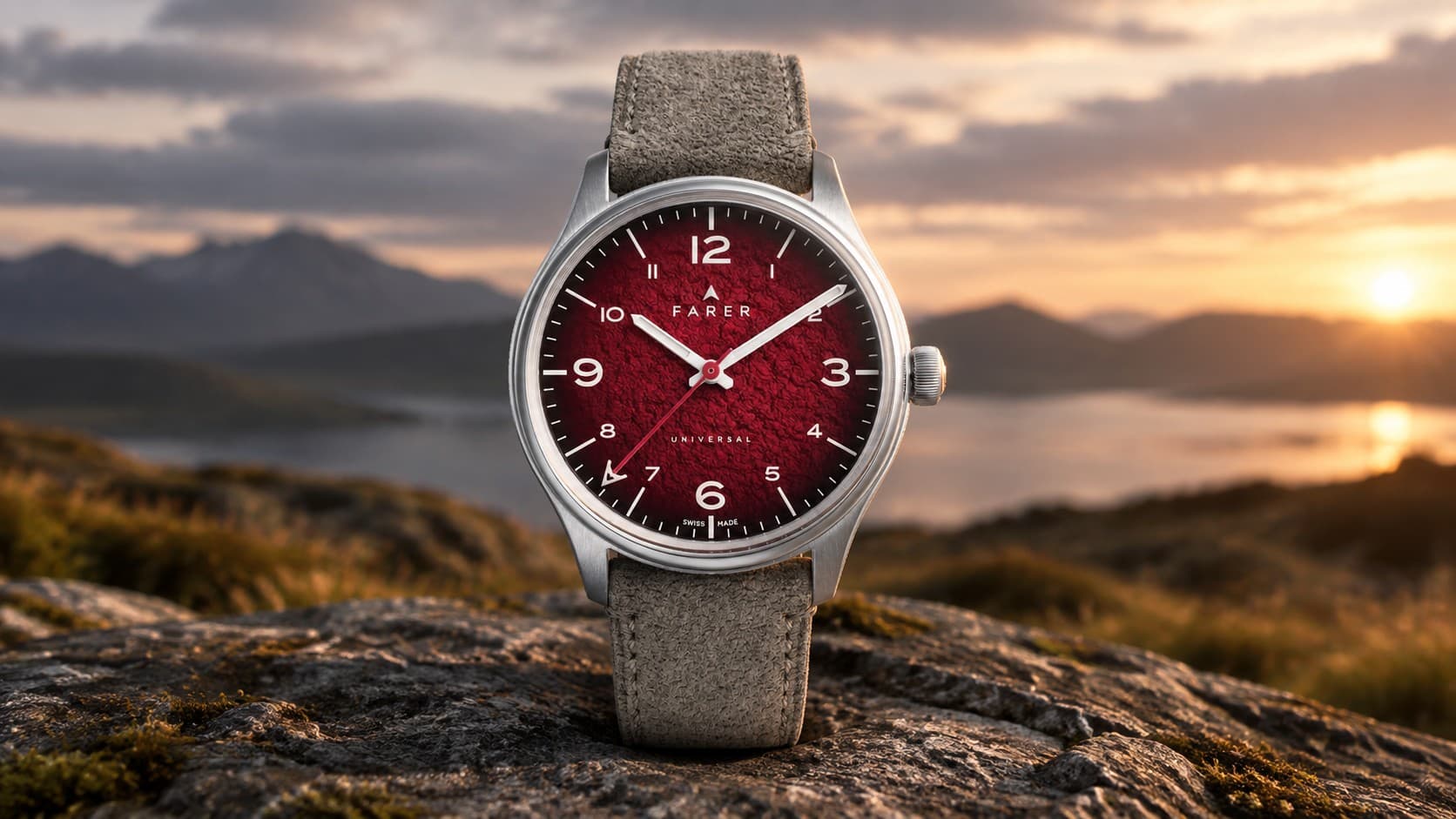
Most watches at the $1,000 to $2,000 price point look like they were designed by committee. Safe dials. Conservative colors. Nothing that would risk putting anyone off. Farer went the other way. Since launching in 2015, this small British brand has built a loyal following by doing something most watch brands at this price are too cautious to attempt: making watches that look genuinely different, without cutting corners on what is inside the case. Sea green dials that shift color under different light. Bold Arabic numerals. Bronze crown caps that patinate with wear. Swiss automatic movements backed by a five-year guarantee that most established brands do not match. The result is a brand that gets talked about in serious watch publications including Hodinkee and Fratello, recommended on watch forums, and worn by people who have also owned Omega, Oris, and Christopher Ward and kept coming back. Here is everything worth knowing before buying one.
A Brief History of Farer Watches
Farer started in 2015, founded in London by four people: Stuart Finlayson, Jono Holt, Ben Lewin, and Paul Sweetenham. Three of them ran a branding and marketing agency together. Sweetenham brought something different to the table: he had spent years working as a watch buyer in the duty-free travel retail sector before building a long career in retail. Between them, they had both the design ability and the commercial knowledge to actually build a watch brand from scratch.
The problem they wanted to solve was simple. Affordable vintage-inspired watches were hard to find. Most brands in that price range were either boring or cheaply made. Farer was their answer to that gap.
How Farer Got Its Name
The word “Farer” comes from Old English, tied to words like seafarer and wayfarer. It means traveler, or someone on a journey. That was intentional. The brand built its entire identity around the idea of adventure and exploration, right from day one.
How It Started
Farer’s first product line consisted of nine quartz watches. These early pieces drew attention for their use of bold colors and vintage-inspired styling at a time when most watches in the same price bracket played it very safe.
In September 2016, the brand added three automatic watches to its range, naming them after British Royal Navy ships used by British explorers. Their automatic watches’ winding crowns were uniquely made of pure bronze, which patinates with age and wear. That detail alone made watch enthusiasts take notice. Bronze crowns that change appearance over time are something you usually only see on much more expensive watches.
How the Range Grew Over Time
Things moved quickly after that first automatic range landed well. The brand released a range of GMT and diving watches in 2017, then a range of 37mm hand-wound cushion-cased watches in 2018. In 2019, they released two land speed record themed quartz watches, named after Ainsdale and Pendine Sands, and later that year released a range of chronograph watches.
Each new category they entered came with its own design angle rather than just repackaging what already existed. GMTs, divers, chronographs, dress watches: Farer approached each one with a specific visual identity.
Why Every Farer Watch Has a Story Behind Its Name
One of the things that sets Farer apart is how seriously they take the naming of their watches. Models are named after famous explorers, historic British Royal Navy vessels, remote geographic locations, and land speed record venues. It is not just branding for the sake of it. The names connect back to real history, and that gives the watches a story beyond just how they look.
Where Farer Stands Today
Farer is a relatively modest business that makes less than $5 million a year, yet it has managed to carve out a space for itself in the competitive watchmaking market. It operates out of Ascot, Berkshire, and remains fully independent with no conglomerate ownership behind it. That independence lets them take creative risks that a bigger, shareholder-driven brand simply would not.
Among watch collectors and enthusiasts online, Farer is consistently brought up as one of the best British micro-brands working today. Not because of marketing spend, but because the watches themselves keep delivering on what the brand promises.
What Sets Farer Apart From the Competition
There are thousands of watch brands in the world. Most of them make perfectly fine watches that look more or less like every other perfectly fine watch on the market. Farer is one of the few brands at their price point that actually looks different, and does so without cutting corners on the things that matter mechanically.
The Dial Colors
This is the most obvious thing anyone notices about a Farer watch. While most brands default to black, white, or silver dials, Farer has built its entire reputation around bold dial colors. Deep teals, burnt orange accents, mustard yellows, sea greens, coral tones. These are not accidental choices. Each color combination is thought through carefully, and getting them right is apparently harder than it sounds.
When Farer wanted to produce a purple lacquer dial, their Swiss suppliers told them to give up and just use clear lacquer over a purple base instead. Farer refused. That kind of stubbornness about design detail is rare, especially from a brand that is not charging Rolex prices.
The Movements Inside
Every Farer watch is designed in Britain and then built in Switzerland. Farer uses Swiss-made mechanical movements from manufacturers such as La Joux-Perret and Sellita. Both are well-respected movement suppliers used by many reputable Swiss watch brands.
Farer favors ETA and Sellita calibers, known for their reliability and precision. For example, the Farer Roché II uses a Sellita SW330-1 Elaboré automatic movement with a power reserve of approximately 50 hours. The Aqua Compressor dive watch line uses the La Joux-Perret G101. These are not budget movements thrown in to keep costs down. They are the same movements you find in watches costing significantly more.
Build Quality at the Price Point
Farer uses sapphire crystals across their range, which is scratch-resistant and a step above the mineral glass found on many watches at similar prices. Cases are made from 316L marine-grade stainless steel on most models, with titanium used on the Aqua Compressor dive collection because of its light weight and corrosion resistance. Components like sapphire crystals and Italian leather straps add to both the look and durability of the finished watch.
The attention to finishing is also notable. Brushed lugs against a polished case, custom rotors visible through exhibition casebacks, hand-stitched straps with color-matched edge painting. These are details you typically see on watches at a higher price bracket.
What Farer Tells You About Their Watches
Farer will openly tell you not just who makes their movements, but also who makes their cases, dials, straps, hands, and lume. In an industry where brands are often secretive about their supply chain, that level of openness is genuinely rare.
For buyers who want to know exactly what they are paying for, this matters. You are not left guessing whether the movement is a cheap anonymous caliber or a respected Swiss-made one.
The 5-Year Movement Guarantee
Farer offers a 60-month, five-year movement guarantee on all their watch movements. If anything goes wrong, they will repair or replace it. They also offer a 30-day no-questions-asked return or exchange policy.
A five-year warranty from an independent brand is a strong commitment. It tells you the brand is confident enough in what they are selling to back it up for longer than most competitors.
Limited Production Runs
Farer regularly produces limited edition models and colorways. Once they are gone, they are gone. This keeps the brand from becoming too common, which watch collectors tend to appreciate. It also means that certain discontinued models pick up interest on the secondary market from people who missed them the first time around.
Named After Real People and Places
Every Farer model is named after something with a real story behind it. Explorers, Royal Navy ships, geographic locations, land speed record venues. Watch names include figures like George Mallory and Amy Johnson, as well as vessels like HMS Beagle. It gives each watch a context beyond just its looks, which is something a lot of buyers genuinely connect with.
Top 10 Best Farer Watches
Farer has over a dozen active collections right now, covering everything from simple three-hand automatics to world timers and dive watches. The ten picks below cover the best across different styles, complications, and budgets, so whether you are buying your first Farer or adding to a collection, there is something here worth considering.
1. Farer Lander IV GMT — Best Overall
The Lander is the watch most people think of when Farer comes up in conversation, and it earns that reputation. It comes in two sizes, 36mm and 39.5mm, which gives it an unusually wide appeal for a GMT watch. Most GMTs at this price point go 40mm and above, so the compact sizing is a genuine differentiator, especially for daily wear where a bulkier watch quickly becomes tiring on the wrist.
The Lander IV runs on a Sellita SW330-2 GMT movement regulated in five positions, beating at 4Hz, with a 56-hour power reserve. The sea green sunray dial with a burnt orange seconds hand and red GMT hand is one of the most distinctive color combinations at this price. A screw-down monobloc case construction, bronze crown cap, and 100m water resistance round out a package that works just as well for weekend adventures as it does for crossing time zones on a flight. If you only ever buy one Farer, this is probably the one.
Case: 36mm or 39.5mm, 316L stainless steel
Water Resistance: 100m
Movement: Sellita SW330-2 Elaboré
Power Reserve: 56 hours
Price: $1,575 USD / £1,375
2. Farer Aqua Compressor Endeavour — Best Dive Watch
The Aqua Compressor is Farer’s most technically ambitious watch. It revives the super compressor case principle from vintage dive watches of the 1950s, where water pressure building on the outside of the case naturally compresses the internal gaskets, making the seal tighter the deeper you go. Modern materials make this far more reliable than it was in the originals.
The current 2025 series uses the La Joux-Perret G101 movement with a 68-hour power reserve, visible through a sapphire exhibition caseback. The titanium case keeps the total weight down to 62 grams at 41mm across, which is genuinely light for a capable dive watch. Both crowns are screw-down and double-gasketed, and the internal rotating bezel is controlled by the lower crown for timing dives. Farer donates a portion of profits from every Aqua Compressor sold to the Hebridean Whale and Dolphin Trust, and has raised over £63,500 toward a £75,000 conservation target. For anyone who actually spends time in the water and wants a watch with real depth ratings and character to match, the Endeavour is the pick.
Case: 41mm, Grade 2 titanium
Water Resistance: 300m
Movement: La Joux-Perret G101
Power Reserve: 68 hours
Price: $1,295 USD / £1,175
3. Farer Roché II World Timer — Best Complication
A world timer that shows the time in 24 cities simultaneously is normally found on watches costing five figures or more. Farer has been consistently praised for making one of the best affordable world timers available, with the Roché cited as the standout model across multiple watch publications.
The Roché II uses a Sellita SW330-1 Elaboré movement with approximately 50 hours of power reserve. The glossy midnight blue dial features a Clous de Paris guilloché texture with applied Super-LumiNova markers, and the bidirectional rotating bezel operated from the crown at 10 o’clock displays 24 international time zones. For 2024, Farer updated the city list on the bezel, replacing a few entries and adding Bienne, the Swiss town where the watches are actually built. If you travel regularly across time zones and want something you can actually read without pulling out your phone, the Roché II is a genuinely practical watch at a price no established Swiss brand comes close to matching for this complication.
Case: 39mm, 316L stainless steel
Water Resistance: 100m
Movement: Sellita SW330-1 Elaboré
Power Reserve: ~50 hours
Price: $1,775 USD / £1,525
4. Farer Cobb Monopusher GMT — Best Chronograph
The Cobb combines two complications that rarely appear together at this price: a monopusher chronograph and a GMT function. The cushion-shaped 41mm stainless steel case is 14.5mm thick but only 44mm lug-to-lug due to the compact cushion shape, so it wears significantly smaller than the numbers suggest. Inside is a hand-wound Sellita SW530 in elaboré grade, and the watch is rated to 100m water resistance.
The Cobb gets an ice-blue sunburst dial with cream-tone accents, small seconds at nine o’clock, and a chronograph counter at twelve. Its companion model the Segrave uses a black grained dial with higher contrast colors including an orange GMT hand and green running seconds. For watch fans who want a chronograph with genuine complication depth and a dial that does not look like everything else on the market, there is nothing else at this price that competes directly.
Case: 41mm, stainless steel
Water Resistance: 100m
Movement: Sellita SW530 Elaboré (hand-wound)
Power Reserve: Not publicly specified
Price: $2,195 USD
5. Farer Field Watch II — Best Value
The Field Watch II collection, updated in late 2024, is the most affordable entry point into Farer’s lineup and one of the easiest recommendations for someone who wants a great everyday watch without any complications or extra bulk. Three dial options are available: the sand-toned Pembroke II, navy blue Lomond II, and green Exmoor II.
All three run on the Sellita SW221-1 with 26 jewels, a 28,800 VPH beat rate, and a 41-hour power reserve, including a pointer date function. The 38mm brushed stainless steel case has a sapphire crystal with three anti-reflective coatings, a screw-down crown with bronze insert, and 150m water resistance, which is higher than most non-dive watches at this price. Each watch has an individually numbered solid caseback. At $1,250, it is the most straightforward way to get into Farer without overthinking it.
Case: 38mm, brushed stainless steel
Water Resistance: 150m
Movement: Sellita SW221-1
Power Reserve: 41 hours
Price: $1,250 USD / £1,095
6. Farer Halley Moonphase — Best Dressed-Up Farer
The Moonphase collection launched in 2023 and brought one of watchmaking’s most poetic complications into Farer’s world of bold color and compact cushion cases. The Halley is the midnight blue variant, featuring a hand-painted moonphase disc with a yellow Super-LumiNova moon that glows in the dark. The disc itself is painted by hand in Geneva, Switzerland.
The movement is a Sellita SW288-1 Ma in elaboré grade, hand-wound, with 18 jewels, 28,800 VPH, and 45 hours of power reserve. The cushion case measures 38.5mm in diameter and just 10.5mm thick, sitting at 43.8mm lug-to-lug, which makes it genuinely slim and comfortable for extended wear. The decorated movement bridge features Farer’s arrow pattern with blued screws, visible through the sapphire exhibition caseback. The Halley is currently sold out on Farer’s website but turns up regularly on the secondary market for those who want one.
Case: 38.5mm cushion, stainless steel
Water Resistance: 50m
Movement: Sellita SW288-1 Ma Elaboré (hand-wound)
Power Reserve: 45 hours
Price: Around $1,895 USD / £1,695 (currently sold out)
7. Farer Integra — Best Sports Watch on a Bracelet
The Integra, released in 2025, is Farer’s first integrated bracelet sports watch and represents a different side of the brand entirely. Where most Farer watches lean into vintage adventure styling, the Integra is clean, modern, and built for the city as much as the outdoors.
The stainless steel case measures 38.5mm in diameter and 10.3mm tall with a 42mm lug-to-lug. The integrated bracelet tapers from 24mm at the case down to 16mm at the clasp, with a hidden butterfly clasp that includes a micro-adjustment system of up to 6mm for comfort. Each watch also ships with a rubber strap. Inside is a Top Grade Sellita SW300-1, adjusted in five positions for accuracy, running at 28,800 VPH with a 56-hour power reserve, featuring a custom fully circular rotor vapor-coated to match the dial color. Four dials are available: Tenebris in dark blue, Cuprum in salmon, Viridis with a malachite stone dial, and Perlarum with mother of pearl. For someone who wants a watch that works equally well with a suit or a t-shirt, the Integra fills that gap better than anything else Farer makes.
Case: 38.5mm, stainless steel
Water Resistance: 100m
Movement: Sellita SW300-1 Top Grade
Power Reserve: 56 hours
Price: $1,650–$1,765 USD / £1,450–£1,550
8. Farer Thorne Gold World Timer — Best Statement Piece
The Thorne Gold takes the World Timer complication and gives it a warm, formal look that sits well above its price point visually. The entire 39mm stainless steel case, including both crowns, is finished in yellow gold PVD and paired with a burgundy guilloché dial. PVD coating is significantly more durable than standard gold plating, which means the finish holds up far better with daily wear.
The dial uses Lumicast markers, solid blocks of ceramic blended with Super-LumiNova, keeping it legible in low light despite the dressed-up aesthetic. The world timer complication uses a rotating 24-hour disc combined with the city bezel to show any time zone at a glance. The plain steel Thorne is priced at $1,715 while the Thorne Gold commands a slight premium at $1,790. For anyone who has wanted a gold-toned watch that actually does something interesting on the dial without spending real gold money, the Thorne Gold is a hard one to argue with.
Case: 39mm, stainless steel with yellow gold PVD
Water Resistance: 100m
Movement: Sellita SW331-2 Elaboré
Power Reserve: ~50 hours
Price: $1,790 USD
9. Farer Lander Kano GMT — Best for Smaller Wrists
The Lander Kano shares the same mechanical foundation as the Lander IV but comes exclusively in the 36mm case and with a pink sunray dial paired with a blue GMT hand. It is a bolder, more playful take on the Lander formula and the obvious choice for wrists where the 39.5mm version would feel oversized.
The 36mm case with a 41.2mm lug-to-lug makes the Kano one of the most compact GMTs available at this price, without sacrificing any of the core specs. The same Sellita SW330-2 movement, 100m water resistance, screw-down crown, and bronze crown cap all carry over from the standard Lander IV. Named after Mary Kano, the watch follows Farer’s tradition of connecting model names to real historical figures with genuine stories behind them.
Case: 36mm, 316L stainless steel
Water Resistance: 100m
Movement: Sellita SW330-2 Elaboré
Power Reserve: 56 hours
Price: $1,575 USD
10. Farer Aqua Compressor Hecla Hunter Green
The Hecla Hunter Green is the most visually striking watch in the 2025 Aqua Compressor lineup. Where the Endeavour uses a black dial and the Ocean Blue goes for an icy tone, the Hecla goes deep green in a way that looks equally good on a rubber strap or a metal bracelet.
All three 2025 Aqua Compressor models share the same Grade 2 titanium cushion case at 41mm across, 12.5mm thick, and 45mm lug-to-lug, with the same 68-hour La Joux-Perret G101 movement and 300m water resistance via the super compressor gasket system. The only meaningful difference between the Hecla and the Endeavour is the dial color and lume treatment. If you want the full Aqua Compressor experience with the most interesting dial in the range, the Hecla is the one to go for.
Case: 41mm, Grade 2 titanium
Water Resistance: 300m
Movement: La Joux-Perret G101
Power Reserve: 68 hours
Price: $1,295 USD / £1,175
How to Choose Your First Farer Watch
Farer has over 13 active collections and hundreds of models when you count every colorway and dial variation. For a first-time buyer, that can feel overwhelming. These are the things that actually matter when narrowing down your choice.
Case Size
Farer covers a wider size range than most people realize. Their current lineup runs from 35mm cushion-cased models all the way up to 41mm on the Aqua Compressor dive watches. The most popular sizes sit in the 36mm to 39.5mm range.
A good starting point is measuring the distance from your wrist bone to the other side. A wrist under 17cm typically wears a 36mm to 38mm case most comfortably. Between 17cm and 19cm, 38mm to 40mm usually works well. Above 19cm, the 39.5mm to 41mm models will sit proportionally on the wrist.
The Lander IV in particular comes in both 36mm and 39.5mm versions of the same watch, so you can pick the exact size for your wrist without changing any other spec. Not many brands at this price point offer the same model in two case sizes, which makes Farer more accessible for buyers on either end of the sizing spectrum.
Which Complication Do You Need?
This is the biggest decision because it affects both the price and how you actually use the watch day to day. A complication is any function beyond simply showing the hours and minutes, and Farer offers more variety here than most brands at the same price point. Getting this choice right matters because a complication you never use just adds cost, while the right one becomes something you genuinely interact with every day.
- Three-hand automatic (hours, minutes, seconds): The simplest and most versatile option. Models like the Field Watch II and the Lissom collection sit in this category. Best for someone who wants a clean, reliable daily watch.
- GMT: Tracks a second time zone via an additional hand. The Lander IV is the flagship here. Practical for anyone who travels or works across time zones regularly.
- World Timer: Displays all 24 time zones simultaneously via a rotating bezel and internal disc. The Roché II is the pick here. More complex to read than a GMT at first, but genuinely useful for frequent international travellers.
- Chronograph: A stopwatch function built into the watch. The Cobb Monopusher GMT combines this with a second time zone. More of a collector piece than a practical daily tool for most people.
- Moonphase: Tracks the lunar cycle on the dial. The Farer Moonphase is the dressier option in the lineup. More decorative than functional for most buyers.
If you are buying your first Farer, a GMT or three-hand automatic is almost always the right starting point. Both are easy to live with daily, straightforward to operate, and represent the strongest part of Farer’s lineup in terms of design and value. The more complex complications like the World Timer and Chronograph are worth considering once you already know the brand suits you and you want to go deeper into the collection.
Dial Color
This is where Farer is genuinely unlike most other brands, and it is the thing that trips up new buyers the most. The color combinations in Farer’s range look bold in photos and even bolder in person. Sea green dials with burnt orange hands. Midnight blue with barleycorn guilloché. Textured sand with red pointer date numbers.
The safest approach is to look at the dial color alongside the strap it ships with and ask whether that combination matches what you already wear. Farer does a good job pairing their dials with complementary strap colors, so if the default combination works for your wardrobe, you are in good shape.
All Farer straps use quick-release spring bars, meaning you can swap from the default leather to a rubber or bracelet option without any tools, in seconds. This makes it easy to buy the watch you want and change the look later without sending it anywhere.
Strap Options
Farer sells their own range of straps including St. Venere leather in multiple colors, perforated rubber straps, and oyster-style stainless steel and titanium bracelets. The steel bracelet for 36mm models uses screwed links with half-links for precise sizing and a concealed butterfly clasp.
If you are buying the Aqua Compressor, rubber or a titanium bracelet makes the most practical sense given the dive watch use case. For the Lander GMT or Roché World Timer, the leather strap ships as standard and works well, but many owners switch to the steel bracelet for a sportier daily look.
Warranty
Farer offers a five-year movement guarantee on every watch they sell. If anything goes wrong with the movement during that period, they will repair or replace it. They also offer a 30-day return or exchange window, no questions asked, if you are not fully satisfied with your purchase.
A five-year warranty from an independent brand is genuinely generous. Most Swiss watch brands at this price point offer two years, and some offer as little as one. The fact that Farer backs their movements for five years tells you something about how confident they are in what they are putting inside the watches. It also means that if you are on the fence about spending over $1,000 on a watch from a brand you have not bought from before, the 30-day return policy removes most of the risk. You can wear it, try it in your daily life, and send it back for a full refund if it is not what you expected.
New or Pre-Owned?
Buying new from Farer directly gives you the full five-year movement guarantee and the 30-day return window. That is worth something, particularly on a first purchase when you are not yet sure if the watch is for you.
Buying pre-owned can get you discontinued models that are no longer available from Farer directly, which is worth considering if a particular sold-out colorway caught your eye. Prices on the secondary market for Farer are generally reasonable, with most models sitting at 60 to 80 percent of their original retail price in good condition depending on the model and what it comes with.
Farer also runs an Archive and Showroom section on their own website where discontinued models occasionally appear at reduced prices. It is always worth checking there before looking elsewhere, since you still get some level of assurance buying directly from the brand even on older stock.
Budget
Farer’s current range starts at around $975 and goes up to $2,195 for the Cobb Monopusher GMT. Most of the core collection sits between $1,165 and $1,775. The sweet spot for first-time buyers is the $1,165 to $1,575 range, where you get the most choice across the GMT, field watch, and three-hand collections.
There is no significant jump in build quality between the entry-level and mid-range models. The price difference mostly reflects the complexity of the complication and whether the watch uses a higher-grade movement variant. Either end of the range gets you the same sapphire crystal, the same stainless steel case quality, and the same five-year warranty.
Limited Edition or Core Collection?
Farer regularly releases limited edition models, some limited to as few as 20 or 50 pieces. These tend to sell out quickly, and discontinued colorways and editions do appear on the secondary market, sometimes above their original retail price depending on demand. If you are drawn to a limited edition, waiting is usually a mistake. Core collection models are the safer bet if you want time to research before committing, since they are available consistently and easier to compare against each other before making a decision.
Where to Buy a Farer Watch
Farer is primarily a direct-to-consumer brand, which means buying from them directly is almost always the right first choice. That said, there are a few other legitimate ways to get your hands on one, and it is worth knowing what each option actually gives you before deciding.
Buying Direct from Farer
The main place to buy is farer.com, which operates separate storefronts for the UK, US, and Europe so you can shop in your local currency. Farer offers free global shipping and free 30-day returns on all watch orders worldwide.
Buying direct means you get the full five-year movement guarantee, access to every in-stock model and colorway, and the option to add complimentary engraving at checkout. Farer does not run sales, discounts, or promotions on their watches. Their stated reason is that they believe in offering the best possible price from the start, rather than inflating prices and then discounting them later. That is worth knowing if you find yourself waiting for a sale that will never come.
If you are based in the US and want to spread the cost, Farer offers interest-free installment payments over 12 months for purchases over $450 through Klarna, selected at checkout.
One important point for international buyers: all orders ship from the UK, meaning import duties or local taxes may apply depending on where you live. These are not refundable if you return the watch, so it is worth checking with your local customs office before ordering if you are unsure what charges might apply in your country.
Visiting the Farer Showroom
If you want to try a watch on before buying, Farer has a physical solution for that. They run an appointment-only showroom located between Ascot and Bracknell in Berkshire, England. During your appointment you can view the entire range, try on any watch you are considering, and buy directly to take home with you on the same day.
The showroom is roughly 15 minutes from Junction 10 of the M4 motorway by car, with secure off-road parking on site. For those coming by public transport, the nearest train stations are Bracknell and Maidenhead, both around a 10 to 15 minute taxi or rideshare ride away. The exact address is only shared once you book an appointment, for security reasons. Appointments can be booked directly through the Farer website.
This is a genuinely useful option if you are spending over £1,000 on a watch from a brand you have not handled before. Seeing the dial colors and feeling the weight in person makes a big difference with Farer watches specifically, because photos rarely capture how the dials look under different lighting.
Authorized Retailers
Farer has a small network of hand-picked authorized retailers that stock their watches, listed on their website’s Retailers page. The network is intentionally limited. Farer has kept their retail partnerships selective so they can maintain control over how the brand is presented and priced. You will not find Farer in a large chain watch retailer.
The advantage of an authorized retailer is that you can sometimes handle the watch in person before buying, and any purchase still comes with the full Farer warranty since these retailers are approved by the brand.
Farer’s Archive Section
Farer occasionally lists discontinued and ex-showroom watches on a dedicated section of their own website at reduced prices. Stock here is limited and tends to move quickly, but it is the safest way to buy an older model since you are still buying directly from Farer, and the purchase comes with whatever remaining warranty applies to that specific piece.
Buying Pre-Owned
Buying pre-owned is worth considering if you are after a discontinued colorway or model that is no longer available anywhere new. Farer watches do appear on the secondary market regularly, and pricing is generally reasonable compared to what the watches originally sold for.
The most important thing when buying pre-owned is to check that the watch comes with its original box, papers, and warranty card, and to confirm how much of the five-year guarantee remains. A pre-owned Farer bought without documentation loses most of the warranty protection, which matters given how much of the brand’s value proposition is tied to that five-year coverage.
Also worth noting: if a watch has been engraved, it cannot be returned to Farer since engraved watches have no resale value. This is relevant when buying pre-owned too, since an engraved watch may be harder to resell later if your circumstances change.
Are Farer Watches Worth Buying as an Investment?

This is one of the most common questions people ask before buying any watch at this price point, and it deserves an honest answer rather than a vague one. The short version is: buy a Farer because you want to wear it, not because you expect to make money from it. Here is what the data actually shows.
What Farer Watches Actually Sell for Pre-Owned
Secondary market tracking across completed sales shows Farer watches averaging around $1,301 on the pre-owned market, compared to an average retail price of roughly $1,615 across all 80 tracked models. That puts most Farer watches at approximately 19 percent below their original retail price when sold pre-owned.
That 19 percent drop is not unique to Farer. It is actually typical for brands that sell primarily direct-to-consumer, where buyers can purchase new at a fair price anytime they want. There is no artificial scarcity driving secondary market premiums the way there is with Rolex or Patek Philippe, because Farer does not limit supply to the same extreme degree and does not rely on a dealer network with waitlists. The result is a sensible, stable secondary market rather than a volatile one.
Is Farer a Good Investment?
No, not in the financial sense. Farer is not in the same category as watches that are bought specifically to flip for profit. The brand has only been operating since 2015, which means its long-term collector value is still unproven. A watch brand typically needs decades of history and a strong secondary market track record before it becomes something people buy purely to hold as an asset.
That said, Farer holds its value reasonably well compared to other micro-brands and independent watch companies at a similar price point. Selling a Farer in good condition with its original box and papers for 80 percent of what you paid for it is a realistic outcome. Selling one in poor condition without documentation for 50 percent is also realistic. The condition and completeness of the set matters a lot, just as it does with any other watch brand.
How Limited Editions Hold Their Value
Farer’s limited edition models are the exception worth knowing about. Some editions limited to 50 pieces or fewer have appeared on the secondary market at or above their original retail prices after selling out. The Charlton Atlantic GMT, limited to 50 pieces, was listed on the secondary market above its original retail price. The Foxe World Timer, which sold out as a limited run, has also appeared pre-owned above retail.
These are not guaranteed outcomes for every limited edition. The key factors that drive secondary market interest in any Farer limited edition are the same as for any watch: how few were made, how distinctive the dial is, and whether the community wanted it more than the production run could satisfy. Farer’s most color-forward and most sought-after limited editions tend to be the ones that hold up best after selling out.
Farer vs. Other Microbrands on Resale
Among independent British micro-brands, Farer holds its value better than most. The brand has a genuinely loyal collector community, consistent new releases that keep the brand relevant, and a ten-year track record of delivering on quality. Watches from brands that have since ceased operating or significantly changed direction tend to fade in secondary market interest quickly. Farer’s consistent output and growing reputation work in favor of its older models holding reasonable value.
That said, comparing Farer to established Swiss brands on resale value is not really the right comparison. Farer sits in a different category entirely, and the buyers shopping Farer are typically not the same people shopping a pre-owned Rolex. The competition for Farer’s resale value is other micro-brands and independent watchmakers at similar price points, where Farer generally comes out looking favorable.
What Affects Your Farer’s Resale Value
If you are thinking about resale value at all before buying, these are the factors that actually move the needle:
- Complete set matters a lot. Box, papers, warranty card, and any additional straps or bracelet that came with the watch. A Farer sold without documentation takes a bigger hit on price than the same watch sold with everything included.
- Condition is everything. Farer cases include highly polished sections that show scratches clearly. A well-kept watch with minimal case wear sells for meaningfully more than one that has been knocked around.
- Limited editions outperform core collection models. If resale is a consideration, limited production watches have historically shown stronger secondary market interest than core collection equivalents.
- Popular models over niche ones. The Lander GMT and Roché World Timer are the most recognized Farer models among enthusiasts. Watches from those families tend to sell more easily and at better prices than less-known models from the same brand.
- US buyers should factor in tariffs. As of April 2025, US buyers importing directly from the UK face an estimated combined duty of around 17 percent on top of the retail price. This does not affect resale value directly, but it does change the true cost of entry for US-based buyers, which is worth factoring into any value calculation.
How to Keep Your Farer Watch Running Well
A Farer watch is a precision mechanical device with dozens of moving parts inside. It does not need constant attention, but it does need the right kind of attention at the right times. Follow the guidance below and your watch should last decades without any serious issues.
How Often to Get It Serviced
Farer recommends having your watch professionally serviced every 4 years. The main reason for this interval is lubrication. The oils used inside a mechanical movement to reduce friction between gears, jewels, and other components do not last forever. Over time they dry out, thicken, or break down, and once that happens the movement parts start grinding against each other with more friction than they were designed to handle. Left long enough, this causes accelerated wear that can be expensive to put right.
The four-year interval applies even if you do not wear the watch that often. Less wear does not mean the lubricants last longer. The oils degrade on their own timeline regardless of how much the watch is being used.
Skipping services does not just risk damaging the movement. Farer’s own warranty documentation notes that your coverage may be negatively affected if the watch is not serviced at the suggested intervals. In other words, if something goes wrong with a movement that was overdue for a service, the five-year guarantee may not cover it.
Signs Your Watch Needs Attention Early
You should not wait for the four-year interval if you notice any of the following:
- Unusual sounds coming from the movement, such as rattling or grinding
- Significant changes in how much resistance you feel when winding the crown
- The watch is losing or gaining noticeably more time per day than it used to
- Moisture, condensation, or fogging visible under the crystal
- The crown feels stiff, loose, or catches when you try to use it
Any of these signs means the watch needs to go in for inspection sooner rather than later. A movement problem caught early is almost always cheaper to fix than one left to develop further.
Where to Get It Serviced
The safest option during the warranty period is to send the watch back to Farer directly using their Servicing and Repairs contact form on farer.com. Farer will inspect the watch, advise you of any costs for work not covered under warranty, and return it serviced to their standards.
One critical point: having your watch serviced or repaired by anyone other than Farer or their approved repair partners will void your warranty. If your watch is still within its five-year movement guarantee period, going to a local watchmaker instead of Farer is not worth the risk unless the watch is out of warranty.
For buyers based in Australia and New Zealand, Farer handles repairs through a regional partner, which speeds up turnaround significantly compared to shipping to the UK.
Once the warranty has expired, a watchmaker experienced with Sellita or La Joux-Perret movements is a perfectly suitable alternative for routine servicing, since those are the movement families used across the Farer range.
How to Clean Your Farer Watch
Farer’s official care guidance is straightforward:
For the case, rubber strap, or steel bracelet: Wipe the front and back of the watch using a clean, slightly damp cloth. Dry it off and polish with a soft microfibre cloth. Do not use any chemical cleaners, solvents, or abrasive cloths on the case.
For leather straps: Clean regularly with a leather care balm formulated specifically for watch straps. Keep leather away from water as much as possible. Body oils and sweat degrade natural leather over time, which is why Farer notes that leather straps are not covered under the guarantee beyond manufacturing defects. They are a wear item.
For the bronze crown cap: The bronze cap found on many Farer models will naturally patinate over time as it is exposed to air, moisture, and skin contact. This is intentional and expected. Farer designed it this way. Do not try to clean or polish it back to a bright finish as this removes the patina that gives the crown its character.
What to Avoid
There are specific things that cause the most damage to mechanical watches, and most of them are easy to avoid once you know what they are:
Magnets. Magnetic fields are one of the most common causes of a mechanical watch running fast. Modern life puts watches near magnetic sources regularly: phone speakers, laptop closures, bag clasps, and even some desktop accessories. If your watch suddenly starts running several minutes fast per day, magnetisation is the most likely cause. A watchmaker can demagnetise the movement quickly and inexpensively. Magnetisation from normal use is not covered under Farer’s warranty, so it is worth being aware of where you leave the watch.
Shocks and drops. The movement inside a Farer watch is a finely adjusted instrument. A hard knock or drop can knock the movement out of regulation and in worse cases damage components directly. Farer’s warranty explicitly excludes damage caused by accidental shocks or drops, so there is no coverage if you drop the watch on a hard surface.
Heat and direct sunlight. Prolonged exposure to direct sunlight or high heat can affect both the movement lubricants and the dial colors over time. Farer recommends avoiding excessive heat exposure as part of their standard care guidance.
Adjusting the date between 8pm and 2am. This applies to any watch with a mechanical date function. During that six-hour window, the date-change mechanism is already engaging internally. Forcing a manual date change during this period can strip the gears. Farer explicitly excludes this from their warranty. Set the date either earlier in the day or well after 2am to be safe.
Overwinding a manual watch. Farer’s manual-wind models need to be wound by hand each day. You will feel resistance build as the mainspring reaches full tension. Once you cannot turn the crown any further, stop immediately. Continuing to force it risks snapping the mainspring. Automatic models self-wind through wrist movement and do not have this risk during normal wear, though Farer still advises against manually winding an automatic once it is already fully wound.
How to Store Your Farer Watch
If you are not wearing the watch for an extended period, store it in its original blue presentation box or a watch roll away from direct sunlight, heat sources, and strong magnetic fields. Automatic watches that are stored for long periods will run down and stop, which is completely normal. They just need to be wound or worn again to restart. Manual watches stored for long periods should be wound before putting them back on.
If you own multiple watches and rotate between them, an automatic watch that sits unworn for more than a couple of days will likely stop, since it relies on wrist movement to stay wound. A watch winder is an option if you want the watch to stay running between wears, though it is not a requirement and Farer does not specify one as necessary.
Strap Care and How Long Straps Last
Steel and titanium bracelets will last indefinitely with basic cleaning. Rubber straps are durable and can handle water exposure without issue, but should be rinsed with clean water after saltwater exposure to prevent corrosion on the metal hardware.
Leather straps have a finite lifespan. How long they last depends on how often you wear them, how much your wrist sweats, and whether you ever get them wet. A leather strap worn every day in warm weather might need replacing after a year or two. One worn occasionally in cooler conditions could last five years or more. The quick-release spring bar system Farer uses on all their watches means swapping straps takes seconds and requires no tools, so replacing a worn leather strap is simple and inexpensive.
Common Questions About Farer Watches
Buying a watch from a brand you have not owned before raises a lot of questions, and Farer is no exception. Here are honest answers to the ones that come up most often.
Are Farer Watches Worth the Money?
Yes. Swiss movements, sapphire crystal, a five-year warranty, and genuinely distinctive design at under $2,200 is a strong package. The caveat is that the bold colors and adventure-explorer identity are not for everyone. If the aesthetic clicks, the value is real. If it does not, no amount of good specs will make the watch right for you.
How Do You Pronounce Farer?
FAIR-er, rhyming with “bearer” or “fairer.” It comes from Old English and simply means one who travels.
Where Are Farer Watches Made?
Designed in Britain, built by hand in Switzerland. The design work happens at their base in Ascot, Berkshire. Manufacturing and assembly take place in Switzerland, which is why the watches carry the legally protected Swiss Made label.
What Movements Do Farer Watches Use?
Mostly Sellita calibers across the range, including the SW330-2 in GMT models, the SW330-1 in the World Timer, and the SW221-1 in the Field Watch. The La Joux-Perret G101 goes into the Aqua Compressor dive collection. Both are respected Swiss movement suppliers whose calibers appear in watches costing significantly more than Farer charges.
How Accurate Are Farer Watches?
Elaboré-grade Sellita movements, which Farer uses in several models, typically achieve minus 4 to plus 6 seconds per day. The SW300-1 in the Integra achieves minus 4 to plus 4 seconds per day. Most owners report their watch running within a few seconds per day, which is completely normal for a mechanical watch. If the watch suddenly starts gaining several minutes a day, check for magnetisation before assuming a service is needed.
How Does Farer Compare to Similar Brands?
All three offer Swiss movements, sapphire crystals, and solid build quality at accessible prices. The main difference is design direction. Farer is significantly bolder in color and more adventurous in dial design than either of those brands. Christopher Ward leans toward restrained British design. Oris carries more decades of brand heritage. If bold design matters to you, Farer stands out. If something more conservative is the goal, the others may suit better.
Can You Try a Farer Watch Before Buying?
Yes, two ways. Farer has an appointment-only showroom near Ascot, Berkshire, where any in-stock watch can be tried on and purchased to take home. For buyers outside the UK, the 30-day free returns policy works as an effective trial period since the watch can be worn, assessed, and returned for a full refund if it is not right. Engraved watches are the only exception and cannot be returned.
Is the Farer Warranty Transferable?
Yes. When a Farer is sold or gifted, the remaining warranty carries over to the new owner, provided they can show the original purchase documents and warranty card. A pre-owned Farer bought with its full paperwork still has whatever time is left on the original guarantee.
Do Farer Watches Get Magnetised?
Mechanical watches in general are vulnerable to everyday magnetic sources: phone speakers, laptop closures, bag clasps. Farer’s movements are not specifically anti-magnetic beyond what Sellita and La Joux-Perret offer as standard. If the watch starts running noticeably fast after being near a magnetic source, a watchmaker can demagnetise it quickly and cheaply. Magnetisation is excluded from Farer’s warranty, so it is worth being mindful of where the watch is stored.
Can You Engrave a Farer Watch?
Yes. Farer offers complimentary engraving at the time of purchase. The key detail is that engraved watches cannot be returned or exchanged, so it is a permanent decision. Engraved models also have no resale value according to Farer’s own policy, which is worth factoring in if there is any chance the watch might be sold later.
Does Farer Ever Have Sales or Discounts?
No. Farer has a firm policy of never discounting their watches, stating that prices are set at the best possible value from the outset. The Archive and Showroom section on their website occasionally lists discontinued models at reduced prices, but that is the only exception.
What Happens if Your Farer Watch Needs a Repair?
Contact Farer directly through the Servicing and Repairs form on farer.com. They will assess the issue, confirm what is and is not covered, and arrange safe return of the watch. If the fault falls under the five-year movement guarantee, there is no charge. Having the watch repaired by anyone other than Farer or an approved partner during the warranty period voids coverage, so always go through Farer first.
36mm vs 39.5mm Lander IV: What Is the Difference?
Only the case size. Both versions share the same dial design, movement, water resistance, and price. The 36mm measures 41.2mm lug-to-lug and is better suited to wrists under 17cm. The 39.5mm suits larger wrists or anyone who prefers a stronger presence on the wrist. When in doubt, the 36mm is the more versatile choice.
Conclusion
Farer has built something genuinely rare in a crowded market: a watch brand with a clear point of view that does not compromise on the things that actually matter inside the case. Starting from a gap in the market for affordable vintage-inspired watches back in 2015, the brand has grown into one of the most talked-about independent watchmakers in Britain, covering everything from entry-level field watches to world timers and dive watches with genuine mechanical substance. The colors get the attention, but the Swiss movements, sapphire crystals, titanium cases, and five-year warranty are what make the purchase defensible beyond aesthetics.
The best Farer for most people is whichever one they will actually want to put on every morning. For first-time buyers that is almost always the Lander IV GMT or the Field Watch II, both of which deliver the core Farer experience at the most accessible price points in the current lineup. Those who want more complication should look at the Roché II World Timer, which remains one of the best arguments for what an independent brand can do at under $2,000. And for anyone drawn to a serious tool watch, the Aqua Compressor earns its place among the most interesting dive watches at this price, mechanically and visually.
Whether or not Farer becomes a long-term name in watchmaking the way established Swiss brands are is still an open question. What is not in question is that right now, in 2025, they are making watches that punch well above their price, designed by people who clearly care about the details, backed by policies that protect the buyer, and distinct enough to stand out on any wrist. For someone who wants something genuinely different from the usual safe choices at this price point, Farer is one of the first places worth looking.