Nivada Grenchen is one of those brands that quietly did something extraordinary decades ago, disappeared for a while, and then came back to remind everyone why it mattered. Founded in 1926 in the small Swiss watchmaking town of Grenchen, the company built tough, honest tool watches for pilots, divers, and explorers long before “vintage-inspired” was a marketing term. Today, after a 2018 relaunch, its reissued models have become some of the most talked-about affordable Swiss watches around, and understanding which ones stand out can help anyone curious about the brand make sense of a lineup that spans polar expeditions, deep-sea diving, and classic 1960s and 1970s chronographs.
What Is Nivada Grenchen Known For?
Nivada Grenchen is known for faithfully reissuing its own historic tool watches, especially the Antarctic, Depthmaster, and Chronomaster. The brand built its name between the 1950s and 1970s making rugged, functional watches for people who actually needed them, not just people who wanted to look adventurous.
That reputation was not built on luxury or status. The company was founded in Grenchen, Switzerland, by Otto Wüllimann, Hermann Schindler, and Jakob Schneider, originally operating under the name Wüllimann, Schneider, Nivada SA. From the start, the founders focused on watches that solved real problems: keeping time reliably underwater, in freezing cold, or while timing a race. Nivada also moved into automatic watchmaking earlier than most of its peers, building its early reputation on models like the Aquamatic and Sea Blade made for seafarers, and later adding other tool-watch designs such as the Rollamatic and the water-resistant Reglavit.
Like most Swiss watchmakers, Nivada Grenchen was hit hard by the quartz crisis of the 1970s, when cheap, accurate quartz watches from Japan crushed demand for mechanical Swiss watches. The brand was forced out of the Western market by the late 1970s and changed ownership more than once, with the rights eventually passing to a Mexican group and the Nivada name separately continuing in South Korea under a local watch manufacturer through the 1980s and beyond. The Swiss side of the brand lay dormant for decades until 2018, when two French watch-industry entrepreneurs, Guillaume Laidet and Rémi Chabrat, revived it. Since then, the modern Nivada Grenchen has focused almost entirely on rebuilding its old catalog rather than inventing brand new designs from scratch, and that approach, amplified heavily through social media, is exactly what has won it such a loyal following among collectors who want real history on their wrist without a huge price tag.
The Antarctic: The Watch That Went to the South Pole
The Antarctic is Nivada Grenchen’s most historically significant model because an original version actually traveled to Antarctica with the US Navy in the 1950s. It started life as a rugged, waterproof, automatic watch built for explorers, and today’s reissue keeps that same simple, reliable spirit.
The story behind this watch is genuinely remarkable. Admiral Richard Byrd’s US Navy crew carried the watch to the South Pole in 1955 and 1956, when Nivada supplied it for Operation Deep Freeze I, one of the first major expeditions to establish a permanent American research presence in Antarctica. The model was built on the foundation of the Aquamatic, an earlier automatic and waterproof design, and the Antarctic series itself launched in the mid-1950s. Nivada leaned into the expedition story in its own advertising soon after, with an early Antarctic campaign produced by Doyle Dane Bernbach, a well-known New York advertising agency, framing the watch as a survivor of extreme conditions rather than just an accessory. Surviving a real polar expedition gave the watch instant credibility, and it became one of the earliest examples of a “proven in the field” marketing story in the watch industry.
The modern reissue, sold as the Super Antarctic, updates the original with a slightly larger case and better technology while keeping the vintage look intact. The current Super Antarctic line was released in 2021, with a larger 38mm case, automatic movement, and improved water resistance compared to the older, more historically accurate 35mm models, which rely on a hand-wound Landeron 21 movement and stay closer to the original size. The Super Antarctic instead runs on the Swiss Soprod P024 automatic movement with roughly a 38-hour power reserve, and it comes housed in a stainless steel case with a double-domed sapphire crystal, a screw-down crown, and around 100 meters of water resistance. A gold medallion on the caseback, showing scenes from the original expedition, ties the modern watch directly back to its polar history, and buyers can choose between cream, white, or green lume tones along with leather, rubber, or “beads of rice” bracelet options.
The Antarctic proves that a good story and a solid design can outlast an entire company’s disappearance from the market.
The Depthmaster: A 1,000-Meter Dive Watch for Under $1,000
The Depthmaster is Nivada Grenchen’s dedicated dive watch, and its main claim to fame is a water resistance rating that was record-breaking when it first launched. It is best known today for its nickname, “Pac-Man,” thanks to a distinctive dial design.
When it first appeared, this watch was genuinely ahead of its time. The Depthmaster launched in 1965 as the first dive watch sold commercially with a 1,000-meter depth rating, at a moment when most competing dive watches topped out around 100 to 200 meters. That figure held up as the deepest rating on a production dive watch for roughly thirteen years, a record that only fell in 1978 when Rolex pushed its Sea-Dweller reference 16660 past it to 1,220 meters. The achievement built on earlier work from the brand, including the Depthomatic, a 1964 diving watch that reached a more modest 200 meters but introduced a novelty of its own: a built-in capillary depth gauge that let divers read their depth directly off the dial. The “Pac-Man” nickname came later still, since the arcade game did not exist yet in 1965. Collectors coined it unofficially because of the watch’s jagged yellow hour markers, and once Nivada Grenchen relaunched the model, the brand adopted the nickname itself, spelling it as a single word to steer clear of any trademark issue with the video game’s maker, Namco.
The modern Depthmaster keeps that same underwater ambition. Every current Depthmaster uses the Soprod P024 automatic movement, running at a steady 28,800 beats per hour with a 38-hour power reserve. It still carries that famous 1,000 meters of water resistance, and a helium escape valve positioned near 9 o’clock lets trapped gas vent safely during decompression, a feature more commonly found on gear built for serious saturation diving. Most versions use a 39mm cushion-shaped stainless steel case around 13mm thick, along with a unidirectional rotating bezel and a twelve-sided screw-down caseback, and the range includes both the original “Pac-Man” dial and a bolder “Art Deco” dial with oversized numerals. Its combination of extreme water resistance and a price point often under $1,000 is still seen as one of the best value propositions in the dive watch world.
The Chronomaster: Nivada’s Most Iconic Chronograph
The Chronomaster Aviator Sea Diver is widely regarded as Nivada Grenchen’s most iconic model because it was designed to do almost everything at once: time a race, navigate a flight, and survive a swim. It combines a chronograph, tachymeter, and water resistance into one busy but charming dial.
This ambition was baked into the watch from day one. Developed from an earlier Nivada design known internally as the “Super Chronograph,” the Chronomaster Aviator Sea Diver reached the market in the early 1960s with nothing else quite like it available at the time. It packed a stopwatch function, a tachymeter scale for calculating speed, a yacht-racing countdown timer, and a way to track a second time zone at once, appealing to the kind of buyer who might be flying a plane one day and racing a car or diving the next. It also carried 200 meters of water resistance, making it a genuine multi-purpose instrument rather than a single-focus tool watch, and Nivada’s distribution reportedly reached more than 80 countries by the 1960s, an unusually wide footprint for a Swiss watchmaker of its size at the time.
Today’s reissue stays remarkably close to that original design. The modern Chronomaster keeps the peripheral tachymeter scale, bidirectional bezels with double graduations, and the wide broad arrow hands from the 1960s version, and it is offered in a genuinely wide range of dial colors and configurations. It comes with either a manual-wind or automatic movement, both built on the Sellita SW510 platform. The manual version runs 27 jewels at a 4Hz beat rate and stores roughly two days of power on a full wind, while the automatic version, built on a substantially reworked movement descended from the well-known Valjoux 7750 family, beats at the same 28,800 vibrations per hour but stretches its reserve out to around 62 hours. The case stays close to the original as well, at roughly 38mm wide with a lug-to-lug distance near 46.5mm, which feels compact by modern chronograph standards but keeps the vintage proportions intact. Some early relaunch buyers even received a copy of a book titled “Chronomaster Only,” underlining how much the brand leaned on this single model to reintroduce itself to the world.
Other Notable Nivada Grenchen Collections
Beyond its three most famous families, Nivada Grenchen also produces two collections built almost entirely around forgotten or never-released 1970s designs, and both have become fan favorites in their own right.
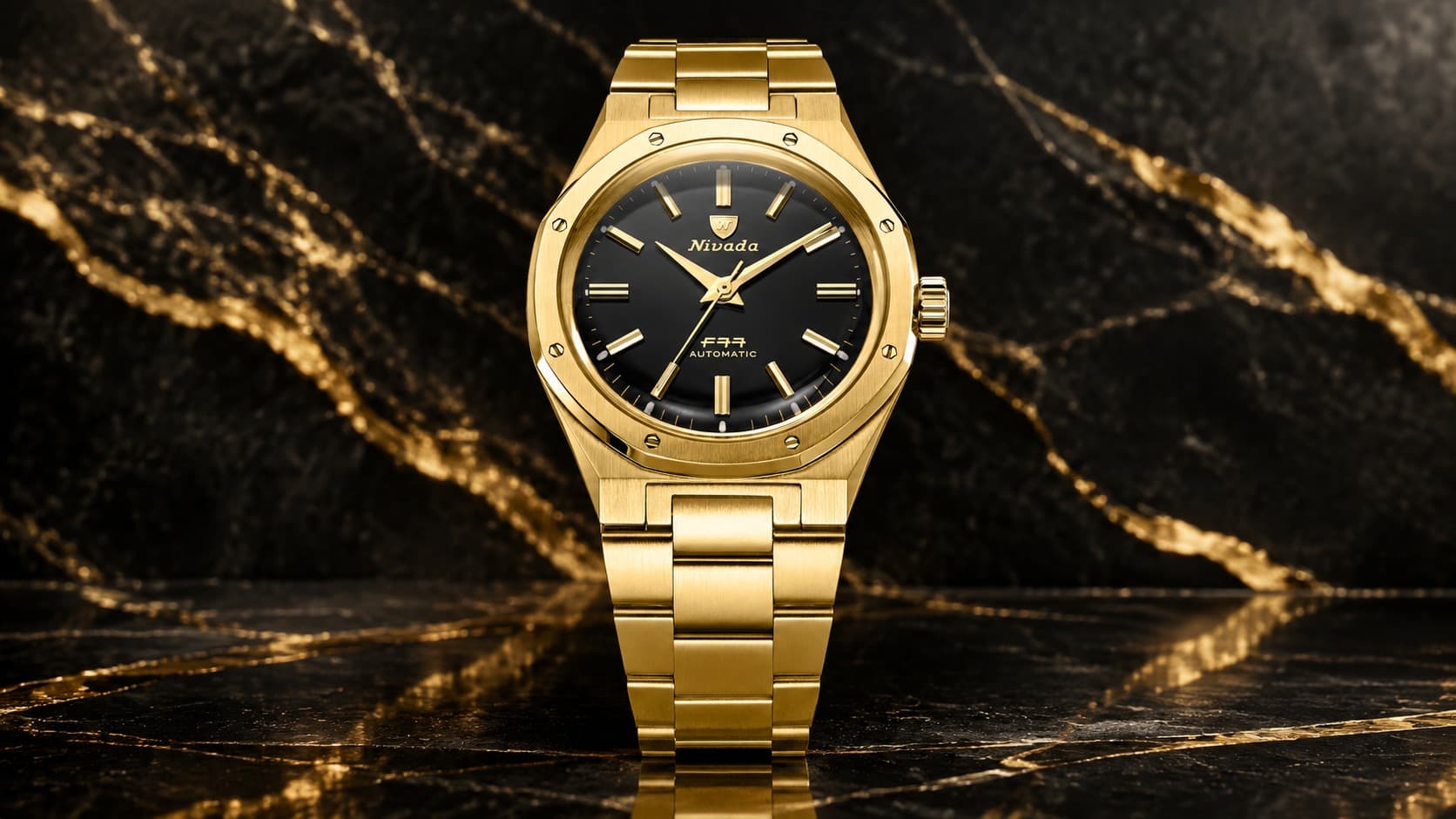
The F77 is a reissue of a real 1977 sports watch with an integrated steel bracelet, in the same design tradition as the Audemars Piguet Royal Oak, but built around a rounded octagonal case and a distinctive basket-weave dial rather than a sharp-edged one. According to the brand, founder Guillaume Laidet came across an original F77 while scrolling through social media and decided almost immediately that it deserved to come back. It launched in 2023 at $1,150, considerably below most integrated-bracelet sports watches on the market, and runs on the same Soprod P024 automatic movement used in the Antarctic and Depthmaster. A second-generation F77 MKII arrived in 2025 with a slightly larger 38mm case and gold-plated options, and the line has since grown further with stone dial variants introduced in lapis lazuli, meteorite, and aventurine.
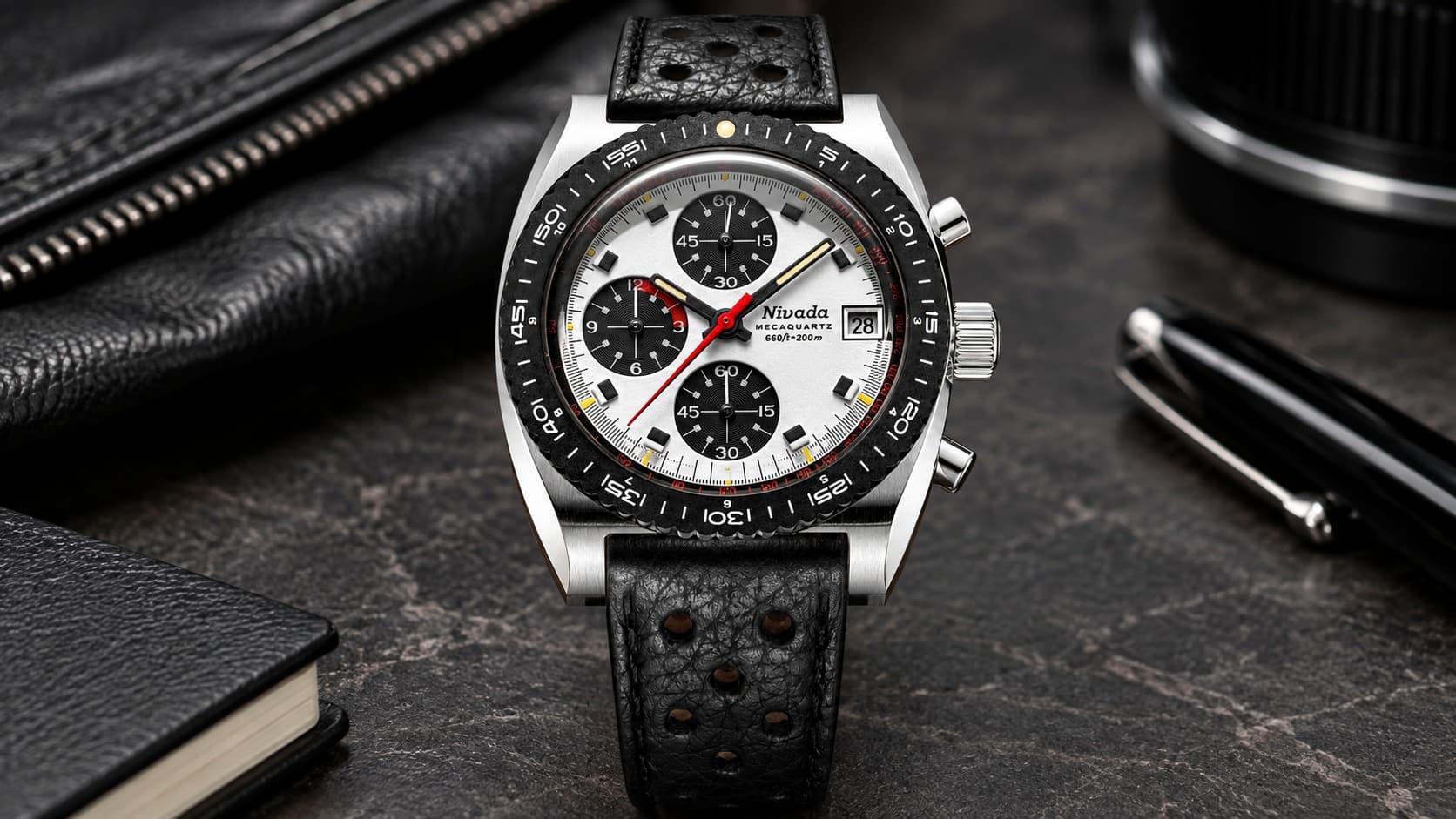
The Autochron tells an even stranger story. It is based on a chronograph prototype developed in the late 1970s that Nivada never actually put into production, with fewer than 20 original examples believed to exist. The design combined a racing-style chronograph dial, a rotating bezel, a date window, and dive-watch levels of water resistance in one unusually experimental package. Nivada Grenchen revived it in 2024 with a mechanical Valjoux 7750 movement, then followed up in 2025 with a more affordable meca-quartz version powered by a Seiko VK67 movement, which combines quartz accuracy with a mechanical-style chronograph reset. A later “Panda” dial version, created in collaboration with a Puerto Rico-based collector group called the Santurce Watch Club, drew direct comparisons to Paul Newman’s famous Rolex Daytona because of its matching black-and-white color scheme, even though the case and dial layout remain distinctly Nivada’s own. Alongside these two, the Chronomaster family also includes the motorsport-flavored Chronoking, giving the brand a fairly complete range of chronograph styles built entirely from its own archives.
Which Nivada Grenchen Watch Fits Which Buyer
The right Nivada Grenchen watch depends less on budget and more on which story and use case matters most, since the five collections cover fairly different needs.
- Most historically faithful piece: the 35mm Antarctic, with its manually wound Landeron 21 movement, sits closest to the original 1950s design and suits buyers who value authenticity over modern conveniences like a bigger case or longer power reserve.
- Best value for daily wear: the Super Antarctic offers the same polar-expedition story with an automatic movement, sapphire crystal, and a size that works on most wrists, making it the easiest starting point for a first Nivada Grenchen watch.
- Serious dive watch: the Depthmaster stands out thanks to its 1,000-meter water resistance and helium escape valve, and it remains one of the strongest value propositions in the dive watch category at large.
- Most complete, do-it-all tool watch: the Chronomaster Aviator Sea Diver combines a chronograph, tachymeter, and water resistance in one design, and its wide range of dial options makes it easy to match to personal taste.
- Dressier sports look: the F77 suits buyers drawn to 1970s integrated-bracelet watches but unwilling to pay Royal Oak-level prices.
- Collector’s conversation piece: the Autochron, built from a chronograph that never even reached production, appeals most to buyers who already know the brand and want something with a stranger, more obscure backstory than the brand’s core lineup.
Is Nivada Grenchen Better Than Other Affordable Brands?
Nivada Grenchen stands out from other affordable Swiss microbrands mainly because it is reviving its own genuine history rather than borrowing design cues from bigger names. This gives its watches a documented backstory that many competitors simply cannot match.
| Feature | Nivada Grenchen | Typical Microbrand |
|---|---|---|
| Design origin | Reissues of its own 1920s-1970s archive | Often inspired by other brands’ designs |
| Founded | 1926, relaunched 2018 | Usually founded in the last 10-15 years |
| Signature model | Antarctic (Operation Deep Freeze) | Varies, often without documented history |
| Typical price range | Roughly $530 to $2,500 | Similar range, quality varies widely |
| Movement suppliers | Soprod, Sellita, and Seiko meca-quartz | Often Miyota, Seiko, or Sellita |
The comparison simplifies things, but the main takeaway holds up: buying a Nivada Grenchen watch means buying into a documented piece of watchmaking history, not just a modern design that borrows a vintage look.
Frequently Asked Questions
Is Nivada Grenchen a good brand?
Yes, Nivada Grenchen has built a strong reputation for faithfully reissuing its historic tool watches with modern, reliable Swiss movements. Because it uses proven movements from suppliers like Soprod and Sellita, and because its designs are backed by real documented history rather than borrowed inspiration, it is generally well regarded among collectors who want genuine vintage character without the maintenance problems that come with owning an actual vintage watch.
What movements does Nivada Grenchen use?
Most current Nivada Grenchen watches use either the Soprod P024 automatic movement or a Sellita movement, depending on the model. The Soprod P024 runs at 28,800 beats per hour with about a 38-hour power reserve and appears in the Antarctic, Depthmaster, and F77 lines, while the Chronomaster and Autochron use Sellita or Valjoux-based chronograph movements, with a lower-cost Seiko VK67 meca-quartz option available on some Autochron models.
Is the Nivada Grenchen Depthmaster actually good for diving?
Yes, the Depthmaster is built as a genuine diving tool, not just a diver-style fashion watch. It carries 1,000 meters of water resistance and includes a helium escape valve to manage pressure during decompression, both features associated with real professional dive watches rather than casual lifestyle pieces.
How much do Nivada Grenchen watches cost?
Prices vary widely by model and movement. The Autochron MecaQuartz starts around $530, the Super Antarctic and Depthmaster typically sit under $1,300, the F77 ranges from about $1,150 to $1,700 depending on the version, and Chronomaster models generally run from around $1,700 to $2,400 depending on the movement and bracelet choice.
Why did Nivada Grenchen disappear for so long?
Nivada Grenchen was a victim of the 1970s Quartz Crisis, when inexpensive and highly accurate quartz watches from Japan dramatically reduced demand for traditional Swiss mechanical watches. The brand’s Swiss operations changed hands multiple times afterward, while the Nivada name itself continued for years in other markets such as South Korea and Mexico, before Guillaume Laidet and Rémi Chabrat relaunched the Swiss brand in 2018, focusing the comeback on faithful reissues of its most iconic 1950s, 1960s, and 1970s designs.
The Bottom Line
Nivada Grenchen’s appeal ultimately comes down to authenticity backed by real history. The Antarctic carries the story of a genuine South Pole expedition, the Depthmaster held a real water resistance record for over a decade, the Chronomaster was a genuinely ambitious multi-tool watch built for pilots and racers, and even newer additions like the F77 and Autochron are pulled straight from the brand’s own forgotten archives rather than invented from scratch. Anyone drawn to vintage watch design but wary of the maintenance headaches that come with actual vintage pieces will find that Nivada Grenchen’s modern reissues offer a rare combination: documented history, reliable modern movements, and prices that stay well within reach of a first serious Swiss watch purchase.